


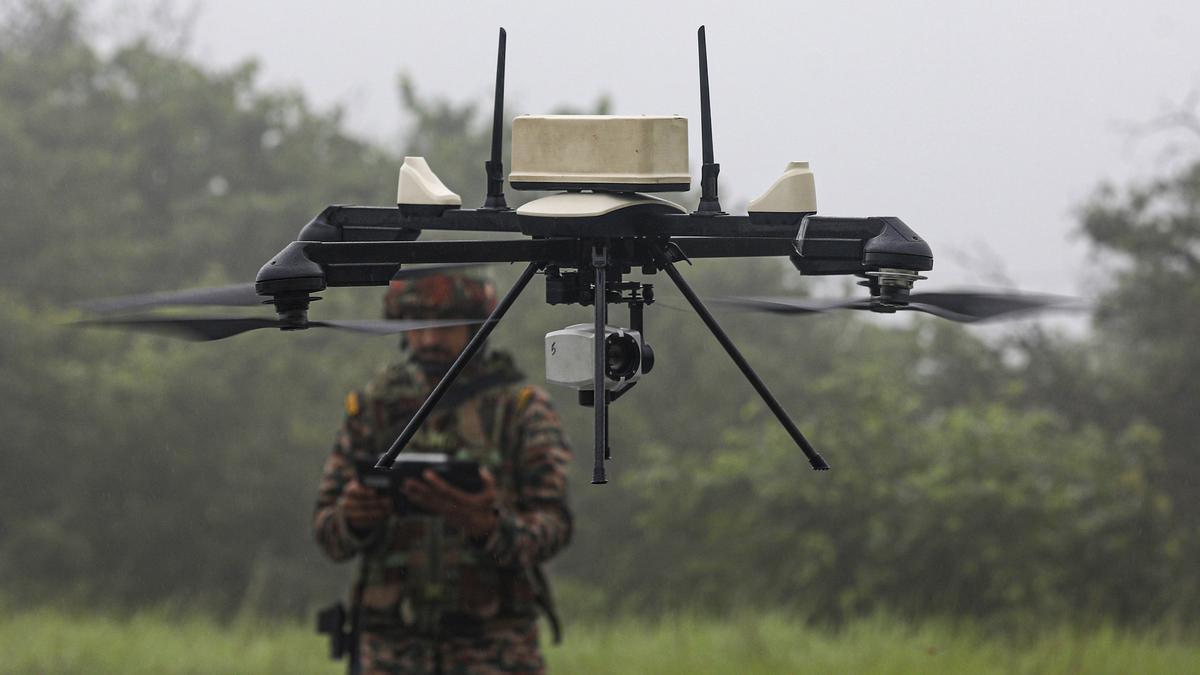
The system is designed to detect, track, identify, and neutralise hostile drones and unmanned aerial systems in real time, ensuring comprehensive airspace security across the newly defined Tactical Battlefield Space. Representational file image.
| Photo Credit: PTI
In a major leap towards operational readiness against emerging aerial threats, the Indian Army has initiated procurement of the indigenously developed ‘Saksham’ Counter-Unmanned Aerial System (CUAS) Grid System.
The system is designed to detect, track, identify, and neutralise hostile drones and unmanned aerial systems in real time, ensuring comprehensive airspace security across the newly defined Tactical Battlefield Space (TBS), which now includes the Air Littoral (airspace up to 3,000 metres, or 10,000 feet, above ground level).
According to the Army, the requirement for a robust CUAS framework emerged prominently during Operation Sindoor, which underscored the vulnerabilities of existing airspace control measures against hostile drone activity. In response, the Army expanded its operational concept from the Tactical Battle Area (TBA) to the broader TBS, acknowledging that future conflicts will unfold simultaneously across land and low-altitude air domains.
This paradigm shift enables ground formations to maintain control over the Air Littoral, ensuring unrestricted movement for friendly aerial assets, while countering potential hostile incursions.
Developed in collaboration with the Bharat Electronics Limited (BEL), Ghaziabad, Saksham, or Situational Awareness for Kinetic Soft and Hard Kill Assets Management, is a modular, high-end Command and Control (C2) system operating on the secure Army Data Network (ADN). It creates a real-time, integrated Recognised UAS Picture (RUASP) for commanders, merging sensor data, counter-drone systems, and AI-driven analytics, the Army added.
The system will have features like real-time threat detection and AI-enabled predictive analysis, integration of CUAS sensors and weapons for synchronised response, automated decision support and 3D battlefield visualisation, seamless interoperability with other operational systems, and inputs from the Akashteer System to map all friendly, neutral, and hostile airspace users.
Saksham reflects the government’s vision of Atmanirbhar Bharat in defence technology and is completely indigenous. Approved under the Fast Track Procurement (FTP) route, it will be rolled out to all field formations within a year.
Once operational, Saksham will form the backbone of the Army’s CUAS grid, enhancing decision-making speed, enabling swift engagement, and securing control over the Air Littoral. The initiative marks a decisive stride toward a digitally enabled, networked battlefield, aligned with the Army’s Decade of Transformation (2023–2032).
Published – October 09, 2025 08:01 pm IST



