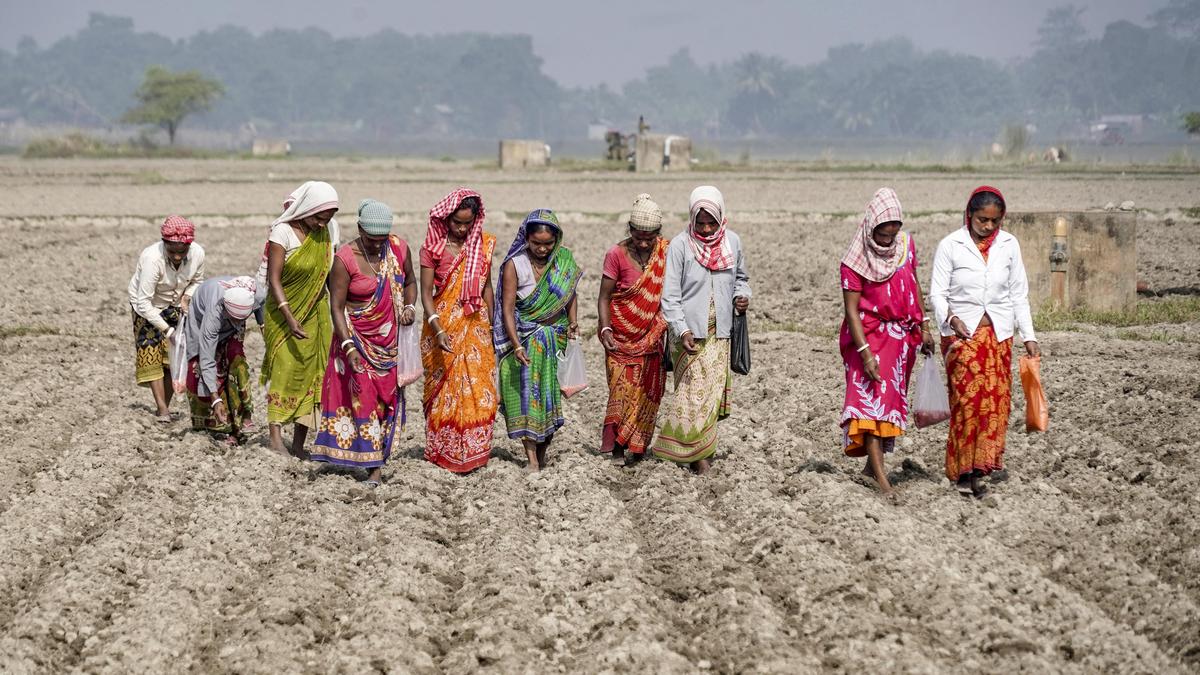
Women farmers sow maize seeds in a field, in Morigaon on November 10.
| Photo Credit: PTI
The story so far: The Union Agriculture Ministry released the draft Seeds Bill on November 12, and has invited public comments on it till December 11. The Seeds Bill, seen as a regulatory step to ensure quality of seeds sold and distributed to farmers, promotes “ease of doing business” and reduces compliance burden, while maintaining strong provisions to penalise serious violations, as per the government. The government has been open about its intention to amend the Seeds Act of 1966 and the Seeds (Control) Order of 1983.
What has been the history?
According to the Union Agriculture Ministry, in 2023-24, the country had an overall requirement of 462.31 lakh quintals of seeds for various crops with availability being 508.60 lakh quintals, which then led to a surplus of 46.29 lakh quintals of seeds.
The seed industry has been demanding that the 1966 Act should be amended to accommodate technological and scientific advancements in the sphere of seeds and to address the changes in trade and commerce over the last six decades. In their initial response, the Federation of Seed Industry of India Chairman Ajai Rana said the release of the draft is a timely and much-needed step toward modernising India’s seed regulatory framework. However, the Samyukt Kisan Morcha, an umbrella body of farmers, said they will continue to oppose moves to bring amendments in the Bill that are “anti-farmer”.
What are the new provisions?
The Bill provides a regulatory mechanism in the area of import, production and supply of quality seeds. The Bill does not restrict the right of the farmer to grow, sow, re-sow, save, use, exchange, share or sell his farm seeds, except when he sells such seed or planting material under a brand name. The Bill defines farmer, dealer, distributor and producer as separate entities that deal with the production, distribution, trade and use of seeds. It also provides for the establishment of 27-member Central and 15-member State seed committees. The Central seed committee can recommend the minimum limits of germination, genetic and physical purity, traits, seed health and additional standards of seeds to the Union Government. The State Seed Committee can advise the State Government on registration of seed producers, seed processing units, seed dealers, distributors and plant nurseries.
Under the Bill, it is mandatory that all seed processing units must be registered with the State governments based on the provisions in the proposed legislation. The Bill, however, adds that to promote ease of doing business, the Union government may establish a merit based and transparent Central Accreditation System for companies operating in multiple States.
The Bill suggests the creation of the office of Registrar to keep a National Register on seed varieties under the Central seed committee. The procedure for conducting field trials to assess the Value for Cultivation and Use of any kind or variety is also detailed in the draft Bill.
The Bill also has provisions for the establishment of Central and State seed testing laboratories, where analysis of seed of any kind or variety shall be carried out in the prescribed manner. The Bill also explains the role and powers of seed inspectors, an officer with powers under the provisions of the Bharatiya Nagarik Suraksha Sanhita to search or seize. The Bill details the punishment for trivial, minor and major offences for flouting provisions under the Bill. The punishment ranges from a fine of ₹50,000 to ₹30 lakh and up to three years of imprisonment.
What are changes from 2019 draft?
One of the major changes is in the section of offences and punishments. In the previous draft, the offences were covered under consumer protection laws and the penalty ranged between ₹25,000 and ₹5 lakh and an imprisonment up to one year. There are substantial changes with respect to this section in the new draft.
On farmers’ rights, the new draft links the matter with the Protection of Plant Varieties and Farmers Rights Act. On quality norms, the standards have been tightened. The new Bill looks at the import of seeds in a more liberal way.
What are the concerns of farmers?
The All India Kisan Sabha, a constituent of the Samyukt Kisan Morcha, said the Bill is poised to increase cost of cultivation by allowing corporates to indulge in the predatory pricing of seeds. They doubt the Bill is part of a larger political project of the RSS-BJP to dispossess small farmers and surrender the country’s seed sovereignty to a handful of multinational and domestic monopolies.
They demanded that the new draft must complement, not conflict with, the progressive legal safeguards already established under the Protection of Plant Varieties and Farmers Right Act of 2001, and India’s international commitments under the Convention on Biological Diversity and the International Treaty on Plant Genetic Resources for Food and Agriculture. The Kisan Sabha pointed out that the draft Seeds Bill introduces a heavily centralised and corporatised regulatory system that risks weakening farmer-centered protection and diluting India’s legal architecture for biodiversity conservation and farmers’ rights.
Published – November 26, 2025 08:30 am IST