


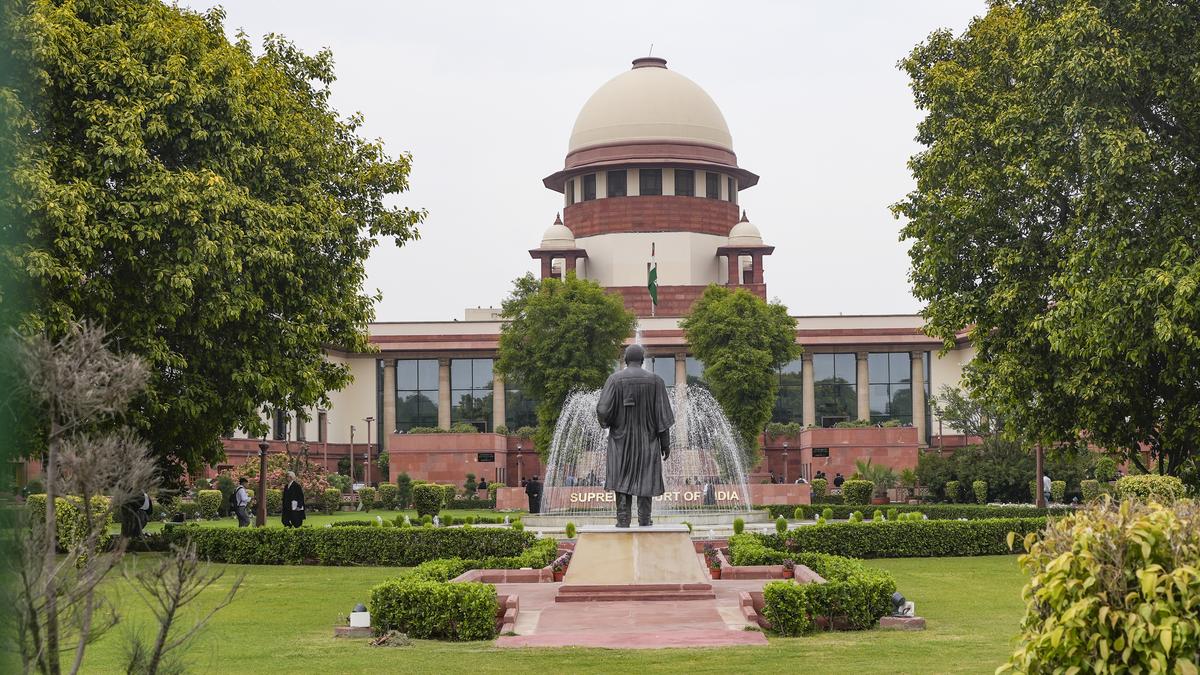
The application said convicts of heinous crimes such as terrorism, rape, and murder “take the judicial process for a ride” under the garb of Article 21 of the Constitution (right to life). File
| Photo Credit: PTI
The Supreme Court has dismissed the Union Government’s plea seeking stricter timelines for death row convicts to exhaust their legal remedies and for executions to be carried out within seven days of the rejection of a mercy petition.
A Bench comprising Justices Vikram Nath, Sandeep Mehta, and N.V. Anjaria observed that there was no merit in the application and that the court’s 2014 ruling in ‘Shatrughan Chauhan v. Union of India’, which the Centre sought to modify, was exhaustive and did not require any clarifications.
“We do not find any merit in this miscellaneous application filed by the Centre,” the Bench said, adding that the government would be at liberty to pursue some of the measures it had proposed in appropriate proceedings.
Rights of victims
The Union Government had sought a revision of the Shatrughan Chauhan ruling to ensure that the framework governing death penalty cases also recognised the rights and anguish of victims, apart from dealing with the prolonged delay surrounding the execution of sentences. Additional Solicitor General K.M. Nataraj, appearing for the Centre, had argued that while the 2014 judgment protected the rights of convicts, it did not adequately account for the suffering endured by victims’ families.
During the proceedings, the court declined to revisit its earlier judgment, observing that the safeguards laid down in Shatrughan Chauhan required no modification. The judgment had held that undue delay in deciding mercy petitions violates a convict’s right to life and dignity under Article 21 of the Constitution, and that such delay, by itself, constitutes a valid ground for commuting a death sentence to life imprisonment.
The Ministry of Home Affairs had filed the modification plea in 2020, after multiple legal remedies filed one after another by the four convicts in the 2012 Delhi gang rape and murder case delayed their execution. The convicts were ultimately hanged in March 2020 after the Supreme Court, in a late-night hearing, rejected their final plea.
Deadline for curative pleas
In its application, the Centre urged the court to mandate that curative petitions be filed within a fixed period following the dismissal of a review petition. It further sought a clarification that mercy petitions should be submitted within seven days of the issuance of a death warrant. The government also requested that executions be carried out within seven days of the rejection of a mercy plea, irrespective of any pending proceedings filed by co-convicts.
Editorial | Needless impatience: On Centre’s plea on death row convicts
The application said convicts of heinous crimes such as terrorism, rape, and murder “take the judicial process for a ride” under the garb of Article 21 of the Constitution. (right to life). It emphasised that public interest and the deterrent effect of capital punishment must not be undermined.
While the Shatrughan Chauhan judgment recognised that undue delay in executing a death sentence has a “dehumanising effect” and prescribed safeguards for convicts, the Centre has argued that these directions are entirely “accused-centric” and must be balanced against the rights of victims and the interests of society.
Published – October 09, 2025 11:18 pm IST



