


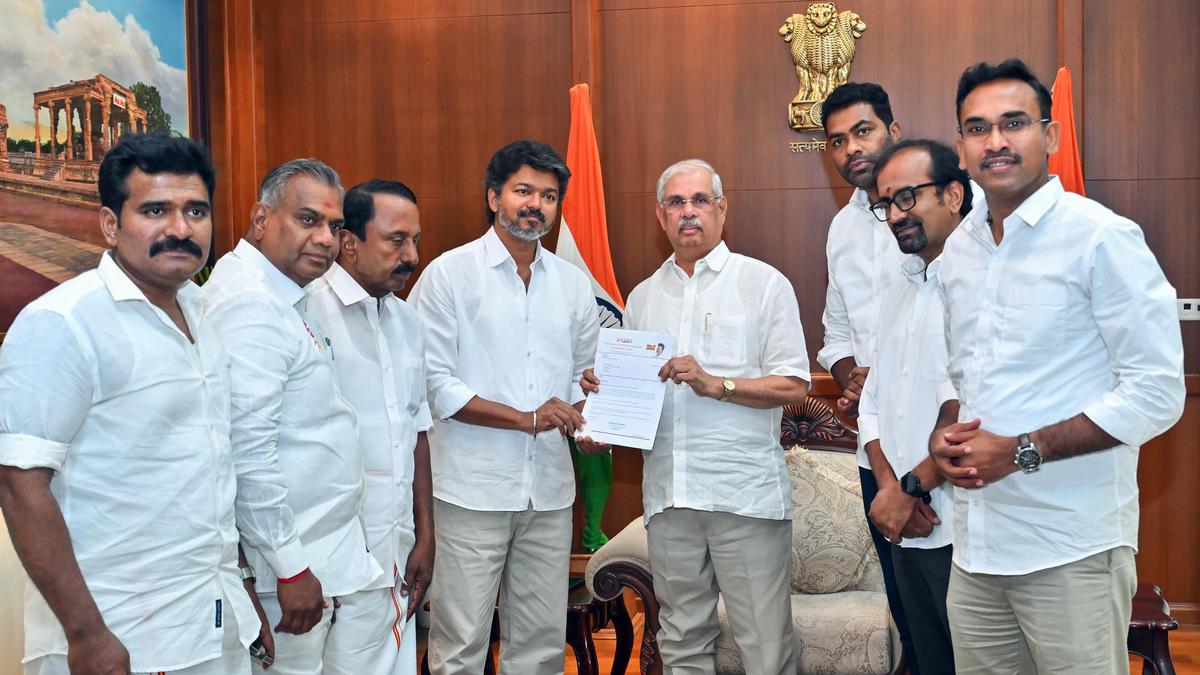
TVK chief Vijay with Tamil Nadu Governor Rajendra Arlekar on May 6, 2026.
| Photo Credit: ANI
The insistence that Tamilaga Vettri Kazhagam (TVK) president C. Joseph Vijay must prove majority support in the Legislative Assembly is based on a time-tested legal principle that a Governor’s first priority is the formation of a stable government, lest the State slip into a situation of complete breakdown of constitutional machinery, leading to President’s Rule.
Government formation LIVE updates – May 7, 2026
Supreme Court precedents have said a Governor cannot refuse to allow the formation of a government once the majority is established. The only exception could be where the Governor is of the view that a stable government may not be formed by the claimants. On the other hand, the court has also noted that a Governor is not expected to wait indefinitely, and in the process, encourage defections or adoption of other objectionable activities.
The Supreme Court and the Sarkaria Commission have highlighted the importance of giving Governors reasonable time to “explore alternatives with political parties, groups and Independents MLAs” to form a stable government. The phrase ‘reasonable time’ is not defined in the Constitution.

The ‘alternatives’ before the Governor in a hung Assembly would be to invite a pre-poll alliance of parties with the largest number of seats to form the government first. The single largest party would be the second option if it could show majority support. A post-poll alliance or coalition is the last option before the Governor.
A nine-judge Bench in the 1994 S.R. Bommai judgment, while endorsing this hierarchy of preference, liberally added that the Governor could either go for the single largest party or “group”. It did not matter whether the ‘group’ was formed before or after the election.
What is the S.R. Bommai case, and why is it quoted often?
It would be a case of failure of constitutional machinery if these alternatives fail, and no party or group is able to command a majority to form a popular government.
“Suppose after general elections, no political party or coalition of parties or groups is able to secure absolute majority in the legislative assembly and despite the Governor’s exploring the alternatives, the situation has arisen in which no political party is able to form stable Government, it would be a case of completely demonstrable inability of any political party to form a stable government commanding the confidence of the majority members of the legislature. It would be a case of failure of constitutional machinery,” the court observed in the Bommai judgment.
However, the Supreme Court, in its seven-judge Bench judgment in Rameshwar Prasad versus Union of India, has also cautioned against Governors misusing their office for partisan politics.

“Whether it is a case of an existing government losing the majority support or of installation of a new government after fresh elections, the act of the Governor in recommending dissolution of Assembly should be only with the sole object of preservation of the Constitution and not promotion of political interest of one or the other party,” the court said.
The Rameshwar Prasad case flagged the criticism recorded in the Sarkaria Commission that Governors have, more often than not, used their powers to recommend President’s Rule under Article 356 to “promote the political interests of the party in power at the Centre”.
What is the Governor’s role if elections produce fractured verdicts?
“It is seen that one day a person is in active politics in as much as he holds the office of the Chief Minister or Minister or a party post and almost on the following day or, in any case, soon thereafter, the same person is appointed as the Governor in another State with hardly any cooling period. Ordinarily, it is difficult to expect detachment from party politics from such a person while performing the constitutional functions as Governor,” the court had highlighted the need for a “cooling-off period”.
Supreme Court judgments have acknowledged that coalition governments have become the norm rather than a rarity in recent years. “Coalition governments are in place in several States and in fact at the Centre. There is nothing wrong in post-poll adjustments, and when ideological similarity weighs with any political party to support another political party though there was no pre-poll alliance… There is nothing wrong in it,” the court has observed.
Published – May 07, 2026 05:37 pm IST



