


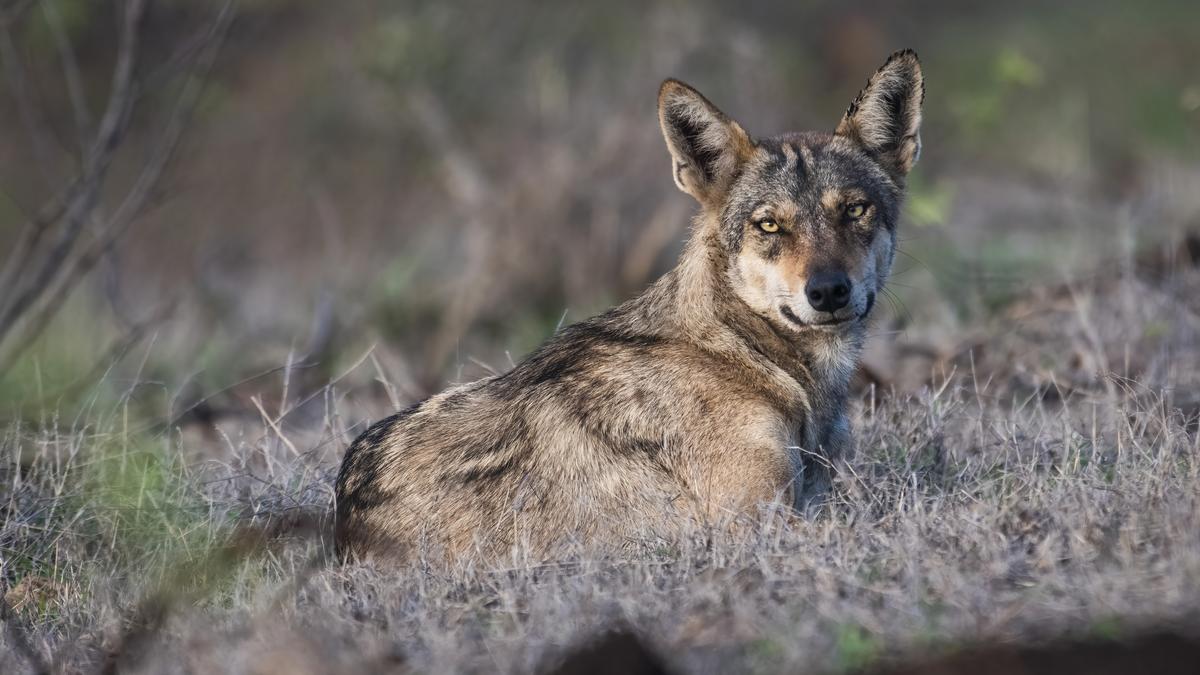
They are poisoned, their natural prey base is vastly depleted, the semi-arid areas they inhabit are condemned as wasteland.
| Photo Credit: Wikimedia Commons
The discreet, charismatic denizen of scrubland and grasslands, the Indian wolf (Canis lupus pallipes), whose population has dwindled to just around 3,000 individuals in India and Pakistan, is likely to be classified as a new species by the International Union for Conservation of Nature (IUCN), which would take the number of wolf species in the world to eight.
The Indian wolf was first placed within the umbrella genus of the grey wolf that roamed swathes of Asia. But the Indian wolf has the oldest living lineage of any wolf in the world, as genome and DNA sequencing has shown.
The canine has also been listed as “vulnerable”, bringing it much-needed attention and incentive to protect the much-maligned animal and conserve its rapidly shrinking habitat, which has been condemned as “wasteland“ and often taken over by large projects.
The threats to this animal are many, Y.V. Jhala, former dean of the Wildlife Institute of India and now a senior scientist of the Indian National Science Academy, explained. They are poisoned for preying on livestock, their natural prey base is vastly depleted in its fragile habitat, and the semi-arid areas they inhabit are destroyed by highways and renewable energy projects, Dr. Jhala told The Hindu.
“A den site I studied in Kutch is now engulfed by the Adani Solar Farm,” he added.
Then there is the worrying contact with feral dogs. “They mate with wolves, creating hybridised animals and spread diseases” such as rabies.
The wolf’s persecution is curious as they aren’t known to attack humans, unlike the leopard for instance.
“There have been two recent spates of wolf-human conflict, one in 1996 and the other last year in Bahraich district [in Uttar Pradesh],” said Dr. Jhala.
The Bahraich incident stemmed from “extreme poverty,” he added: “people, even babies, sleep on cots outdoors. And there is no prey for wolves.”
According to reports, since September, six people, including four children were killed and 30 others were injured in wolf attacks in Bahraich. Meanwhile almost the entire pack has since been shot to death.
How would the IUCN’s upgrade help?
“There has been a call for over two decades to have it be declared a distinct species,” Abi Vanak, director of the Centre for Policy Design at the Ashoka Trust for Research in Ecology, Bengaluru told The Hindu.
“The Indian wolf is already under Schedule 1 of the Wildlife Protection Act. The wolf, like the bustards and other denizens of the open natural ecosystems, do not need strict protected areas. Rather they serve as the best models for co-existence, and this is what needs to be incentivised. With the downgrading of the wolf to ‘vulnerable’ (I don’t call it upgrading), hopefully more international attention and funds can flow towards its conservation, and the protection of its habitats.”
Going forward, Dr. Jhala said, it’s important to acknowledge the IUCN assessment by developing a national policy and management plan for the unique, ancient Indian wolf.
Published – October 16, 2025 06:00 am IST



