


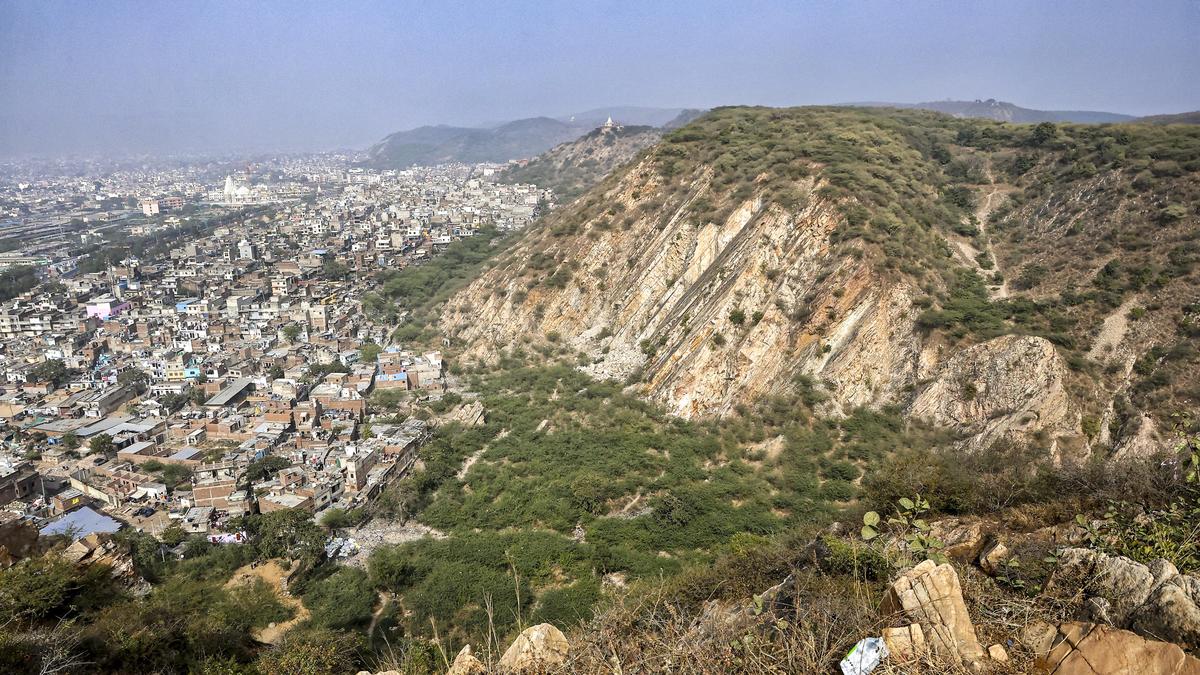
The Aravalli Hills, as seen from the Sun temple at Galta ji, in Jaipur, Saturday on Jan. 3, 2026.
| Photo Credit: PTI
A satellite audit has proved that 31.8% of the Aravalli range is under ecological risk after the recent classification by the Centre fixing the height of hills at 100 metres for legal protection, a people-driven conservation collective said in Jaipur on Monday (January 5, 2026). The group has demanded a complete ban on mining in the Aravalli hills.
The Supreme Court has since put its directions concerning the definition of the Aravalli hills in abeyance. The “We Are Aravalli” collective said the Centre’s assessment of the affected area at 0.19% also does not reflect the geological reality of the Aravalli Range.

Expressing concern over the government’s approach to the country’s oldest mountain chain stretching from Gujarat to Delhi, climate scientist Sudhanshu, who is associated with the group, said the independent forensic analysis of Aravalli’s geography was conducted by using satellite data and the Bristol Forest and Buildings Removed Copernicus Digital Elevation Model (FABDEM).

“Our analysis has confirmed that 31.8% of the total hill area falls below the arbitrary threshold of 100 metres. These areas of Aravalli landscape, comprising ecologically vital hills and ridges, are now effectively stripped of legal protection,” Mr. Sudhanshu said.
While the Centre’s figure of 0.19% as the affected area ignores the geological reality of the range, the low-elevation zones are not wasteland, according to the group’s findings. These regions are the primary water recharge zones and dust barriers for 30 crore people across Rajasthan, Haryana, and Delhi, and the removal of protection will pose a “direct threat” to their lives.
Mr. Sudhanshu said the group’s study had identified critical gaps in the unprotected hills, where the Thar Desert was already expanding. Removing them would eliminate the final barrier preventing desertification of fertile plains, he added.
Besides, the Aravallis act as a windbreak for dust, and mining these hills will increase the Particulate Matter (PM) 2.5 load in Delhi-National Capital Region, worsening the existing pollution crisis.
The group demanded that the entire Aravalli range be declared a “fully protected zone” with the abolition of any kind of distinction between “hills” and “mountains” based on height. “All forms of mining should be completely prohibited immediately, with the only exception for a strictly limited extraction of rare earth minerals critical for national security and strategic use,” it said.
Mr. Sudhanshu said all previously allotted mining leases should also be cancelled, as they had scientifically proven to be destructive to the region’s ecology and water systems. The regions currently excluded from the definition, such as Chittorgarh, Nagaur, Bundi, Kaman (Bharatpur), and Sawai Madhopur, should be officially included within the recognised Aravalli mountain system, backed by historical and geomorphological evidence.
The collective also called upon the State governments in Gujarat, Rajasthan, Haryana and Delhi to initiate reclamation of damaged hills with the focus on restoring soil integrity, water-holding capacity, and native vegetation.
Published – January 05, 2026 09:57 pm IST



