


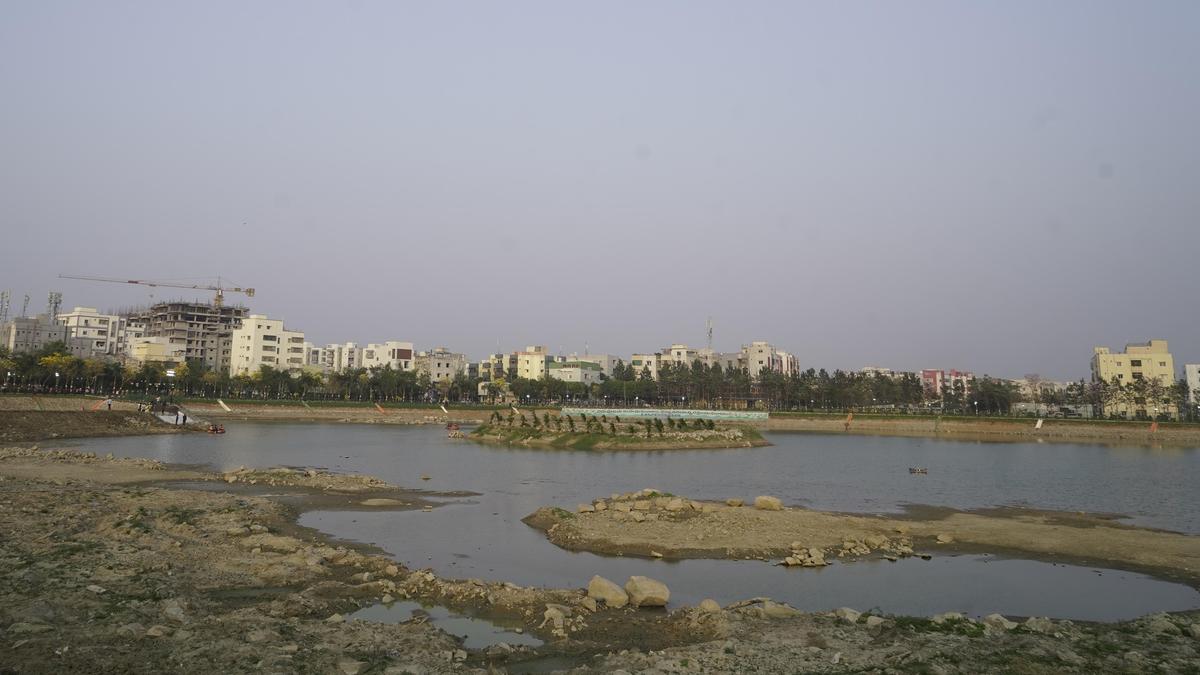
Early onset of higher temperatures has seen water bodies in and around Hyderabad dry up.
| Photo Credit: SIDDHANT THAKUR
Citizens across Telangana can expect temperatures to climb steadily in the coming days, with hot afternoons and warm nights becoming the norm. Meteorologists from the Telangana Development Planning Society (TGDPS) say summer has effectively set in nearly 15 days ahead of schedule—much like last year.
According to senior weather consultant Y.V. Rama Rao, maximum temperatures have already touched 36°C–37°C in Hyderabad and 38°C–39°C in several districts, which is 2°C to 3°C above normal. Minimum temperatures, too, are higher than usual, hovering between 18°C–20°C in the twin cities and 20°C–23°C in the hinterland.
Temperatures are expected to rise further later this week, with mercury likely to hit 40°C–41°C in districts and 38°C or more in Hyderabad. Night temperatures are also set to increase to around 22°C in the capital region and 22–24°C elsewhere, he said.
A brief dip may occur around March 15–16 due to an east–west trough, which could bring cloudy skies and light rain. “Beyond this temporary fluctuation, hot weather will dominate,” Mr. Rao said. He said that Maharashtra, Rajasthan and parts of North India, which typically heat up in April and May, are already experiencing summer-like conditions. “This early heating in northern and western India is likely to influence conditions here as well,” he noted.
Last year, summer conditions arrived early in March and persisted through April before pre-monsoon showers appeared by late May.
El Niño factor
Meanwhile, Hyderabad-based Indian National Centre for Ocean Information Services (INCOIS) has reported that sea surface temperature anomalies in the eastern and central Pacific indicate a weakening La Niña and a shift toward ENSO-neutral conditions until June, with a probability of 50%–65%. El Niño is the second-most likely phase during this period.
El Niño is associated with the warming of the eastern Pacific Ocean, influencing the El Niño–Southern Oscillation (ENSO) cycle. A prevailing El Niño typically weakens the Indian summer monsoon, reducing rainfall and affecting agriculture and the broader economy. It is also linked to stronger, prolonged marine heatwaves in the northern Indian Ocean, which disrupt ecosystems, damage coral reefs and cause significant losses to fisheries
El Niño is expected to become the dominant ENSO phase from July to November 2026 with a 40% to 60% probability, while ENSO-neutral conditions remain the next likely outcome at 40% to 50%, said scientist P.A. Francis.
Published – March 10, 2026 07:36 pm IST



