


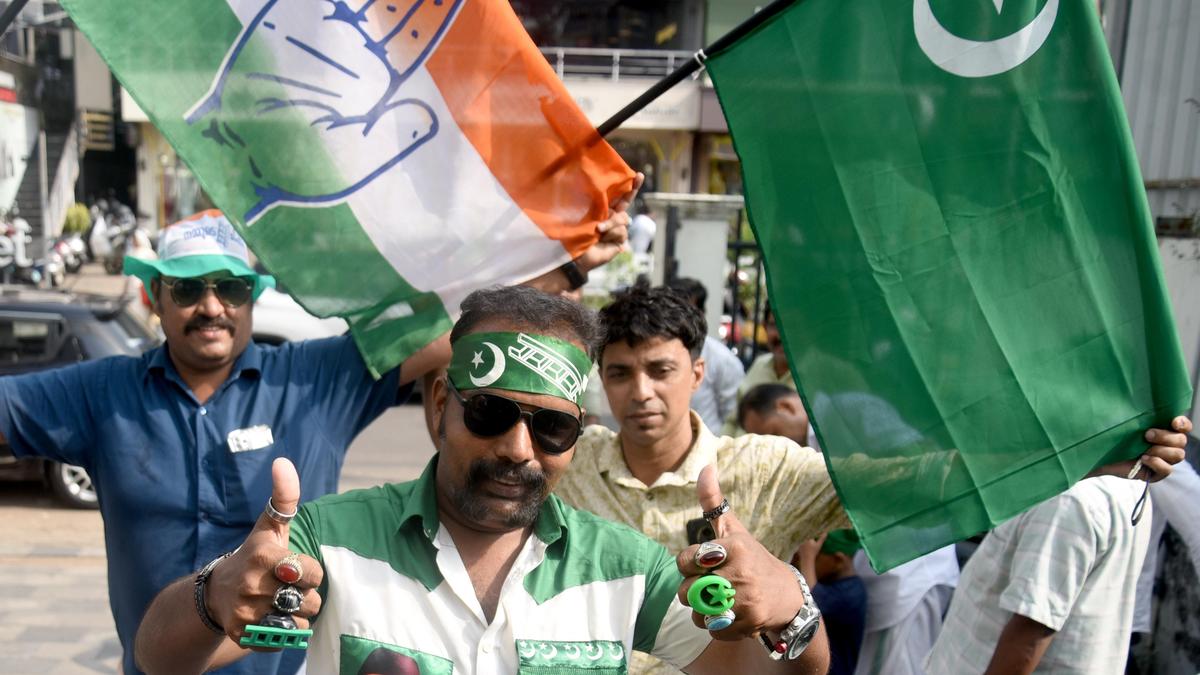
File photo of Congress and IUML workers celebrating their victory in the Assembly elections, in Kozhikode.
| Photo Credit: K. Ragesh
Far from being merely a matter of electoral arithmetic or coalition pragmatism, the decision of the Indian Union Muslim League (IUML), the second-largest constituent in the Congress-led United Democratic Front (UDF), to endorse V.D. Satheesan for Chief Minister reflected a potent mix of public sentiment, distinctive leadership style, and evolving social equations within Kerala’s political landscape.
At one level, the IUML’s firm support for Mr. Satheesan, while overlooking relatively stronger contenders K.C. Venugopal and Ramesh Chennithala, was rooted in political continuity. Since taking over as the Leader of the Opposition, Mr. Satheesan had led the UDF through one of its most difficult phases following repeated electoral setbacks.
E.T. Mohammed Basheer, MP, who is a member of the IUML high-power committee and party national organising secretary, told The Hindu that public sentiment strongly favoured Mr. Satheesan because he had led the UDF through a crisis and worked to revive the front with “enthusiasm, hard work and an inclusive approach.”
According to Mr. Basheer, denying him that consideration would have been an injustice and the IUML, which has 22 MLAs-elect, believed Mr. Satheesan deserved the opportunity to carry forward the political struggle.
Strategic considerations
The League’s backing, however, was also driven by strategic considerations. Over the past few years, Mr. Satheesan emerged as one of the few senior Congress leaders in Kerala willing to openly confront certain Hindu community leaders and organisations whenever they targeted the IUML or the Muslim community. The party viewed Mr. Satheesan as a leader who would not politically isolate the League for the sake of balancing community pressures.
“Mr. Satheesan is not someone who tries to please anyone. He is not subservient to anyone. He belongs to the category of politicians who are fearless and bold,” Mr. Basheer said.
This distinguished him from some other Congress power centres, which the League often viewed as more cautious in handling communal issues. The party also appeared to believe that Mr. Satheesan’s leadership style better suited the UDF’s current political phase. According to them, unlike his rivals, Mr. Satheesan projected a more accessible and aggressive image that resonated with grassroots workers.
Hameed Chennamangaloor, a social critic and political analyst, noted that Mr. Satheesan had maintained close ties with several Muslim organisations and participated in their meetings in recent years. According to him, Mr. Satheesan’s speeches at such gatherings often presented Islam in a manner that appealed strongly to Muslims and created the impression among many in the community that “he was one among us.” This, Mr. Chennamangaloor argued, made him favourable to “organisations such as the IUML and Jamaat-e-Islami Hind.”
Importantly, the IUML’s support for Mr. Satheesan was not without risks. Both sides were aware that an alignment could trigger criticism from sections of the Hindu community leadership, particularly the groups that are already suspicious of the League’s growing influence within the UDF. The sharp reaction from the Nair Service Society (NSS), that the Congress high command has capitulated to the IUML by nominating Mr. Satheesan as Chief Minister, reflected precisely those concerns.
At the same time, the League has been careful to avoid creating the impression that it played the “kingmaker” role in deciding the Chief Minister. Mr. Basheer explicitly stated that the IUML would not interfere in the Congress party’s internal affairs.
Published – May 15, 2026 04:33 pm IST



