


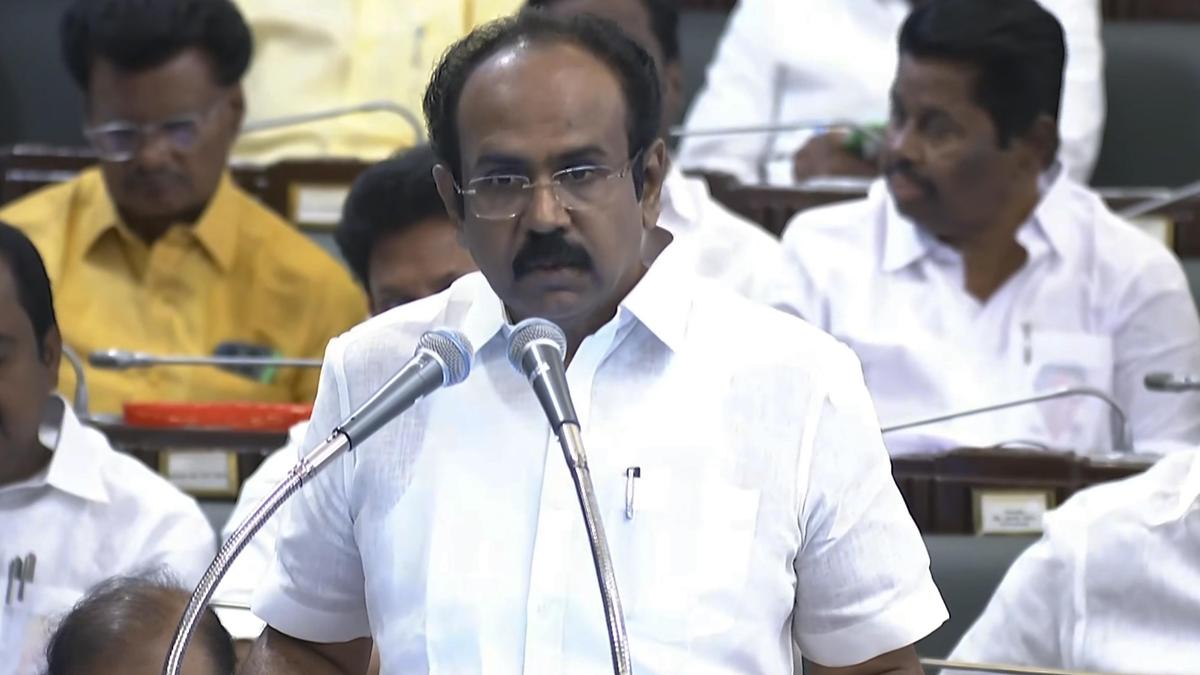
Tamil Nadu Finance Minister Thangam Thennarasu presents the Interim Budget in the Assembly on Tuesday
| Photo Credit: PTI
Tamil Nadu Finance Minister Thangam Thennarasu on Tuesday (February 17, 2026) said the State has been facing unprecedented fiscal challenges from the Union government, which appears to be leaving no stone unturned to “artificially precipitate” a fiscal crisis in Tamil Nadu.
Outlining a series of those challenges while presenting the Interim Budget for 2026-27 in the Assembly, Mr. Thennarasu said the Goods and Services Tax (GST) rate rationalisation was approved by the GST Council without considering the apprehensions and opposition recorded by several States. Even as States are reeling under fiscal stress caused after the termination of the GST compensation regime, this hurried exercise has resulted in another significant blow to the State finances. The revenue shortfall for the Tamil Nadu government is estimated to be around ₹9,600 crore in the current financial year.
Read the full Budget speech here.
In April 2025, the Union government deducted a bulk amount of ₹1,709 crore for IGST settlement from the State’s account in Reserve Bank of India (RBI) without due intimation or consultation. This has added to the revenue shortfall under GST, severely constraining our finances during the current financial year, Mr. Thennarasu said. The share in Central Taxes allocated to Tamil Nadu in the Union Budget 2025-26 has been reduced in the Revised Estimates. This has resulted in an unanticipated shortfall of ₹1,202 crore to the State government current financial year, he added.

Using its powers under Article 293(3) of the Constitution of India for fixation of the borrowing ceiling of the States, the Union government has mandated that a level of 5% of outstanding guarantees has to be maintained in the Guarantee Redemption Fund (GRF). This condition has been imposed suddenly in the current financial year resulting in an unbudgeted expenditure of ₹3,087 crore, the Finance Minister said in his speech.
Further, in exercise of the powers under Article 293, the Union government has mandated that the State government pay an amount of ₹16,290 crore as Loss Funding to Tamil Nadu Power Distribution Corporation Limited (TNPDCL); otherwise, an equivalent amount will be deducted from the State’s borrowing ceiling. When compared to the actual loss of ₹413 crore of TNPDCL, this condition has resulted in an additional expenditure of ₹15,877 crore in the current financial year, he said.
Funds due to T.N.
At a time when all State governments are under pressure due to rising expenditure commitments, Tamil Nadu is further being denied releases under Centrally Sponsored Schemes that are legitimately due to the State. These include an amount of ₹3,548 crore withheld by the Union government under the Samagra Shiksha Scheme, denial of a sum of ₹3,112 crore under Jal Jeevan Mission, and an amount of ₹2,246 crore of Finance Commission Grants, which has not been released to the State government, Mr. Thennarasu said

Even after approval by the Union government of the long-pending demand to take up Chennai Metro Rail Phase-II project in a 50:50 sharing pattern, all the benefits of this project have not been received by the State government. The State government has incurred an expenditure of approximately ₹9,500 crore as payment towards the Union government’s share, which continues to be reflected as part of the State’s outstanding debt, he said.
This not only adversely affects the State’s debt-to-GSDP ratio but has also reduced our ability to borrow within our permissible borrowing limits, thus impacting our liquidity. Despite repeated reminders, the Union government has not acted upon our request so far, he added.
Published – February 17, 2026 04:48 pm IST



