The political dynamics in Seemanchal — encompassing the districts of Kishanganj, Purnia, and Katihar in Bihar — reveal a paradox. Its citizens, in one of India’s most backward regions, yearn for governance that will liberate them from cycles of dependence on weather and migration for a better living. But the demography of the place, the overarching influence of the Bharatiya Janata Party from the Centre, and the fragmented polity ensure that simple equations of communal and caste support continue to over-determine electoral variables in the region. While livelihood issues remain the primary concern for working and underprivileged classes, the electoral landscape here is heavily influenced by a mix of identity politics, caste, and religion.
The spectre of the SIR
The issue of the Special Intensive Revision (SIR) of electoral rolls has loomed large over the region, though it has been handled to some extent. Anomalies caused by its hasty implementation were acknowledged by some Booth Level Officers (BLOs) but have since been corrected. For example, at Booth no 167 at the Upgraded Middle School in Dhobiniya West, Kishanganj Assembly constituency, close to 93% of those who were excluded were marked as dead. The BLO in charge of the booth said this anomaly had crept in because the reasons for omission were marked in a hurry, as there was little time left to verify the names of residents in the area, which included an itinerant tribal population. The BLO said the error was corrected subsequently. The final roll published by the Election Commission of India does not contain the reasons, but mentions that five voters were added afresh to the roll. BLOs across booths, especially in those areas where women voters were disproportionately high among the exclusions, argued that this was done with the families’ consent as many young women had already registered in their spouses’ places and there were no undue or faulty deletions.
Still, the threat of disenfranchisement remains high for some residents who have been denied official documents since 2005. For instance, residents of an Iranian colony in Kishanganj, who asserted that they have lived in the area for generations since British rule, complained that many of them had received notices from the election officers citing inadequate documentation, even after enrolment in the SIR. Haider Ali, a resident, showed that his father held a passport and was enrolled in the 2003 voter list. He himself had other identity documents but received a notice from the Electoral Registration Officer (ERO). Other residents, including some with valid passports, had also received notices. Mr. Ali and a dozen others whose names were in the draft roll managed to be included in the final rolls, but he said there were over 200 people in the area who lack identification documents because of a dispute over their identity since 2005.
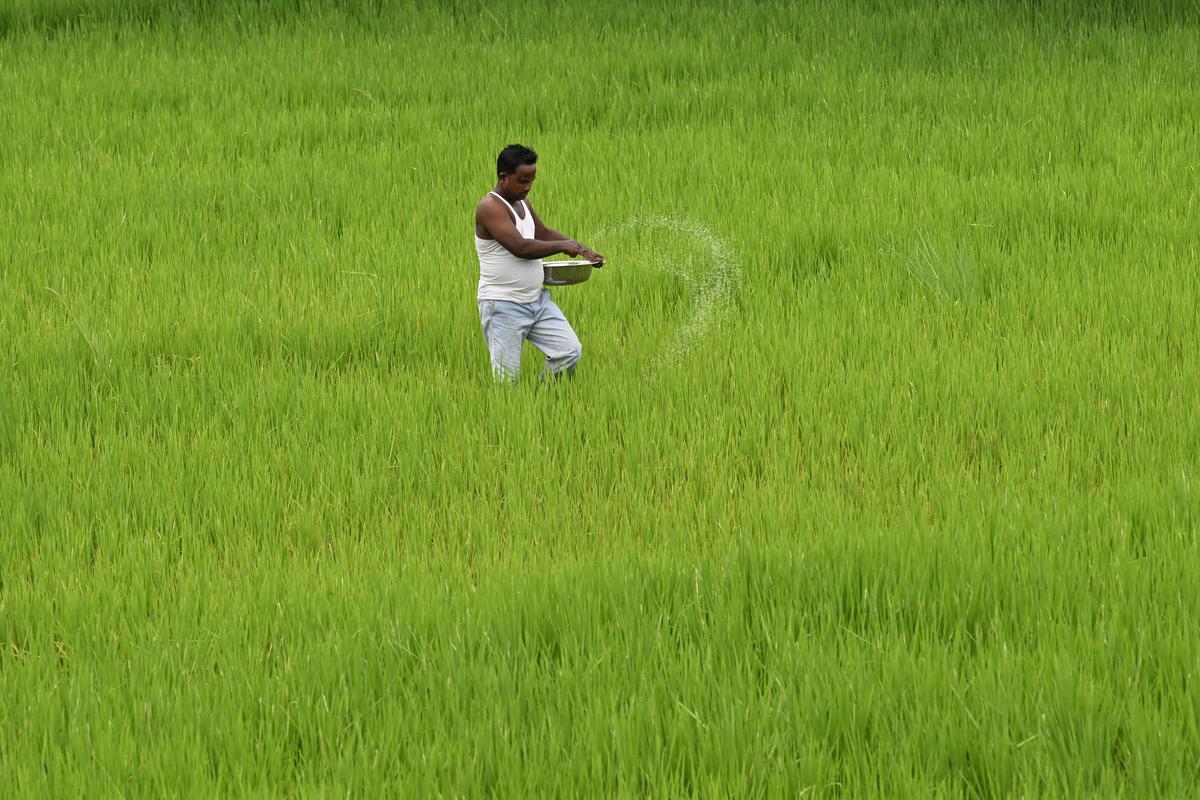
A farmer sprinkles pesticides at his rice crop in Katihar district of Bihar on Wednesday. The verdant landscape hides a host of issues.
| Photo Credit:
R.V. Moorthy
‘Stereotyped’
The travails faced by the Iran-origin residents of Kishanganj, who follow the Shia branch of Islam, were however an anomaly, said Tanzil Asif, the editor of Main Media news portal. He said that Muslim residents in the region had largely secured identification documents fearing harassment ever since the BJP had raked up the “outsiders-infiltrators” campaign. Senior Congress leader and Kadwa MLA Shakeel Ahmad Khan also noted that Muslims in Seemanchal have long been stereotyped, and with the BJP’s rule at the Centre, have become more proactive in equipping themselves with sufficient identification documents. The final voter list was uploaded on the website of the Bihar Chief Electoral Officer on September 30, but in largely illiterate areas, such as the flood-prone Sikorna village in Kadwa, there was little awareness of this, as residents awaited physical verification. Mr. Khan echoed his party leadership’s strong denunciation of the EC and the SIR process.
AIMIM entry
Kishanganj, where nearly 70% of the population is Muslim, had offered a new dynamic in the 2020 Assembly election with the entry of the All India Majlis-e-Ittehadul Muslimeen (AIMIM) into the fray in Seemanchal. While some AIMIM legislators had defected to the parties in the INDIA bloc after the polls, the “spoiler” factor of the party is still fresh in memory, especially among the Muslim community. Mr. Asif asserted that the AIMIM was not a significant force now and that its most well-known face, State secretary and Amour MLA Aktharul Imam, has largely held his own only due to his personal appeal.

A muslim cleric helps children learn at Kadwa block of Katihar district.
| Photo Credit:
R.V. Moorthy
Mr. Imam refuted the allegation that his party was communal, saying that it functioned within constitutional boundaries and he himself, as a senior legislator, had always articulated the interests of not just Muslims, but of marginalised sections such as Dalits. He quoted numbers to suggest that parties such as the Rashtriya Janata Dal – to which he belonged before joining the AIMIM – paid little more than lip service to issues related to Muslims and had not provided commensurate representation to the community in contrast to the dominant Yadavs. Yet, he said, the AIMIM had sought to join the INDIA bloc to counter the majoritarianism of the BJP but it was the RJD and other parties that had shown little inclination to do so.

A former close associate of Chief Minister Nitish Kumar, Master Mujahid Alam, who defected from the Janata Dal (United) to the RJD earlier this year, now seeks to contest on an RJD ticket from Kochadaman. He dismissed the AIMIM threat and suggested that the party’s language, especially that of its leader Asaduddin Owaisi, was sharply communal and could polarise elections. This, he says, is why the INDIA bloc avoids them. Mr. Khan echoed this view, believing that the BJP’s fear-mongering about “infiltration” will ultimately drive long-term residents, including Bengali-speaking Muslims, from places like Kadwa, to continue to support his inclusive and secular views.
Growth vs. division
The communalisation of politics is a clear undercurrent in Seemanchal. At the bustling Gulab Bagh market, farmers and traders expressed satisfaction with the Nitish Kumar government and the BJP, citing good roads, hospitals, and an airport in Purnia. A farmer, Krishnakant Yadav, confidently stated that aside from the “50% of Yadavs and Muslims”, everyone else would vote for the incumbent government, a sentiment echoed by trader Umesh Sahni, who asked rhetorically, “How much more development would residents want?”

A view of the Katihar railway station in Bihar. The people of Seemanchal, of which Katihar is a part, are yearning for development.
| Photo Credit:
R.V. Moorthy
However, a worker in the same market, Faraz Ahmad, discreetly disagreed, suggesting that voter support was not so straightforward, especially in constituencies like Amour, where voters were wary of the BJP and would likely back the Mahagathbandhan (grand alliance). Gauri Shankar Sah, a trader from Samastipur who had come to Purnia to sell his wares, added that while Seemanchal might see support split along communal lines, other parts of Bihar were more contested, with caste variables playing a more prominent role. His co-worker, Raj Kumar Sahni, emphasised that in places like Rupauli, held by Independent MLA Shankar Singh, local issues often trump broader narratives.
The verdant villages of Katihar district promise an abundance of crops and food production to new eyes. But as we delve deeper into these villages, the extent of problems faced by residents in one of India’s most population-dense but backward regions is starkly visible.

Congress MLA Shakeel Ahmad Khan meeting villagers in Katihar in poll-bound Bihar.
| Photo Credit:
R.V. Moorthy
Villagers in Sikorna, where the Mahananda river flows, identify themselves as Shershahbadi, a Bengali-speaking Muslim community. The frequent flooding of the region has devastated village roads and wreaked havoc in the lives of the residents there, who angrily demanded that Mr. Khan respond to their requests for more development work.
In nearby Bharri village, paediatrician Manvendra Thakur pointed to severe issues in the region related to lack of diversity in the economy, corruption, and the regressive outcomes of prohibition, which had led to several youth and teenagers suffering from drug abuse, among others.
All of these would be addressed only if the polity moved beyond issues related to identity and took up those of livelihoods, he asserted.
Published – October 02, 2025 09:25 pm IST