


5 se 30, phir se Nitish” (2025 to 2030, Nitish Again) declares. In mathematics, a constant is a fixed value, while a variable is one that changes. However, in Bihar’s politics, Nitish Kumar is paradoxically both the constant and the variable. In the past two-and-a-half decades, he has taken oath as Chief Minister nine times — seven times with the support of the Bharatiya Janata Party (BJP) and twice with the Rashtriya Janata Dal (RJD). Since November 2005, while the composition of the Opposition in the State has changed occasionally, Nitish has remained firmly in the Chief Minister’s chair, barring a 278-day period when the post was occupied by Jitan Ram Majhi, who was incidentally picked by Nitish as his proxy. Yet Nitish remains the most unpredictable variable in Bihar’s politics.
Through a series of dizzying ideological realignments, he has reinvented himself multiple times. It is widely acknowledged in Patna that the side he aligns with gains a clear edge. He is the variable essential to balancing an equation, both arithmetically and politically.

These days, however, he is making the headlines for a series of gaffes, such as referring to Prime Minister Narendra Modi as “Chief Minister”, scrutinising Modi’s inked finger, exhorting crowds to elect “4,000 MPs”, and referring to his party’s Rajya Sabha member as a Lok Sabha member. Videos of Nitish fidgeting during the National Anthem or touching a bureaucrat’s feet mistaking him for someone else have gone viral.
These videos and remarks may briefly amuse social media users, but they raise vital questions about Nitish’s mental acuity. This perception is further aided and abetted by unverified stories circulated by his political rivals and, at times, even by his own colleagues. Despite all this, neither the BJP wants to be seen abandoning him ahead of the election nor do the rivals want to make any personal attacks on him.
The BJP has gone out of its way to assure voters that Nitish is the chief ministerial face of the National Democratic Alliance (NDA). Any BJP leader saying otherwise has been ticked off. Bihar Deputy Chief Minister and BJP leader Vijay Kumar Sinha, while speaking at an event to mark the birth anniversary of former Prime Minister Atal Bihari Vajpayee on December 25, 2024, said that a BJP-led government would be a true tribute to the late leader. However, the very next day, he held a press conference to issue a convoluted explanation for his remarks and pledged the BJP’s commitment to Nitish. The RJD has been equally careful. Tejashwi Yadav, the Leader of the Opposition in the Bihar Assembly and de facto RJD president, even while excoriating Nitish, ensures that he uses dignified language. He limits himself to saying, “This is the government of a tired Chief Minister run by retired bureaucrats.”
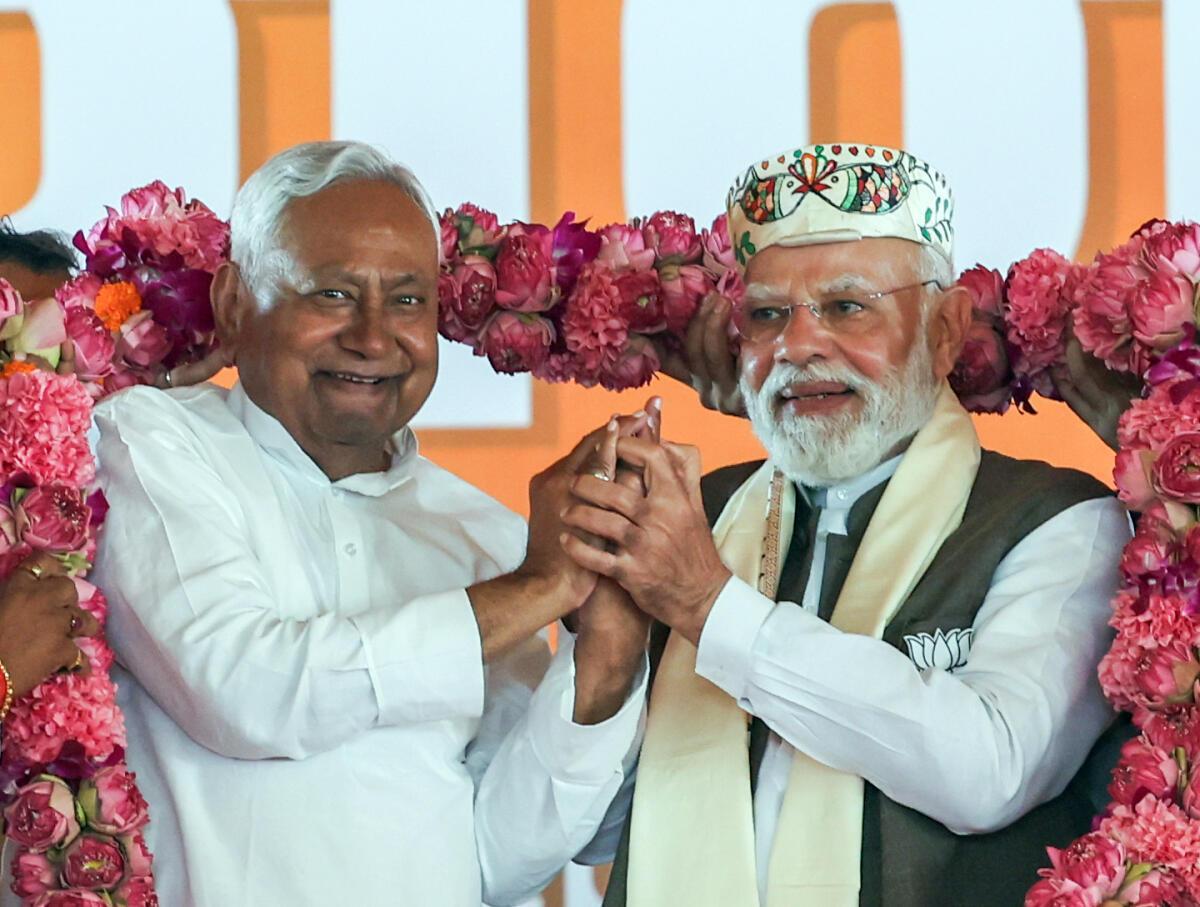
Nitish is standing on a pedestal he has chiseled for himself over the years, covering his past failures and humiliations. His rise has neither been swift nor sudden. He encountered defeat at every step, often pushing him to consider quitting politics. The beginning Nitish Kumar came to Patna in 1966 from Bakhtiyarpur, a mofussil town, to study at the Patna Science College. He dabbled in student politics for a while and joined the Samajwadi Yuvjan Sangh, the youth front of Ram Manohar Lohia’s Samyukta Socialist Party. He later became a member of the steering committee of the Chhatra Sangharsh Samiti, or Students’ Action Committee, of Jayaprakash Narayan (JP). While both Lalu Prasad and Ram Vilas Paswan have claimed that they contested the 1977 Lok Sabha election from constituencies hand-picked for them by JP, Nitish could make no such claim. He shared no personal equation with JP.

In the anti-Congress wave of March 1977, many young leaders from Bihar rode briskly to Parliament — many of them Nitish’s future allies and adversaries. In the Assembly election held in October that same year, the Janata Party contested 311 seats and registered an emphatic majority, winning 214 seats in the 324-member Bihar Assembly. Nitish contested on Janata Party ticket from Harnaut but lost by 5,895 votes — a notable defeat amid a sea of wins. He suffered from the fallout of the infamous Belchi massacre.
On May 27, 1977, eleven young men between the ages of 17 and 25, nine of them Dalits, were killed by members of the dominant Kurmi community. The powerful Kurmi lobby expected the winning candidate to ensure that the perpetrators of the Belchi carnage faced no consequences. Nitish, schooled in socialist ideology, balked at the suggestion. The electorate rejected him for his ambiguity on the issue. He suffered defeat again in the 1980 Assembly election, this time at the hands of Arun Chaudhary, one of the main accused in the Belchi massacre.
Nitish may have been signed by the fallout of the Belchi carnage, but for Indira Gandhi, it became a springboard for her return to power in Delhi. In 1977, the Congress had been routed by the Janata Party. Her comeback began with a dramatic visit to Belchi, when she rode an elephant to the remote village to meet the families of the victims. The visit served as an indictment of the Janata Party governments at the Centre and the State. Nitish finally won in his third attempt in 1985, securing the Harnaut Assembly seat by a margin of 22,000 votes. Since then, he has never been without a seat in the legislature. In 1989, he contested the Lok Sabha election from Barh and went on to win the seat five times in a row. A month after Lalu Prasad was crowned the Chief Minister of Bihar, Nitish was appointed a junior Minister in the V.P. Singh government at the Centre.

Nitish and Lalu’s association dates back to their university days. As a student leader, Nitish avoided the spotlight and instead worked behind the scenes. When Nitish was busy drafting press releases and delivering them to newspaper offices, Lalu was making a name for himself as a student leader. Unlike Lalu, who could sway crowds with his words, Nitish, though a good speaker, was not exactly engaging. His oratory had substance, but he lacked flourish and was often stiff and self-conscious. Nitish campaigned for Lalu when he contested and won the post of president of the Patna University Students’ Union in 1973. In 1989, he once again assisted Lalu, helping him secure the post of Leader of the Opposition after the death of socialist leader Karpoori Thakur, amid a deeply divided Lok Dal in the State. A year later, Nitish was a key advocate for Lalu in the highly contested battle within the Janata Dal for the Chief Minister’s post, propelling Lalu to the position for the first time in March 1990. However, the bond broke within two years, and they were no longer on talking terms.
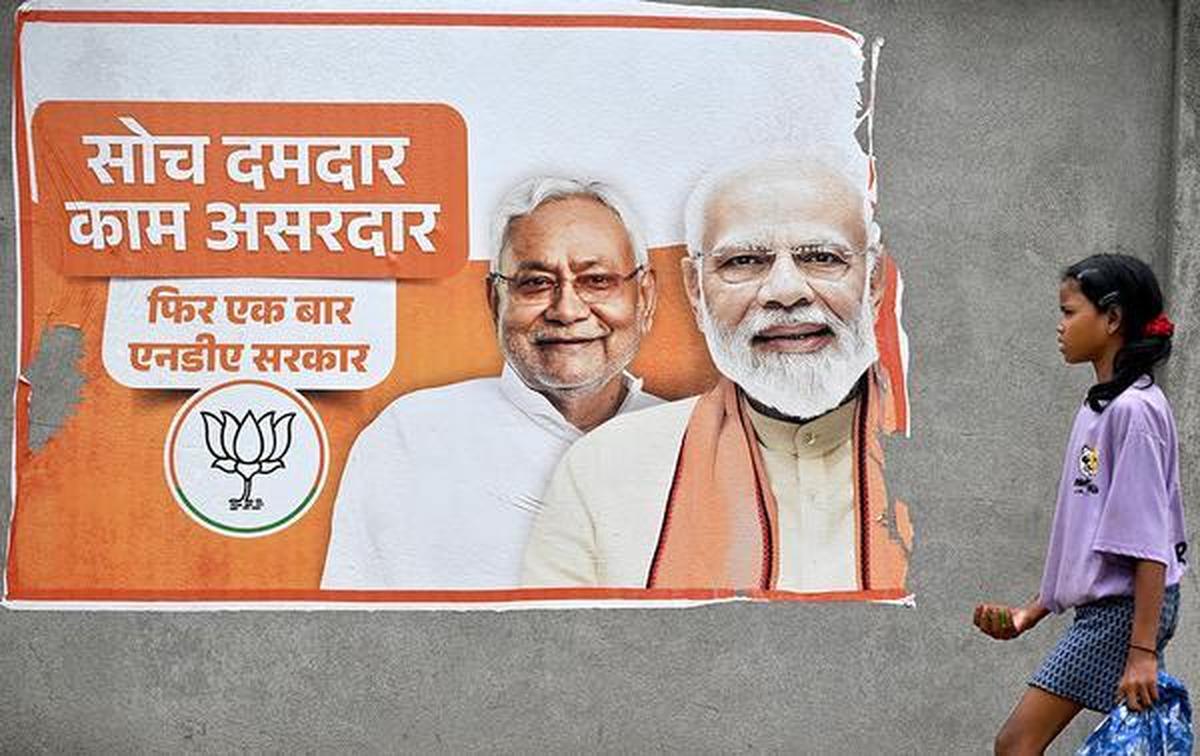
A poster of Bihar’s Chief Minister Nitish Kumar and Prime Minister Narendra Modi is seen in Purnia, Bihar
| Photo Credit:
Shashi Shekhar Kashyap
Nitish was disgusted with Lalu’s “dictatorial” ways and protested against the consolidation of power in the hands of Yadavs. He fumed in private but dithered over openly rebelling against Lalu. Nitish is not a natural rebel. He ruminates over an issue until every thread is unraveled, and then he chews over it for some more time.
The differences with Lalu spilled out into the open only in 1994 at the Kurmi Chetna Rally, a platform for the Kurmi rebellion against the Yadav domination under Lalu’s leadership. The Kurmis, an agrarian caste, constitute 2.87% of Bihar’s population, as per the latest caste survey in the State. Nitish did not join the stage by choice. He was pushed towards it by colleagues who wanted a mascot for the anti-Lalu rebellion. Speaking at the rally in Patna’s Gandhi Maidan, Nitish roared, “Bheekh nahin hissedari chahiye” (We seek our rightful share, not charity). The final split in the Janata Dal came on April 21, 1994, when a group of 14 MPs formed the Samata Party. This journey too began with a setback for Nitish. In the 1995 Assembly election, Lalu secured 164 seats, his best electoral performance till date. The Samata Party was left in a precarious condition, winning just seven seats. The party fielded 310 candidates, of which 271 lost their security deposit. Nitish was left to pick up the pieces of his shattered ego — an exercise he had become familiar with. Pushed to the margins, Nitish found an ally in the BJP. They shared a common goal — to unseat Lalu. With Nitish’s backward caste base and the BJP’s support among the forward castes, the alliance had the necessary numerical strength to put up a fight against Lalu.

Nitish’s secular outlook did not stand in the way of the coalition. He had previously protested against the Rashtriya Swayamsevak Sangh’s anti-Babri Masjid campaign and endorsed L.K. Advani’s arrest in Bihar. The experiment yielded immediate results. In the 1996 Lok Sabha election, the BJP won 12 seats and the Samata Party six. It was this combination that elevated Nitish to the Chief Minister’s chair for the first time on March 3, 2000. However, with only 122 seats between them, two short of the RJD’s tally of 124 seats, his government could survive only for seven days.
A despondent Nitish returned to Delhi to recover from yet another blow. Victory finally came on November 24, 2005. Nitish’s first full term as Chief Minister is considered transformational. He offered a refreshing blend of development and social representation. He worked on building both physical and social connections — constructing extensive road networks while also reaching out to communities hitherto excluded from the government’s welfare programmes. Clearing infrastructure projects and organising Mahadalit sammelans (rallies) went hand in hand. He introduced reservation for the backward sections among Muslims, launched targeted welfare measures for backward communities, and announced 50% reservation for women in local bodies. These moves were seen as a leap forward from the notional empowerment associated with his predecessor. He is a maverick who looked beyond the traditional caste lines to curate for himself a constituency of the Extremely Backward Classes, which is the largest caste grouping in the State, accounting for 36.01% of the population.
The grouping has 130 groups and sub-groups scattered across the State. Despite their collective strength, the EBCs have for a long time remained politically and socially divided. Nitish’s personal political fortunes and the electoral trajectory of the Janata Dal(U), which was formed following the merger of the Samata Party with the Sharad Yadav faction of the Janata Dal and the Lok Shakti party, have followed divergent paths. Despite the JD(U)’s diminishing tally over the years, Nitish has continued to hold on to the Chief Minister’s post. The last time the JD(U) emerged as the single largest party in the Bihar Assembly was in 2010, when it won 115 seats in an election seen as a referendum on Nitish’s governance. However, since then, the State administration has slowly slipped back into the morass of neglect and corruption. In the 2020 Assembly election, the JD(U) was reduced to 43 seats, slipping to third place, a result shaped by the growing disenchantment among voters and machinations by allies to unseat Nitish.
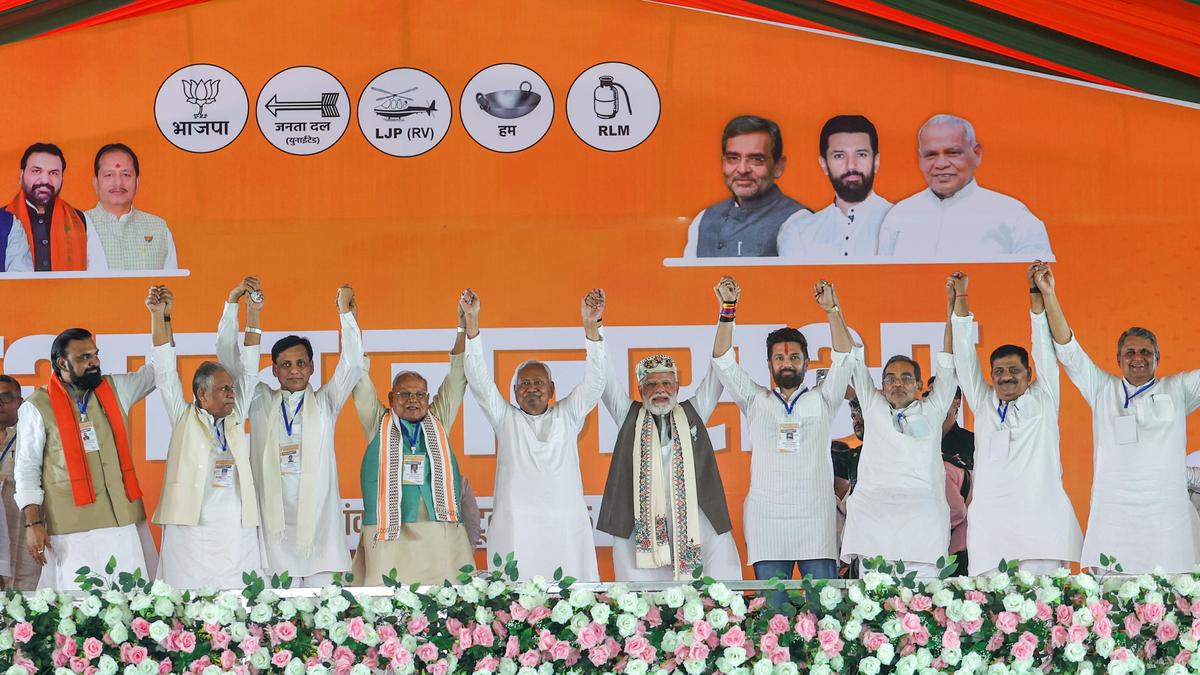
Prime Minister Narendra Modi and Bihar Chief Minister Nitish Kumar along with NDA leaders during a public rally.
| Photo Credit:
ANI
The Lok Janshakti Party, a member of the NDA, struck out on its own in 2020 and directly targeted Nitish using the slogan “Modi se bair nahin, Nitish teri khair nahin” (No enmity with Modi, but Nitish, you won’t be spared). The LJP contested 135 seats. In the 2024 Lok Sabha election, Nitish once again proved his critics wrong, with the JD(U) winning 12 of the 16 seats it contested. “The social base that Nitish Kumar created in his first term, reaching out to the marginalised among the backward and Dalit communities and women, still holds strong,” Manindra Nath Thakur, a Professor at the Centre for Political Studies at Jawaharlal Nehru University, says.
Nitish’s ideological elasticity has helped him nullify voter fatigue. His twists and turns may appear whimsical, but they are guided by his conscience and political expediency. In 2013, he publicly repudiated Narendra Modi after the BJP appointed him campaign committee chief. He severed his 17-yearlong alliance with the BJP and aligned with Lalu in 2015 — the very person he had spent years to oust. However, he was back with the NDA within two years after corruption allegations surfaced against his deputy and RJD leader Tejashwi Yadav. “My decision to quit was taken in the interest of Bihar. We had the mandate to serve the people, not one family,” Nitish explained.
Secularism, he said, should not be used to justify corruption and vowed not to make the mistake again. And yet in 2022, he did just that, returning to the Mahagathbandhan (grand alliance) and appointing Tejashwi as his deputy once again. “I have nothing much to say on how suffocated we felt in the NDA …,” he said after submitting his resignation to the Governor., stepping down as the coalition’s Chief minister. Announcing the party’s split with the BJP, JD(U) president and Nitish loyalist Rajiv Ranjan Singh, better known as Lalan Singh, claimed that the BJP was trying to replicate the Maharashtra model in Bihar by trying to break the JD(U) from within.
The 2024 switch
But this alone does not entirely explain Nitish’s decision. In his twilight years, he was ready to leave his favourite playground to explore an uncertain future, driven by his conviction that the BJP could be defeated in the 2024 Lok Sabha election. He saw a possibility of taking a national role, expecting to guide the Opposition back to power. He worked towards the construction of a coalition of the willing, a group united by its desire to unseat Modi. He made several trips to Delhi, meeting Opposition leaders, advocating “Opposition unity for the greater good of the nation”, and marketing it as the elixir to keep the Indian democracy alive. He arranged for them to come together, and at a meeting hosted by him in Patna in July 2023, the Indian National Developmental, Inclusive Alliance (INDIA) was born. However, by the third meeting of the newly formed coalition, Nitish could sense that the commanding perch he was seeking within the alliance would elude him. He expected that he would be made the convener of the INDIA bloc, but the Opposition parties, especially the Congress, felt that granting him such a role would indirectly make him their prime ministerial candidate, a tag that they were not willing to part with. Opposition leaders later acknowledged that had he been offered the post of convener — bringing him face to face with Modi as his key challenger — Nitish would likely have stayed on. However, no such position of leadership was offered. In January 2024, just months before the Lok Sabha election, he returned to the NDA. His assessment was not entirely wrong. The BJP, which secured 303 seats in 2019, was reduced to 240 seats in 2024.
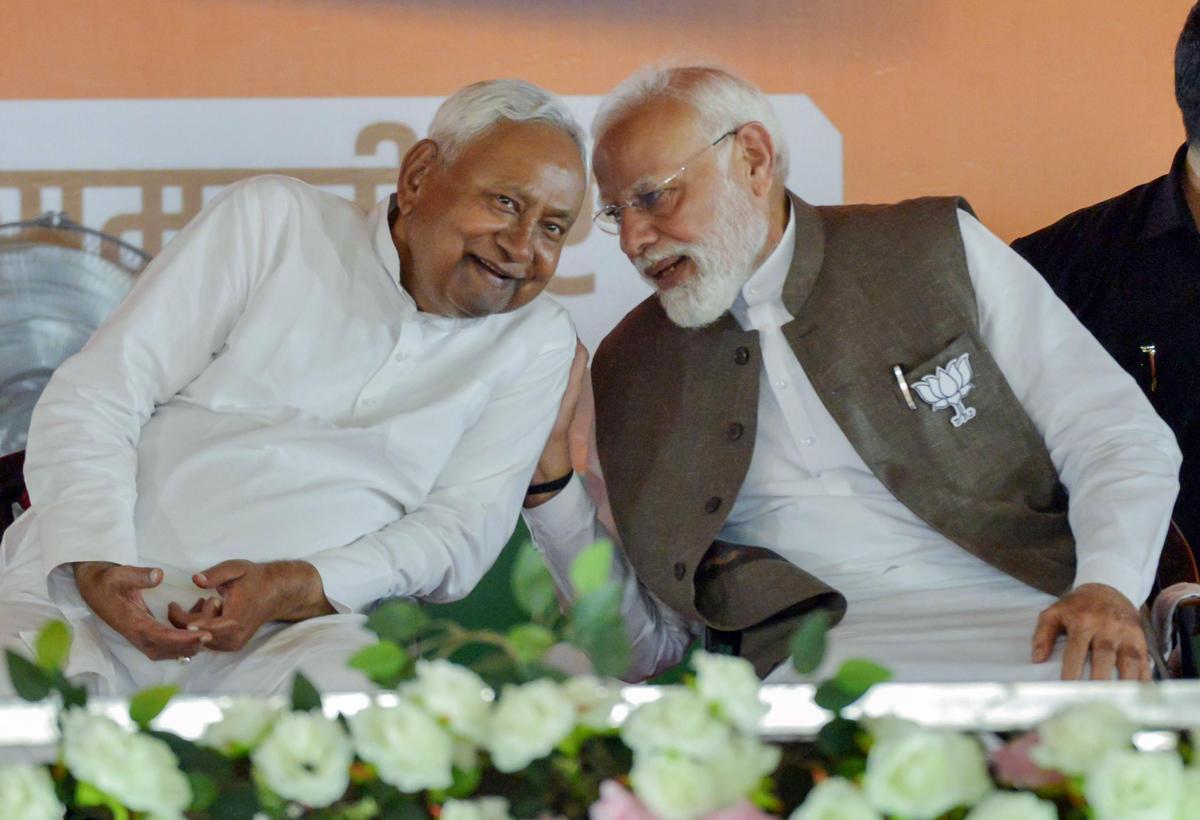
Prime Minister Narendra Modi and Bihar Chief Minister Nitish Kumar Yadav interact during Bihar assembly elections rally, in Samastipur
| Photo Credit:
ANI
The survival of the current Narendra Modi government depends on the JD(U) and the Telegu Desam Party. For a man with Nitish’s political acumen, however, the developments following the 2024 election are inexplicable. In the first meeting of the NDA after the results, he was seen touching Modi’s feet. He then went about making concessions for the BJP that he had resisted in the past. The JD(U) settled for merely two berths in the Union Council of Ministers, both considered “inconsequential” portfolios, without a murmur. JD(U) president Rajiv Ranjan was appointed Minister for Fisheries, Animal Husbandry and Dairying and Minister for Panchayati Raj, while party’s Rajya Sabha member Ramnath Thakur was made Minister of State for Agriculture and Farmers’ Welfare.
This was in sharp contrast to the party’s position in 2019, when Nitish, arguing for “proportional representation” rather than “symbolic presence”, insisted that the JD(U) should get at least four berths since the BJP then had five Ministers from Bihar. It is, of course, another story that in July 2021, Nitish’s former aide R.C.P. Singh, rebelling against him, secured a Cabinet berth for himself. Within a year he was forced out of Modi’s Cabinet, after the JD(U) refused to renominate him to the Rajya Sabha. Nitish and the JD(U) have gone out of their way to advertise their subservience to the BJP, nodding along with Modi’s every decision and showing support for every controversial Bill. A recent example is the Waqf (Amendment) Act, which allows for direct interference by the government in the management of Waqf properties. Rajiv Ranjan emerged as one of the most vocal advocates of the Bill. Despite pressure from various Muslim organisations in Bihar, the JD(U) did not even raise token objections. In his increasingly rare public appearances, Nitish has taken to asking the audience, “What was there before 2005?” Invoking the past has become essential because the present does not look very promising.
After two decades under his rule, the State still stands on a precipice. The recent caste survey has served as a damning indictment of Bihar’s economy and the questionable legacy of Nitish Kumar’s 20-year rule. Of the 2.97 crore households in the State, 34.13 % survive on a monthly income of ₹6,000 or less. The poverty rate is the highest among the Scheduled Castes (SCs) and the Extremely Backward Classes (EBCs). Professor Thakur says that while Nitish took the first step by building infrastructure, he failed to take the second step of attracting private investment to the State. Both migration and unemployment continue to be high in the State. “Bihar is surviving not because of Nitish but on the remittances sent by its migrant population,” he says. A significant portion of Bihar’s Budget is spent on servicing loans from the World Bank and other external agencies. As per an analysis of the 2025- 26 Bihar Budget by PRS India, a non-profit organisation, the State’s standing debt is estimated to reach 37% of its GDP by the end of the 2025-26 fiscal year.
There is no clarity on Nitish’s successor too. “Who after Nitish?” has become an oft-repeated question, with no clear answers. On June 29 2024, the JD(U), at its national executive meeting in Delhi, appointed Rajya Sabha member Sanjay Jha, a close aide of Nitish, the party’s working president, effectively making him the second in-command. From July 2021 to December 2023, Rajiv Ranjan, as the party’s national president, held this post. However, neither Jha, a Brahmin, nor Rajiv Ranjan, a Bhumihar, can be seen as claimants to lead a party that survives on EBC votes. Rajiv Ranjan, in particular, appears to be out of contention after Nitish’s recent public rebuke. At a public meeting on April 24, 2025, which was also addressed by the Prime Minister, Nitish singled out Rajiv Ranjan for the JD(U) breaking the alliance with the BJP-led NDA in 2022 and joining hands with the RJD. This incident has not gone down well with Rajiv Ranjan, and he is reportedly upset with Nitish over the public humiliation. Nitish’s comments are seen as an articulation of the suspicion that Rajiv Ranjan is working closely with the RJD leadership. In the first few months of 2025, Nitish’s son, Nishant, has also made an appearance. Though he has largely stayed away from politics, Nishant’s photographs have started appearing on JD(U) posters. He has also made public statements. While he satisfies the caste criteria and is not tainted by any controversies, the 48-year-old engineering graduate is a political novice and has no electoral experience.
There are many in the JD(U) who are hoping that the mantle would be passed on to them. At the forefront is Dalit leader and Cabinet Minister Ashok Choudhary. A former Bihar Congress chief, he has remained steadfastly loyal to Nitish since he joined the JD(U) in 2018. Nitish shares a warm equation with Choudhary. He lavishly praises him and appears comfortable in his presence. Despite courting controversy with a satirical poem on Nitish’s advancing age, Choudhary, instead of getting a rap on the knuckles, was promoted to the position of national general secretary. Anticipating the JD(U)’s downfall, both the RJD and the BJP have been positioning themselves to grab the vote bank that Nitish has carefully nurtured over his long tenure. “The Extremely Backward Classes would not like to go with the forward-caste-dominated BJP or the Yadav-dominated RJD. Both parties have been trying to shed this image, but between the two, the BJP has been more successful in doing so, by removing Brahmins and Bhumihars from topmost positions,” Professor Thakur says. Another round of Assembly elections is just around the corner. While many expect it to be Nitish Kumar’s swansong, it is still too early to dismiss him as a spent force. Nitish has secured his place in history, giving Bihar the stability it wasn’t used to. This election, however, will decide how he will be remembered — as a leader who changed the State’s destiny or just another Chief Minister in the long and winding conveyor belt of politics.



