


A study conducted by scientists from the India Meteorological Department (IMD) has revealed that Nagpur is the most hailstorm-prone district in Maharashtra, with the highest vulnerability and risk profile in the State. The study, titled, ‘Hailstorm Climatology over Maharashtra with Associated Impacts and Risk Assessment’ published on September 19, 2025, spans three decades from 1991 to 2020. It was authored by Shambu Ravindren and Sushma Nair of the Regional Meteorological Centre, Mumbai, and Soma Sen Roy of IMD Headquarters, New Delhi.
The researchers undertook a comprehensive district-wise analysis of hailstorm occurrences, their intensity, and the resulting damage across Maharashtra. They found that of the 142 hailstorm days recorded during the study period, 58% were classified as heavy and 42% as moderate. Interestingly, while heavy hailstorms dominated the early years, moderate hailstorms have become more frequent in recent years. February emerged as the most active month for hailstorm activity, followed by March and April.
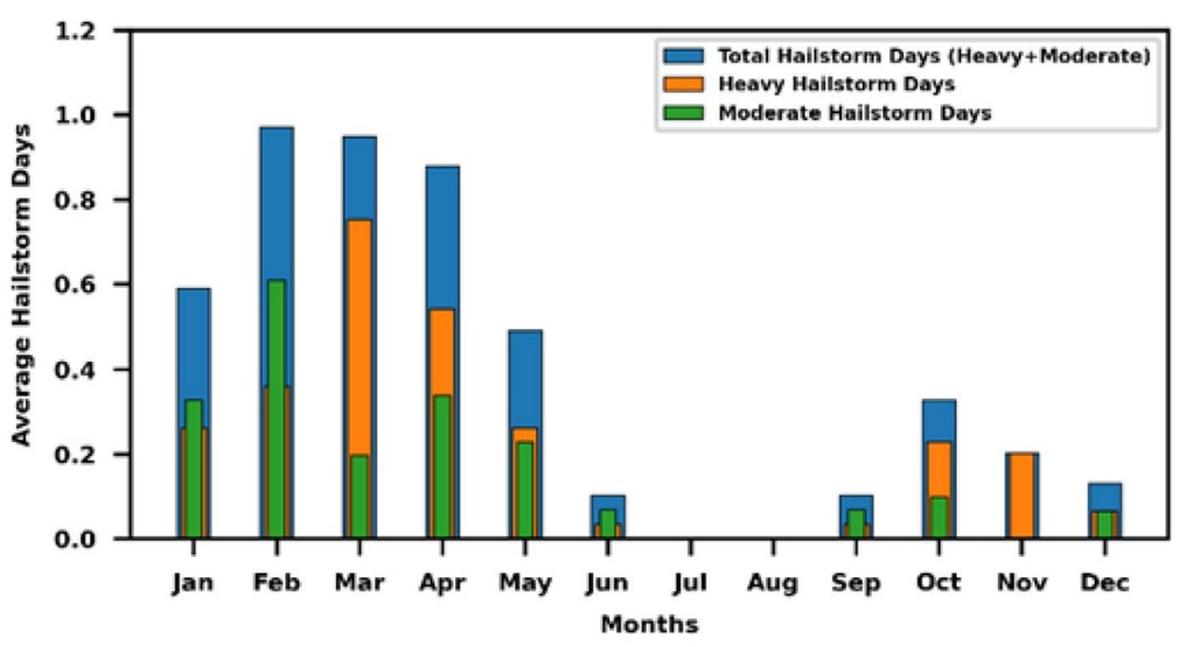
Monthly variation of average hailstorm days for moderate, heavy and total hailstorm days (heavy+moderate) from 1991 to 2020. All values represent the average number of hailstorm days per
month in each category.
| Photo Credit:
IMD
The study also revealed a distinct diurnal pattern in hailstorm occurrences. Nearly 40% of hailstorms were recorded between 4:30 p.m. and 5:30 p.m., with another 20% occurring between 5:30 p.m. and 6:30 p.m. This timing coincides with the period when farmers and livestock are typically outdoors, increasing the risk of accidental deaths and injuries. The median duration of hailstorms was found to be 10 minutes, though some events lasted up to an hour, posing extended threats to life and property.
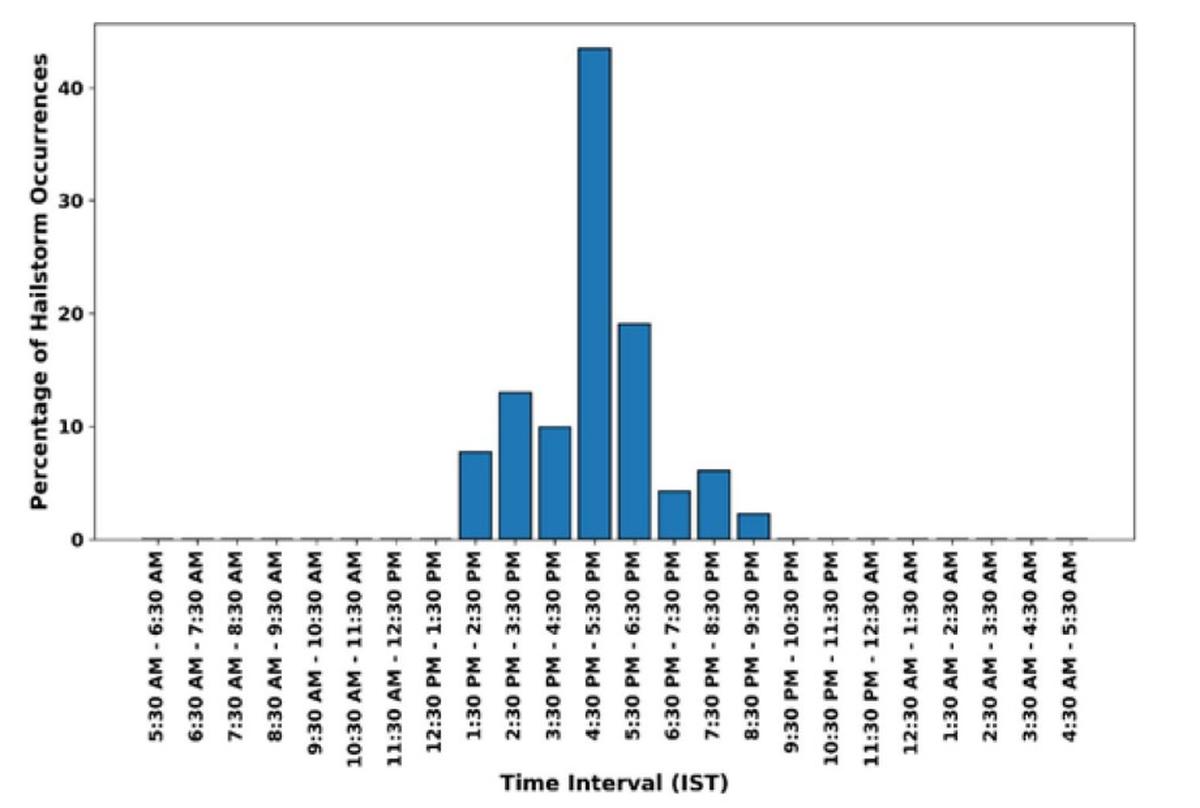
Percentage distribution of hourly hailstorm occurrences over a 24-h period from 05.30 a.m. to 05.30 a.m. the following day. All values represent the percentage (%) of the total hailstorm occurrences in each
hourly interval.
| Photo Credit:
IMD
Using the Intergovernmental Panel on Climate Change (IPCC) 2014 framework, the researchers calculated a Normalized Vulnerability Index (NVI) and Risk Score for each district, factoring in exposure indicators such as agricultural area and population density.
IMD scientist, Sushma Nair said, “Nagpur was the only district classified under the “Very High Risk” category. The authors noted that despite both Nagpur and Nashik being categorised as highly vulnerable districts, their risk profiles differ significantly.”
She explained that Nagpur’s high sensitivity, driven by socio-economic factors such as long-term impacts and a significant below poverty line (BPL) population, coupled with limited adaptive capacity, places it at the top of the risk scale. Nashik, on the other hand, benefits from minimal exposure, which mitigates its overall risk and places it in the “Low Risk” category.
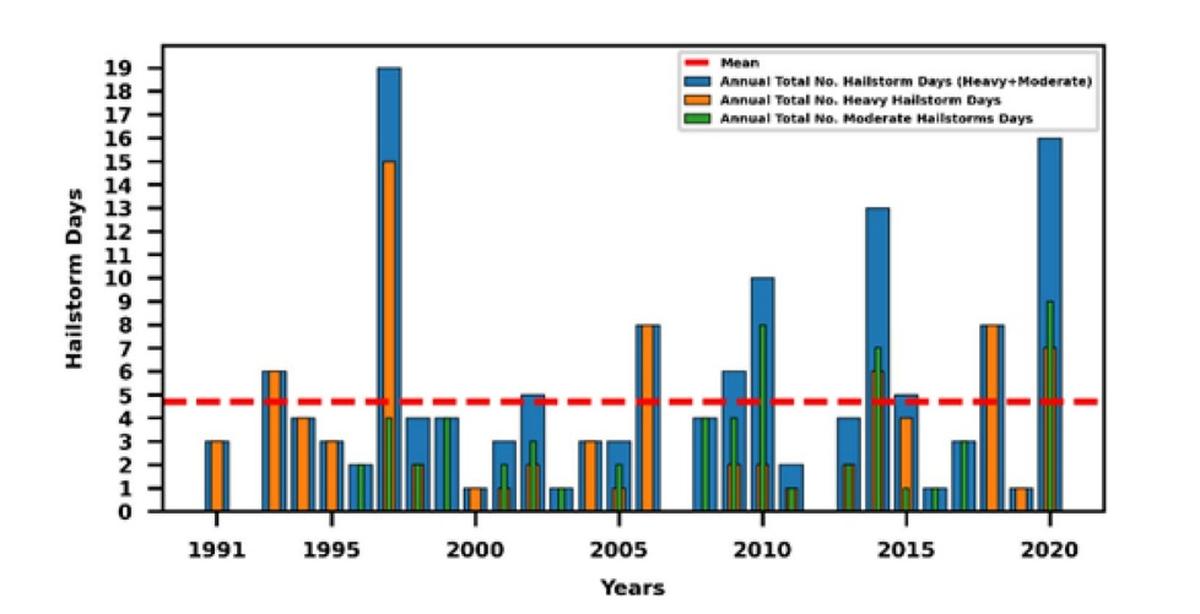
Interannual variability of moderate, heavy and total hailstorm days (heavy+moderate) from 1991 to 2020 along with the mean. All values represent the annual count of hailstorm days in each category. The horizontal dashed red line denotes the multi-year mean
| Photo Credit:
IMD
The study also identified a statistically significant rising trend in hailstorm occurrences in a contiguous belt across Marathwada—specifically in the districts of Jalna, Parbhani, Hingoli, and Nanded, and in South Madhya (Central) Maharashtra, including Satara and Sangli. IMD scientist Shambu Ravindren said, “These findings are crucial for disaster preparedness and resource allocation, especially in regions where hailstorm activity is intensifying.”
In terms of damage, the agricultural sector was found to be the most affected, accounting for 50.9% of total reported losses. Structural damage contributed 13.3%, while human fatalities and injuries together made up 15.5%. Livestock deaths and injuries accounted for 6.4%, bird deaths for 3.2%, and other disruptions — including uprooted trees, damaged electrical poles, and interruptions to essential services — comprised 10.9% of the total damage.
While heavy hailstorms were responsible for the majority of fatalities and structural damage, moderate hailstorms were nearly as damaging to agriculture and infrastructure, especially when they occurred frequently. The authors caution that moderate hailstorms cannot be overlooked, as their persistence and widespread impact can lead to substantial losses. In fact, the year 2020, which recorded 16 hailstorm days, saw the highest total damage at 12.03%, with moderate hailstorms contributing more to the damage than heavy ones.
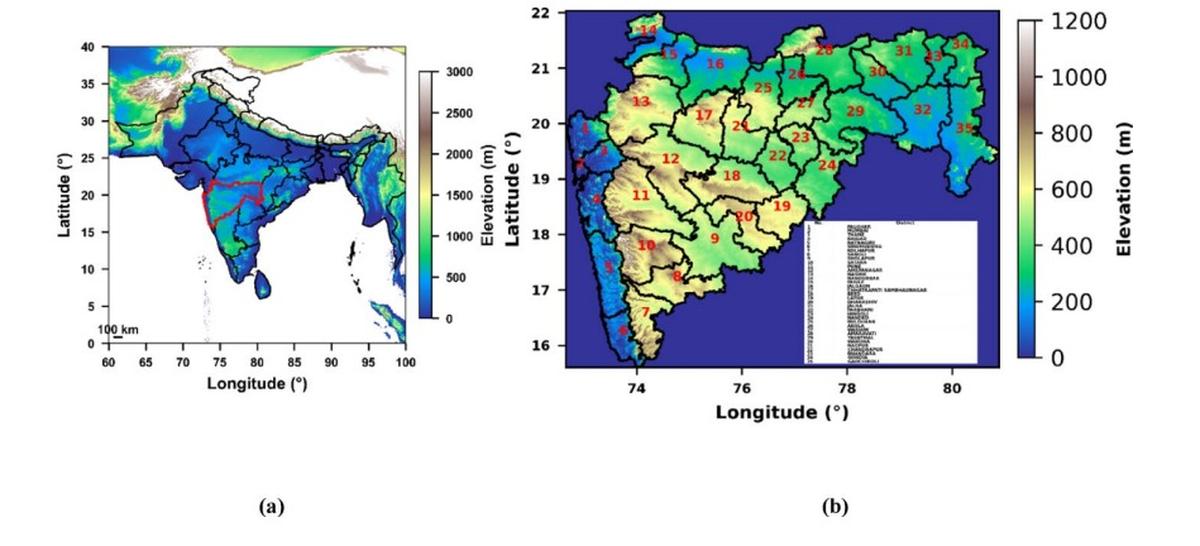
Elevation distribution over India and Maharashtra in meters (m). The left panel (a) shows the 1 km resolution SRTM-derived elevation map of India and neighbouring countries, with the State of Maharashtra highlighted in red. The right panel (b) presents a zoomed-in elevation map of Maharashtra at 90 m resolution, with districts numbered and corresponding names provided in an embedded table within the image.
| Photo Credit:
IMD
The study also highlighted regional disparities in damage patterns. Akola, for instance, reported higher cumulative damage than Nagpur despite having fewer hailstorm days, underscoring the role of population density and wealth in shaping impact outcomes. Similarly, districts like Nashik and Pune, which experienced relatively frequent hailstorms, reported lower total damage compared to districts in Vidarbha, pointing to the influence of socio-economic and infrastructural factors.
The authors emphasise the need for region-specific disaster preparedness strategies, including early warning systems, crop insurance schemes, infrastructure resilience, and livelihood diversification. Ms. Nair said, “A multi-pronged approach to disaster management is essential to safeguard livelihoods and build resilience in hailstorm-prone regions of Maharashtra. This study demonstrates the broader societal impact of hailstorms and the importance of integrating vulnerability, exposure, and hazard data to inform policy and planning.”
Published – October 05, 2025 12:46 pm IST



