

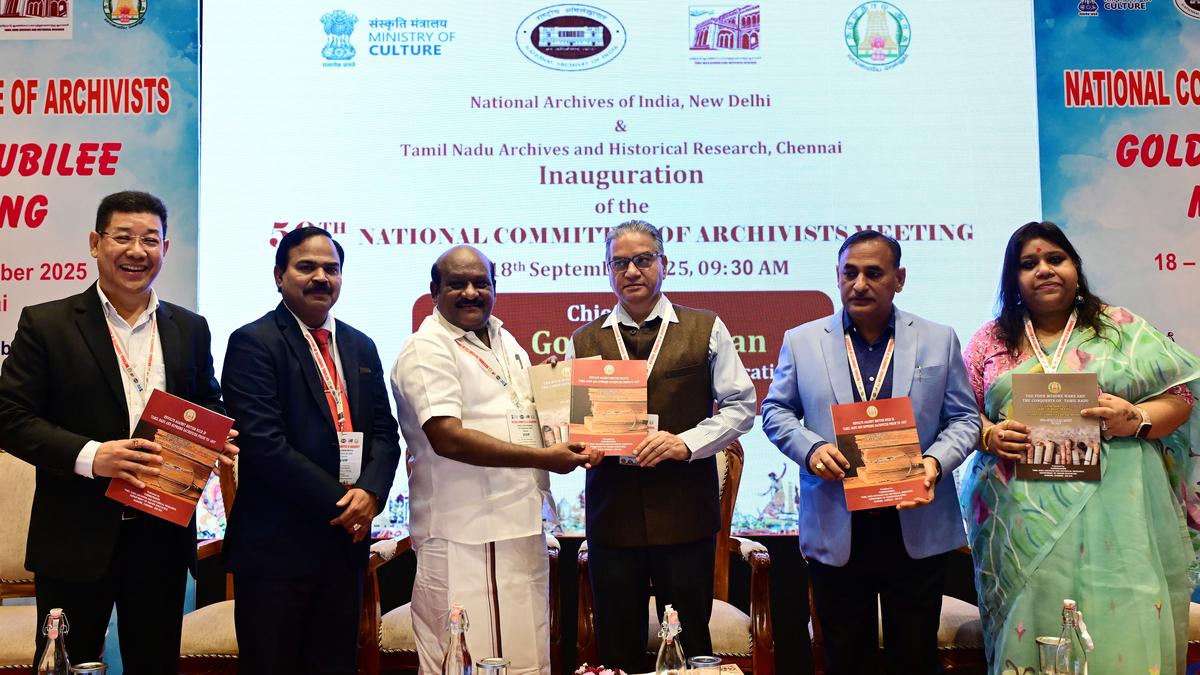

Tamil Nadu Minister for Higher Education, Govi Chezhiaan, releases booklets on ‘Revolts against British Rule in Tamil Nadu and Supreme Sacrifices Prior to 1857 AD’ and ‘The Four Mysore Wars and the Conquests of Tamil Nadu’ at the 50th National Committee of Archivists Meeting in Chennai. Also present are Sanjay Rastogi, Director General of Archives, National Archives of India, New Delhi, and Chairman, National Committee of Archivists; Har Sahay Meena, Commissioner, Tamil Nadu Archives; and P. Shankar, Secretary to the Government, Higher Education Department
| Photo Credit: B. Velankanni Raj
For over 300 years, the Tamil Nadu Archives and Historical Research has held a mirror to the past, having preserved over 40 crore documents using modern preservation techniques with generous allocation from the State government, Higher Education Minister Govi. Chezhiaan said in Chennai on Thursday (September 18, 2025).
Inaugurating the golden jubilee meeting of the National Committee of Archivists, Mr. Chezhiaan said the Tamil Nadu government had allocated ₹10 crore for adopting the advanced Japanese tissue mending technique for preservation of documents last year, and has also allocated the same amount this year, thereby demonstrating its intent. Moreover, to encourage research and publications on the history of the region, especially Tamil Nadu, the government was providing a stipend of ₹25,000 a month to young researchers, he said.
The Minister released two publications titled ‘Revolts Against British Rule in Tamil Nadu and Supreme Sacrifices Prior to 1857 AD’ and ‘The Four Mysore Wars and the Conquests of Tamil Nadu’.
Speaking on the sidelines of the meet, Har Sahay Meena, Commissioner, Tamil Nadu Archives, said the T.N. Archives had completed preserving eight lakh documents using the Japanese tissue mending technique, out of a targeted 10 lakh for the first year. Most military records have been preserved using this method, which, although expensive, was long-lasting and effective in preservation of old documents. The next step would be to preserve revenue records, Mr. Meena added.
Detailing various initiatives, Sanjay Rastogi, Director General of Archives, National Archives of India, said the NAI’s flagship digital platform, abhilek-patal.in, has close to 14 million pages of historical records, including public records, private papers, and manuscripts, uploaded on it. The NAI, he said, was in the process digitising all its records and it intends to complete the exercise in the next two years.
However, a gap in collaboration between the Centre and the States was the absence of a Centrally-funded scheme, Mr. Rastogi observed. While the NAI was in the process of formulating the scheme, which is proposed to be called Abhilek-Sampada, he welcomed more discussions on the contours and nomenclature of the scheme during the two-day archivists meet.
P. Shankar, Higher Education Secretary, said the two publications highlighted the courage and supreme sacrifice of Tamil Nadu’s early heroes of revolt, such as Puli Thevar, Veerapandiya Kattabomman, Marudupandiya Brothers, Rani Velu Nachiyar, Hyder Ali, and Tipu Sultan. “Archives are not just a record of the past, they are the memory of a nation, voice of society, and mirror of humanity. Every archive is a treasure house, a bridge between what was, what is, and what will be,” he added.
Published – September 18, 2025 05:11 pm IST



