


On a fog-laden Delhi morning, the staff of a Municipal Corporation of Delhi (MCD) school begins lining up students for assembly. The primary school is tucked into the by-lanes of Old Delhi, the Capital’s walled city. With more than 100 children, the open space is so small that when they’re asked to stretch their arms out, they get in each other’s way. Run out of a haveli abandoned during Partition, this Urdu-medium school is attended by children who live in the congested lanes around. This school, like many others, was started in the 1960s.
Soon after assembly, conducted in Hindi, students from nursery to class 2 are ushered into a classroom. Three empty classrooms remain locked. Children from classes 3 to 5 take their places on benches in three rows in the arched hallway outside the classroom, facing a blackboard. Some run around. Others chat, distracted by the noise spilling out from the classroom next door. The school has an enrolment of 120 students, 90 boys and 30 girls.

Armaan (name changed to protect privacy), hired as a teacher for children with special needs (CWSN), is conducting classes for the whole school through the day. The only other teacher is out on administrative work. There are only two CWSN students in the school, but Armaan moves between the hallway and the classroom, assigning work to different groups. He chooses a chapter on ‘family’.
“On days like this, or on days when attendance is good, I choose a lesson everyone can follow,” he says. “The senior students have studied it before, but they revise.” After assigning the lesson on the board, he steps into the classroom to help younger students form letters in their books. He comes back to the hallway and calls out roll numbers, to mark attendance.
Scenes like this play out daily across MCD-run Urdu-medium primary schools, which serve as the first point of formal education for children in several densely populated neighbourhoods of Old Delhi, Shahdara, and parts of Central Delhi. Of the 1,185 primary schools run by the civic body across the Capital, 40 have Urdu as their medium of instruction, meaning Science, Maths, and Social Studies, are taught in the language.

Together, MCD schools cater to over 6.4 lakh children, ages 3 to 11, as per MCD data. Out of these, more than 15,000 children, along with 275 children with special needs, are enrolled in Urdu-medium primary schools. These schools follow National Council of Educational Research and Training (NCERT) framework, and are neither Madrasas nor minority schools.
During visits to over a dozen such schools, The Hindufound a recurring pattern of understaffed classrooms, with student enrolments having dropped sharply over the years, particularly in institutions with only two or three teachers. Between 2009 and 2024, only 48 Urdu teachers were appointed under specific recruitment drives. Many have since retired.
Children ask for more
Sitting in the front row is an 11-year-old class 5 student. Irfan (name changed) says he wishes classes were taken separately. “ Bahut shor machate hain,” (They make a lot of noise), he says, referring to the younger children.
After Irfan finishes primary school, he will be transferred to a Delhi government Urdu-medium school from class 6 onwards. But asks his parents to shift him to an English-medium school. “It will be better for studies,” Irfan says.
Delhi-government-run Urdu-medium schools do not face the same level of neglect, say teachers. They emphasise that unlike MCD schools, which operate only at the primary level, Delhi government schools are under the Directorate of Education (DoE) from primary to senior secondary. “Once students complete Class 5 (in MCD schools), they move to DoE or aided schools, which are in better shape,” a teacher says.
Beside Irfan sits another class 5 student, Sana (name changed), whose younger sibling studies with her in class 3. Sana wants to become a doctor, and her sister, a teacher. “Our teacher is good, but it would be nicer if classes were separated,” she says. Mathematics is her favourite subject, but, “At home, there is no one to help me study. I have to work hard.” This year, Sana will go to the government school in Lambi Gali, close by, where her older sibling has told her, “They have different teachers for different classes.”
She recalls that in 2024, for a few months, when one of the two teachers went on maternity leave, two additional teachers were temporarily posted at the school. “Class 3 and 4 students were seated separately then. The teaching was better.” The students mistake any unknown adult on the premises to be their new teacher.
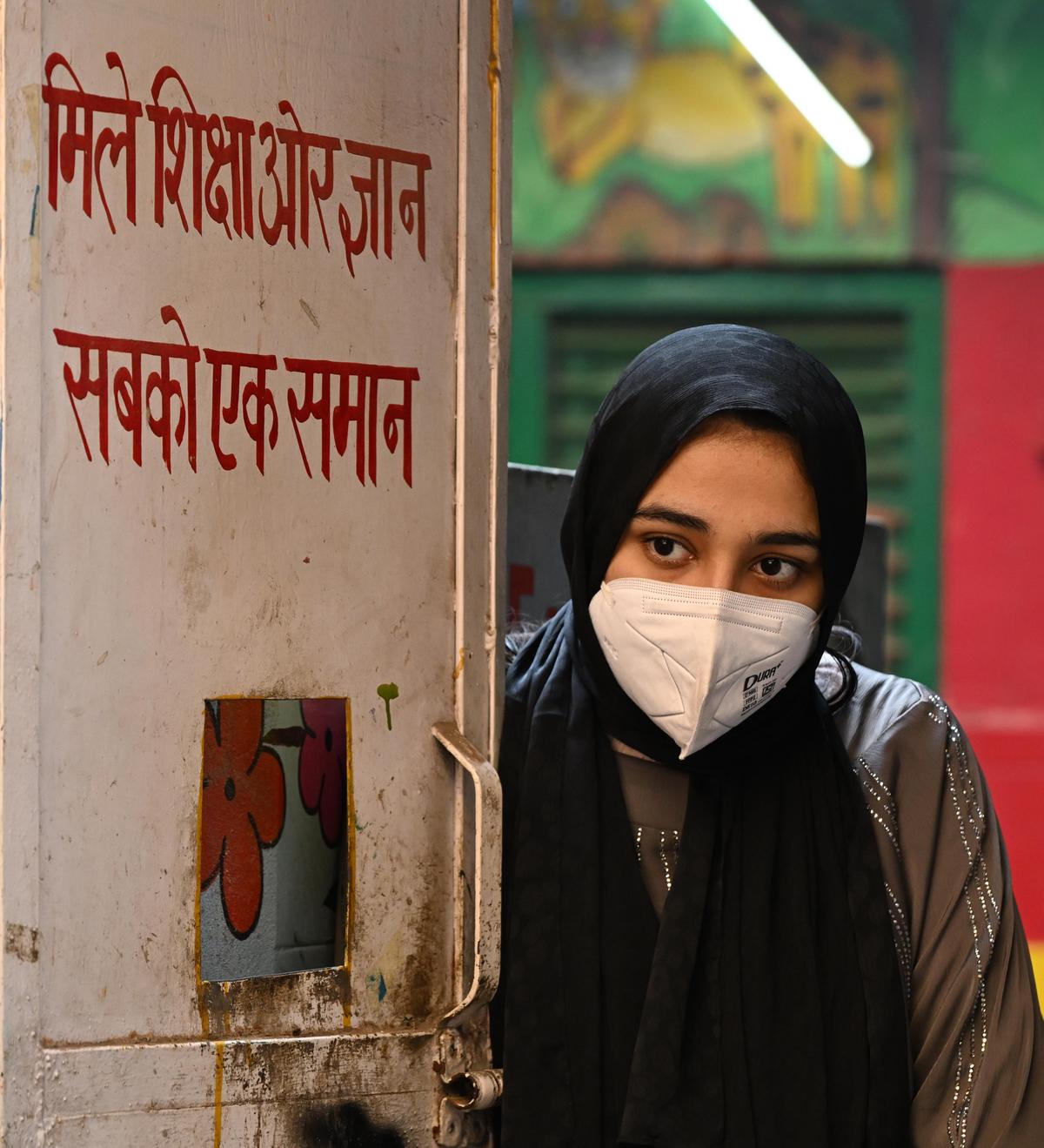
An Urdu teacher at the MCD run school in Old Delhi on January 24, 2025.
| Photo Credit:
R V Moorthy
Parental concerns
In Old Delhi and parts of Shahdara, Urdu-medium MCD schools are tucked deep into neighbourhoods, often a short walk away for children. For families where childcare falls largely on women, that proximity shapes their choice of school.
Aisha Begum, 28, a parent of two children studying in class 3 in the Old Delhi school, says she was unhappy with the quality of education, but had little choice. “This is the closest school, 15 minutes from our house,” she says. “There aren’t enough teachers here. Children keep playing even during class hours. Sometimes I feel I can teach them better at home.”
Conversations with parents return to familiar concerns: classrooms without enough teachers, lessons slipping between languages. Begum says that while textbooks are in Urdu, worksheets arrive only in Hindi. “It becomes hard to translate at home. The child is not learning either Hindi or Urdu properly,” she adds. Officials attribute this to a shortage of staff to translate materials.
Another set of parents says that if they could afford it, they would send their children to privately-run English-medium schools. Only 134 MCD schools are English-medium, with most of the rest functioning in Hindi.
But for families in dense, predominantly Urdu-speaking neighbourhoods, these schools remain the most accessible option. “Our worksheets are also bilingual. In Hindi-medium schools, English is taught as the second language, while in Urdu-medium schools, Hindi is the second language,” an official says.
However, some parents speak of wanting their children’s first years of schooling to be rooted in Urdu, the language spoken at home. A parent, who requested anonymity, says, “In an increasingly polarised climate in India, as a minority, I don’t want my children to lose touch with their language and its script.” Parents say Urdu should continue to be taught, even if other subjects are taken up in Hindi or English.
Teacher troubles
Back in Old Delhi, as the morning progresses, Armaan says that not all students are coming to school as classes are now in hybrid mode, due to pollution-induced Graded Response Action Plan (GRAP) measures. He sends the day’s worksheet over a WhatsApp group with parents. There are no online classes. “We manage somehow,” Armaan says. “But managing is not the same as teaching the way children deserve to be taught.”
He joined the school in 2023, and travels every day from north-west Delhi. On regular days, he draws a partition on the board and teaches two subjects simultaneously. “We have written letters highlighting vacancies in our school to the (education) department, but we get a response to say that if teachers are sent here, then another school will face a shortage,” he adds.
Recruitment rules require primary teachers to have studied Hindi and English to at least the secondary or senior secondary level. An official says that they try and ensure that for Urdu-medium schools, teachers have studied Urdu up to Class 10, but the recruitment rules, amended and notified in 2011, do not mandate this.
According to data shared by MCD officials, out of 410 teachers in Urdu-medium schools — 370 regular and 40 special educators — only 234 had Urdu as a subject till class 10. “We do have an adequate number of Urdu teachers, but some schools are overstaffed and some are under-staffed,” an MCD official says. “So distribution remains uneven.”
The Right to Education Act, 2009, mandates a pupil-teacher ratio of 40:1 for schools with over 200 students. While the MCD official’s numbers add up, Armaan’s school falls short of teachers.
In another school in Old Delhi, the nursery section alone has 97 students, managed by a single teacher. Noor (name changed), a teacher, often comes to school even when she’s unwell, worried about leaving her students unattended to. “With so few teachers, we cannot afford to step away. It is already difficult to give equal attention to every child,” she says.
Schools in Najafgarh, Rohini, and Narela have more staff, while schools in the congested localities of Old Delhi, parts of Shahdara, and Okhla function with two or three teachers. Many teachers, especially those from Delhi Rural and areas bordering Delhi in Haryana and Uttar Pradesh, ask for transfers when they are posted to these schools, say MCD officials.
Stuck inatimewarp
In the City S.P. zone, of which Old Delhi is a part, most of the 15 Urdu-medium schools function out of ageing havelis or rented structures never meant to hold multiple classrooms.
Local representatives say the issue has been flagged time and again. In Sitaram Bazar ward of City S.P. zone, Aam Aadmi Party councillor Rafia Mahir points to a thinning network of Urdu-medium schools – 6 of the 11 in the area were closed before 2022 over low enrolments and building concerns. She speaks of letters sent over three years. “I’ve been pushing for at least two schools to be retrofitted and reopened,” she says.
A building in Raziya Begum area, constructed a decade ago, is among those she hopes to revive. She suggests adopting English as the medium, with Urdu as a mandatory subject.
MCD officials say new schools cannot be opened without approval from the Delhi government, and any decision to convert or shut Urdu-medium schools requires approval by the MCD House. “We cannot simply end Urdu-medium education in areas where people still want it,” an official says. “The National Education Policy talks about multilingual education. The challenge is implementation.”
At an Okhla school, damp patches from past monsoons still cling to the ceiling, paint peeling in thin layers. In another Old Delhi school, parts of one building have been cordoned off after seepage spread across the roof.
“We now run all classes from nursery to Class 5 in fewer rooms. Even the principal takes classes from her cabin. This is how we manage, for now,” the teacher-in-charge says.
suruchi.kumari@thehindu.co.in



