


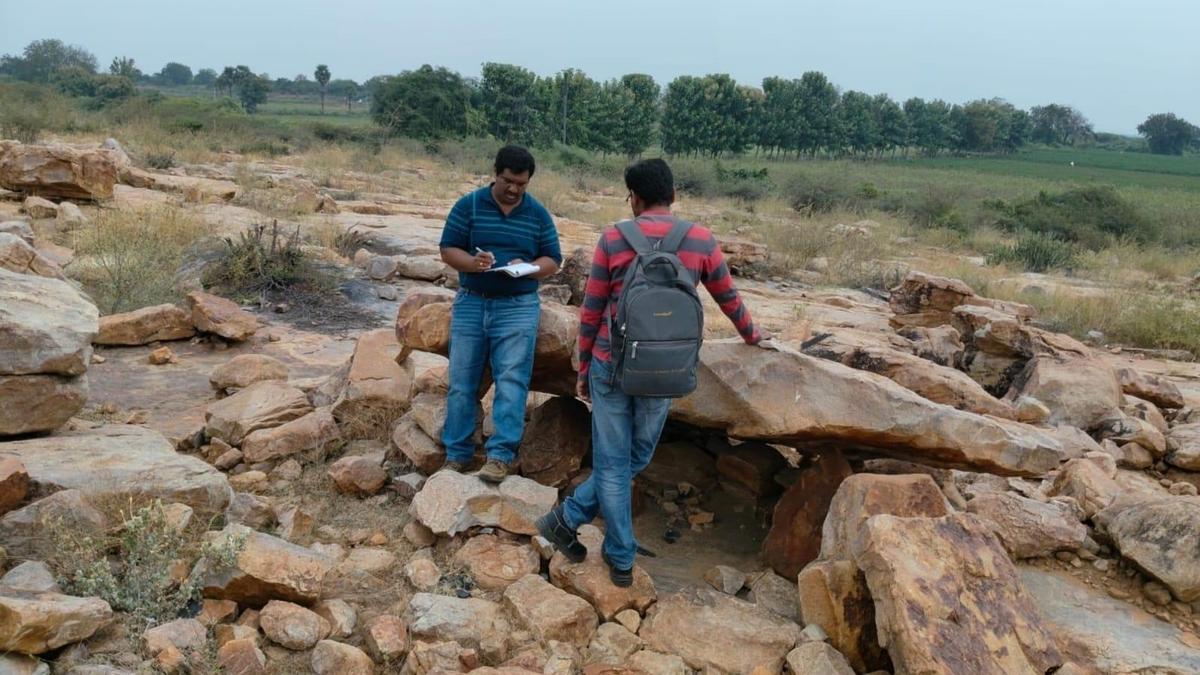
Dr. Sai Krishna Esarapu, Assistant Archaeologist with the Archaeological Survey of India (Hyderabad Circle), and Dr. Yadava Raghu, Assistant Professor of History at Sri Sathya Sai University for Human Excellence, Kalaburagi were documenting details of research at a megalithic dolmen at Pedda Anupu near Nagarjuna Konda in Palnadu district. | Photo credits: Special arrangement
A distinctive cluster of megalithic burials featuring rare dolmens with deliberately sloping capstones has been identified at Pedda Anupu Chenchu Colony in Palnadu district of Andhra Pradesh, pointing to a locally evolved variant of South India’s megalithic tradition in the Lower Krishna Valley.
The finding emerges from recent field investigations by Dr. Sai Krishna Esarapu, Assistant Archaeologist with the Archaeological Survey of India (Hyderabad Circle), and Dr. Yadava Raghu, Assistant Professor of History at Sri Sathya Sai University for Human Excellence, Kalaburagi. The site, located barely 100 metres from the Chenchu tribal hamlet of Pedda Anupu and about five kilometres from the historic Nagarjunakonda complex, was surveyed in detail on November 30, 2025.

Researchers documented nearly 60 to 70 megalithic burials, including dolmens, cists with cairn packing, an oblong cist, a stone circle and a small anthropomorphic stone measuring about a metre in height. The most striking feature is the sloping capstone dolmens, where the front opening is elevated while the rear rests close to the ground — a departure from the conventional horizontal capstones commonly seen across the Deccan. Capstones at the site range between 2.5 and 3.15 metres in length.
The site lies on exposed quartzite bedrock of the Bairekonda Formation, part of the Cuddapah Supergroup, dating back nearly 1.6 billion years. According to the researchers, this geological context would have influenced both settlement patterns and construction techniques of the megalithic communities inhabiting the semi-arid margins of the Lower Krishna basin.

Significantly, traces of a disturbed Buddhist site were also noticed adjacent to the megalithic remains, including a broken ayaka pillar and large rectangular bricks damaged by farming activity. The archaeological evidence suggests continuous or overlapping human activity from the megalithic period to the Ikshvaku-era Buddhist phase, roughly spanning 1200 BCE to 300 CE.
The researchers have urged greater public awareness to protect the site, emphasising its importance in understanding regional cultural adaptations and ancient funerary practices.
Published – January 31, 2026 10:56 am IST



