


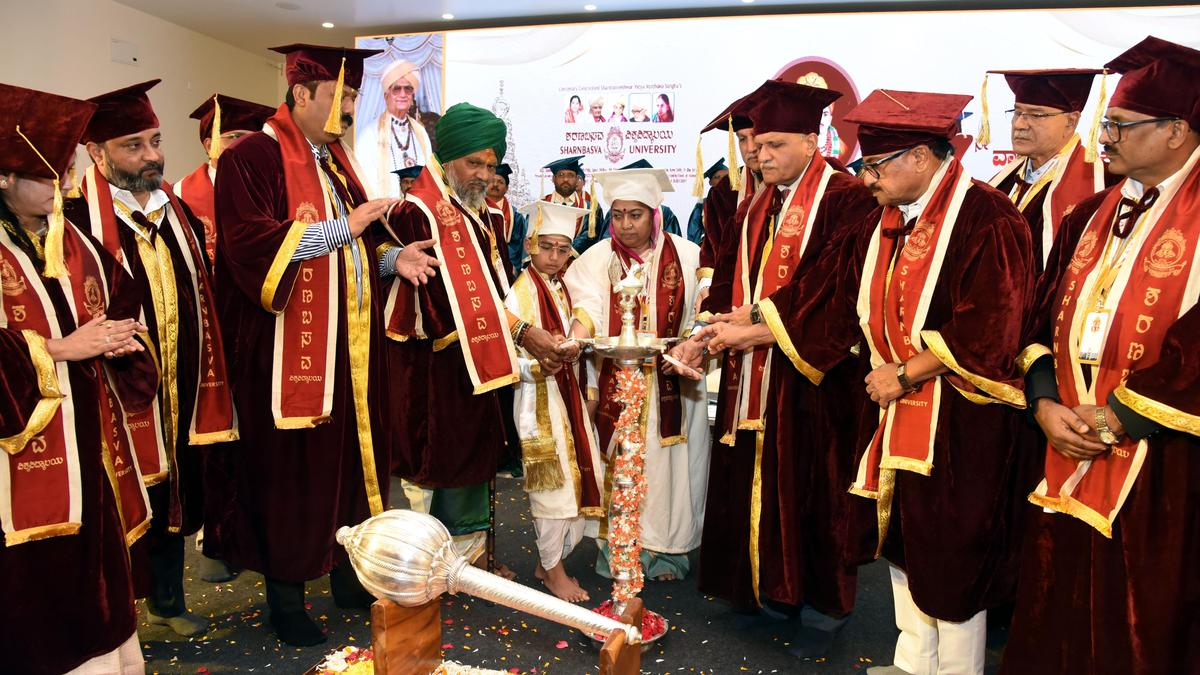
The seventh convocation of Sharnbasva University inaugurated at Sharnbaswappa Appa Anubhava Mantapa in Kalaburagi on Sunday.
| Photo Credit: ARUN KULKARNI
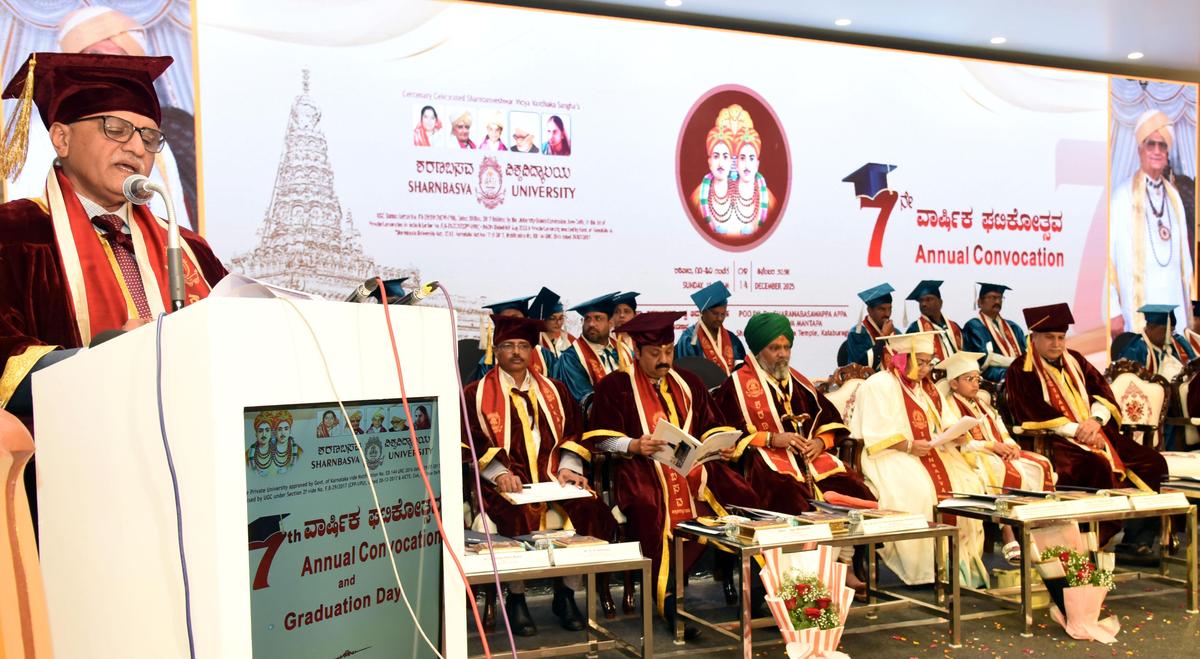
P.L. Patil, senior agriculture scientist and Vice-Chancellor of the University of University of Agriculture Sciences, Dharwad, addressing graduates during the seventh convocation at Sharnbasva University at Sharnbaswappa Appa Anubhava Mantapa in Kalaburagi on Sunday.
| Photo Credit:
ARUN KULKARNI
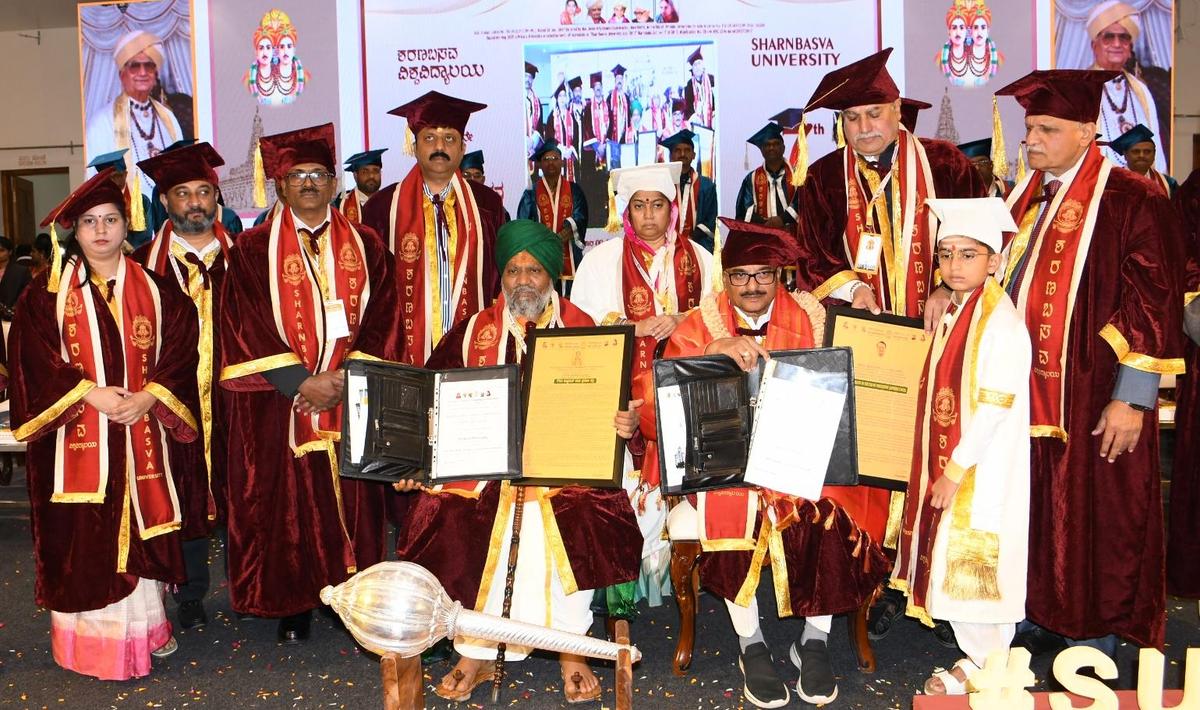
Honorary Doctorate being conferred to Gurupadalinga Mahashivayogigalu and Shashil Namoshi at the seventh convocation of Sharnbasva University, held at Sharnbaswappa Appa Anubhava Mantapa in Kalaburagi on Sunday.
| Photo Credit:
ARUN KULKARNI
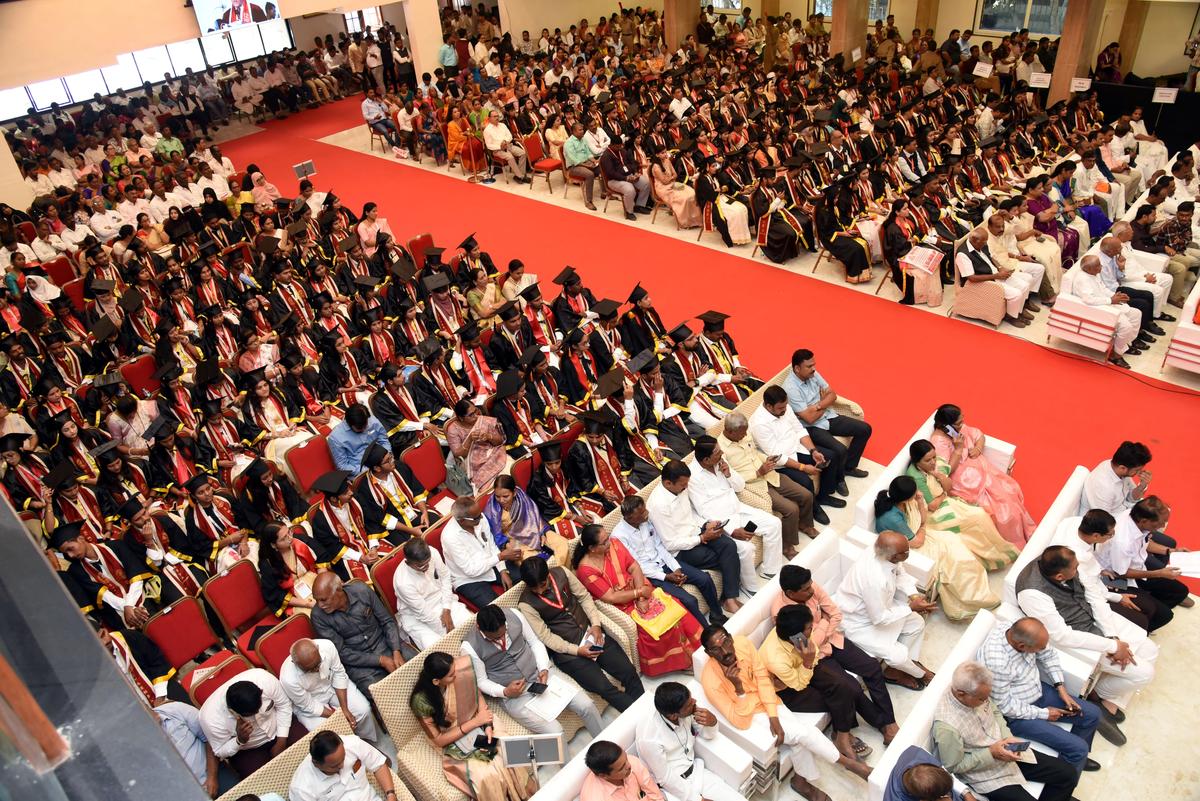
Students and guests at the seventh convocation of Sharnbasva University, held at Sharnbaswappa Appa Anubhava Mantapa in Kalaburagi on Sunday.
| Photo Credit:
ARUN KULKARNI
Senior agricultural scientist and Vice-Chancellor of the University of Agricultural Sciences (UAS), Dharwad, P.L. Patil has said that rapid advances in artificial intelligence (AI) and the Internet of Things (IoT) are transforming engineering and significantly improving the quality of life by strengthening infrastructure and services.
Delivering the seventh convocation address of Sharnbasva University in Kalaburagi on Sunday, Prof. Patil said, “AI has fundamentally changed the way complex systems are designed, developed and deployed. Intelligent infrastructure powered by AI has revolutionised problem-solving approaches, while the integration of machine learning and deep learning has led to major improvements in predictive maintenance, quality control and design optimisation.”
He noted that AI-driven technologies such as autonomous vehicles, drones and robots are now capable of navigating complex environments with ease.
Prof. Patil said IoT has enabled the creation of interconnected systems that communicate seamlessly, driving the growth of smart cities, smart homes and intelligent transportation networks. He urged engineering graduates to fully understand the vast potential of IoT, which offers immense scope for innovation-from designing energy-efficient systems to developing secure communication protocols. With high-speed data transfer and widespread connectivity, 5G technology is set to revolutionise sectors such as healthcare, finance, agriculture and entertainment, he added.
Referring to recent developments in materials science, Prof. Patil highlighted new materials such as graphene, nanomaterials and met materials, which are enabling innovations in flexible electronics, energy storage devices and advanced composites. Cyber security, he said, has also emerged as a critical area of concern due to increasing dependence on digital systems.
With advancements in AI, IoT, 5G, materials science and cybersecurity, Prof. Patil said the possibilities for engineers are limitless. “It is the responsibility of engineers to harness these technologies to create a better future for humanity,” he said.
Touching upon global developments, he observed that diplomatic friction between India and the United States could lead to a talent and skills shortage in America. “For decades, Indian engineers and computer scientists have been the backbone of American innovation,” he said, adding that the U.S. cannot win the 21st-century technology race without India’s expertise.
While noting India’s strong economic growth and record GDP performance, Prof. Patil expressed concern over widening wealth disparities and persistent challenges in healthcare, education, sanitation, urban overcrowding and pollution.
He called upon young graduates to combine professional excellence with wisdom, empathy and moral courage. He described convocation as a sacred transition and said education was not merely about acquiring knowledge, but about developing critical thinking, ethical conduct and a spirit of selfless service.
He also lauded the contributions of Sharnbaswappa Appa to education and social service, and praised Chancellor Dakshayini Appa for her visionary leadership in guiding the university’s growth.
Published – December 14, 2025 07:03 pm IST



