


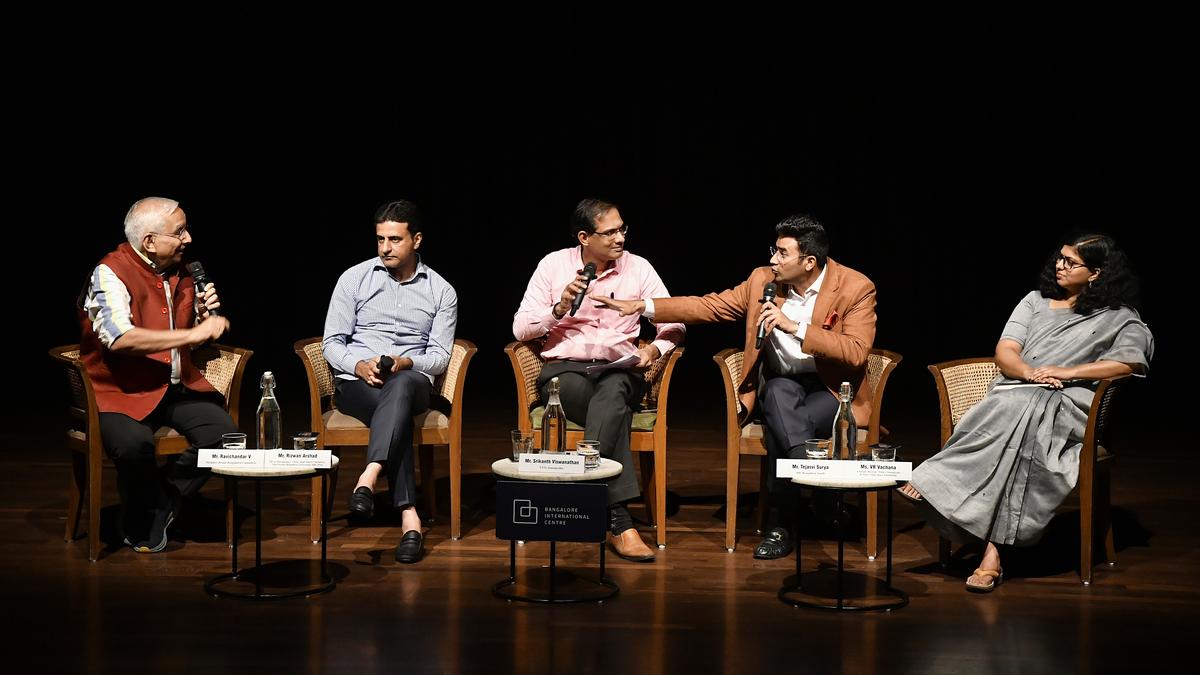
MP for Bengaluru South Tejasvi Surya, MLA for Shivajinagar Rizwan Arshad, Brand Bengaluru Committee member V. Ravichandar, and associate director of Policy, Janaagraha, and Jana Urban Space Foundation V.R. Vachana, during a panel discussion in Bengaluru on Saturday.
| Photo Credit: ALLEN EGENUSE J.
Amid ongoing debate over whether Bengaluru’s new Greater Bengaluru Governance (GBG) Act will deliver better governance for the city, MP for Bengaluru South Tejasvi Surya said the act stands for ‘maximum government, minimum governance,’ while MLA for Shivajinagar Rizwan Arshad, who was also the chairman of the Joint Review Committee on Greater Bengaluru Authority (GBA), defended it as ‘a long overdue reform to a failed civic system.’
Speaking at a panel discussion hosted by Janaagraha and the Bangalore International Centre (BIC) on ‘Can the GBG Act deliver for Bengaluru?’ on Saturday, Mr. Surya argued that all powers meant to be decentralised are now concentrated with the Chief Minister and Deputy Chief Minister. Mr. Arshad, however, said the BBMP system had collapsed under its own weight and required fundamental restructuring.
Mr. Surya argrued that the GBA, instead of devolving power to citizens, has added another bureaucratic layer. “This is decentralisation in the dark. We’ve gone from one powerless ceremonial mayor to five powerless ceremonial commissioners. Ward committees remain toothless, and parastatals continue to be controlled by the State. It gives us new names, not new powers,” he said.
Devolving resources
Mr. Surya added that the GBG Act does not adequately devolve finances or political authority to the new corporations. “The South and East may have higher tax revenues, but the system creates five corporations competing for limited resources. The core problem of centralisation remains unresolved,” he said.
Mr. Arshad, countering this, pointed out that the reforms were driven by necessity. “The BBMP system failed Bengaluru. It was opaque and unable to deliver basic services. This restructuring brings decision-making closer to citizens,” he said.
He pointed out to the financial powers devolved under the Act, noting that corporation councils can now approve works up to ₹10 crore, standing committees up to ₹5 crore, and commissioners up to ₹3 crore. “Each corporation is autonomous and accountable. The new ward committees are selected through a drawing system that includes women, RWAs and NGOs. We have widened representation and involvement,” Mr. Arshad said.
Mr. Arshad also defended the GBA’s coordination mechanism, saying that bringing multiple agencies under one framework would improve accountability. Earlier more than a dozen parastatal agencies worked in silos, but now, they are required to meet regularly under the Chief Minister to plan and coordinate.
Mr. Surya, however, said the Act reflected a deeper political hesitation to devolve real power. “There is a serious unwillingness to decentralise authority in a city that drives the State’s political economy. If you take away Bengaluru, there’s little left of Karnataka’s economic base and that is exactly why those in power are reluctant to share control,” he said.
Focus on other cities
“The Chief Minister’s focus should be on strengthening other cities like Raichur, Mangaluru and Yadgir rather than micromanaging Bengaluru and potholes. Chief Minister Siddaramaiah should not be aspiring to do the mayor’s job, and MLAs should not be doing councillors’ work,” he said.
The panel discussion also included V. Ravichandar, Civic Evangelist and member of Brand Bengaluru Committee and V.R. Vachana, Associate Director, Policy, Janaagraha and Jana Urban Space Foundation.
‘Net positive’
During the discussion, Ms. Vachana said the Act was ‘net positive’ but fell short in critical areas. “The intent is right, but the structure is unclear. The GBA still overlaps with the BDA and other agencies. Functional clarity, predictable fiscal transfers, and exclusive powers for city corporations are missing. The planning and metropolitan jurisdictions also do not fully align,” she said.
Mr. Ravichandar said that with GBA, things are finally now in the implementation stage and have potential to reform through a directly elected mayor. He also requested Mr. Surya to move a constitutional amendment to set up a third-tier government as an MP, to which Mr. Surya agreed and said that everyone must come together and draft a private members bill to propose comprehensive amendments, which he promised to move in the next Parliament session.
Published – October 11, 2025 10:05 pm IST




