


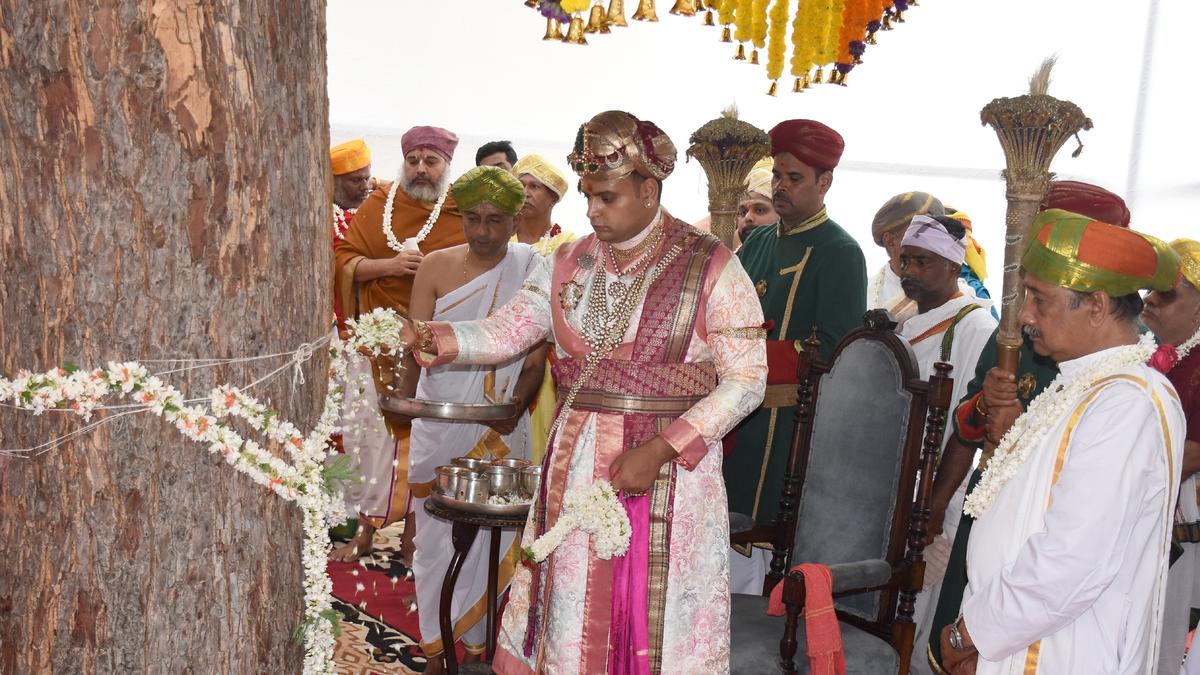
Scion of the ertstwhile royal family of Mysore Yaduveer Krishnadatta Chamaraja Wadiyar performing Banni Puja at the Bhuvaneshwari temple to mark Vijayadashmi, in Mysuru on Thursday.
| Photo Credit: M.A. SRIRAM
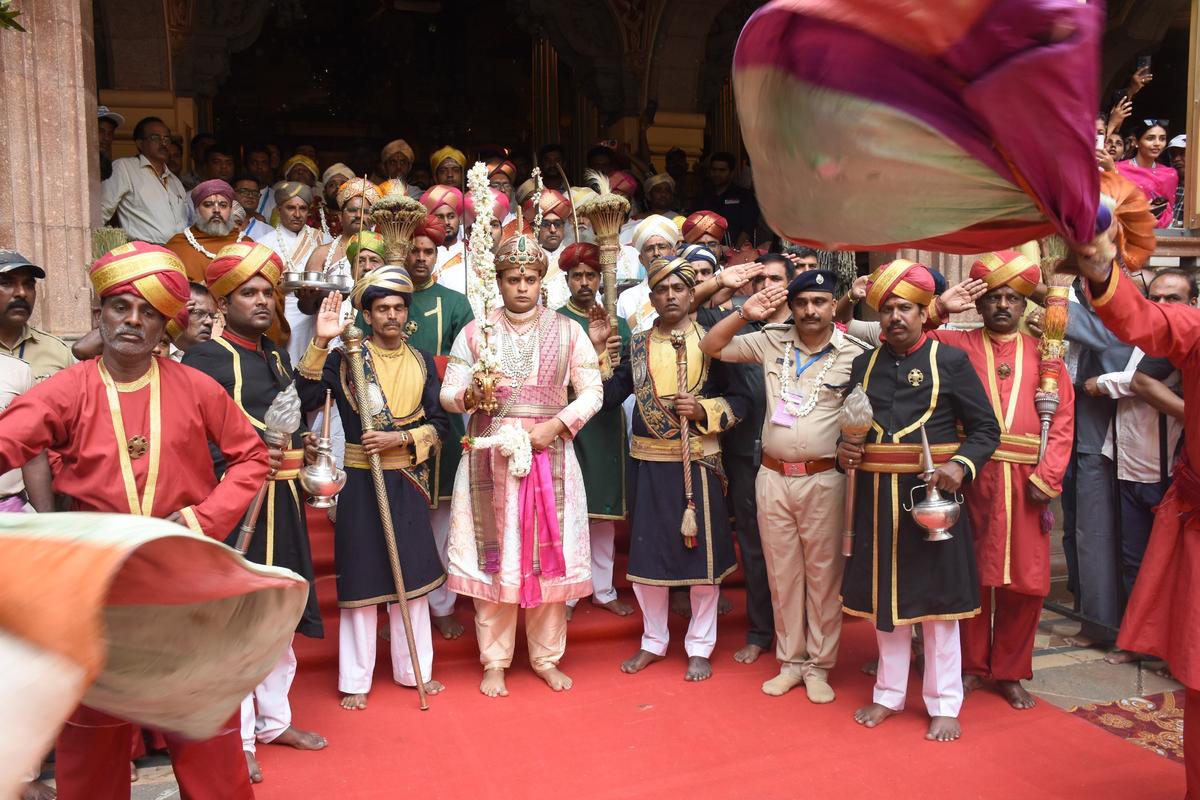
Yaduveer Krishnadatta Chamaraja Wadiyar taking part in ceremonial events that were held as part of Vijayadashmi by the Wadiyars, in Mysuru on Thursday.
| Photo Credit:
M.A. SRIRAM
The Dasara of the Wadiyars which infuses a touch of royal sheen to the Naada Habba, and is marked by religious rites and rituals, concluded on the palace premises on Thursday.
Unlike the State-sponsored festival, which is more of cultural events and sports, the Navaratri, as celebrated by the Wadiyars, entails rigorous observance of religious rites as prescribed in sacred texts under the supervision of trained priests.
A tradition whose origins have a hoary past, the Wadiyars of Mysuru began celebrating Navaratri from 1610 CE when Raja Wadiyar ascended the throne at Srirangapatna.
He inherited the practices of the rulers of Vijayanagara empire and it was continued by Mummadi Krishnaraja Wadiyar after the 4th Anglo-Mysuru war in 1799 and shifting of the capital to the present city. Hence, historians aver that Mysuru Dasara as celebrated by the Wadiyars has a history of at least 415 years.
The scion of the erstwhile royal family and MP for Mysuru Yaduveer Krishnadatta Chamaraja Wadiyar conducted the religious rites and rituals over the last 10 days, completing with homas and propitiating of various deities, invoking Durga, performing abhishekas, presiding over khas durbar, ascending the throne etc., amidst chanting of hymns and rendering of ‘Kayo Sri Gowri’, which was the official anthem of the princely Mysore State.
The last day ceremonies also included watching the Vajra Muhsti Kalaga, going in a procession to Bhuvaneshwari Temple for worship of the Banni tree which symbolised the victory procession of a bygone era. Adding to the royal grandeur was the inclusion of the caparisoned elephants, horses and cows, apart from the retinue of palace staff clad in traditional attire, who were part of the procession. An ensemble of musicians playing devotional numbers added to the solemnity and grace of the occasion.
Dasara in Mysore: Its Origins and Significance authored by C. Hayavadhana Rao and published in 1936 delves deep into the history and origins of the festival and mentions of an elaborate description of Dasara as celebrated by Kanthirava Narasaraja Wadiyar in 1647. The account also refers to beautification of the capital, the worship of the deity in the royal household, the programme of the king’s durbar during the nine days and the State procession on the 10th day, most of which are followed in present times.
The grandeur of Dasara as celebrated during the regime of Nalwadi Krishnaraja Wadiyar (1902-1940) was its apogee and it has been captured in the Dasara murals at the ceremonial hall or the Kalayana Mantapa in the Amba Vilas Palace.
The public or the social face of Dasara as celebrated by the Wadiyars was the durbar and the Vijayadashami procession till late 1960s. But in the present times, it is the religious aspects that has been inherited and passed onto posterity ensuring continuation of a hoary tradition. Of the social side, khas durbar is merely symbolic as the Maharajas have ceased to exist, and in the present times the State-sponsored Jamboo Savari is renowned as the Vijayadashmi procession.
But not withstanding the changes, the Wadiyars, through their patronage of art and culture over four centuries, have bestowed Mysuru Dasara a distinct cultural identity and bequeathed a legacy that finds expression in the celebrations every year.
Published – October 02, 2025 08:18 pm IST



