

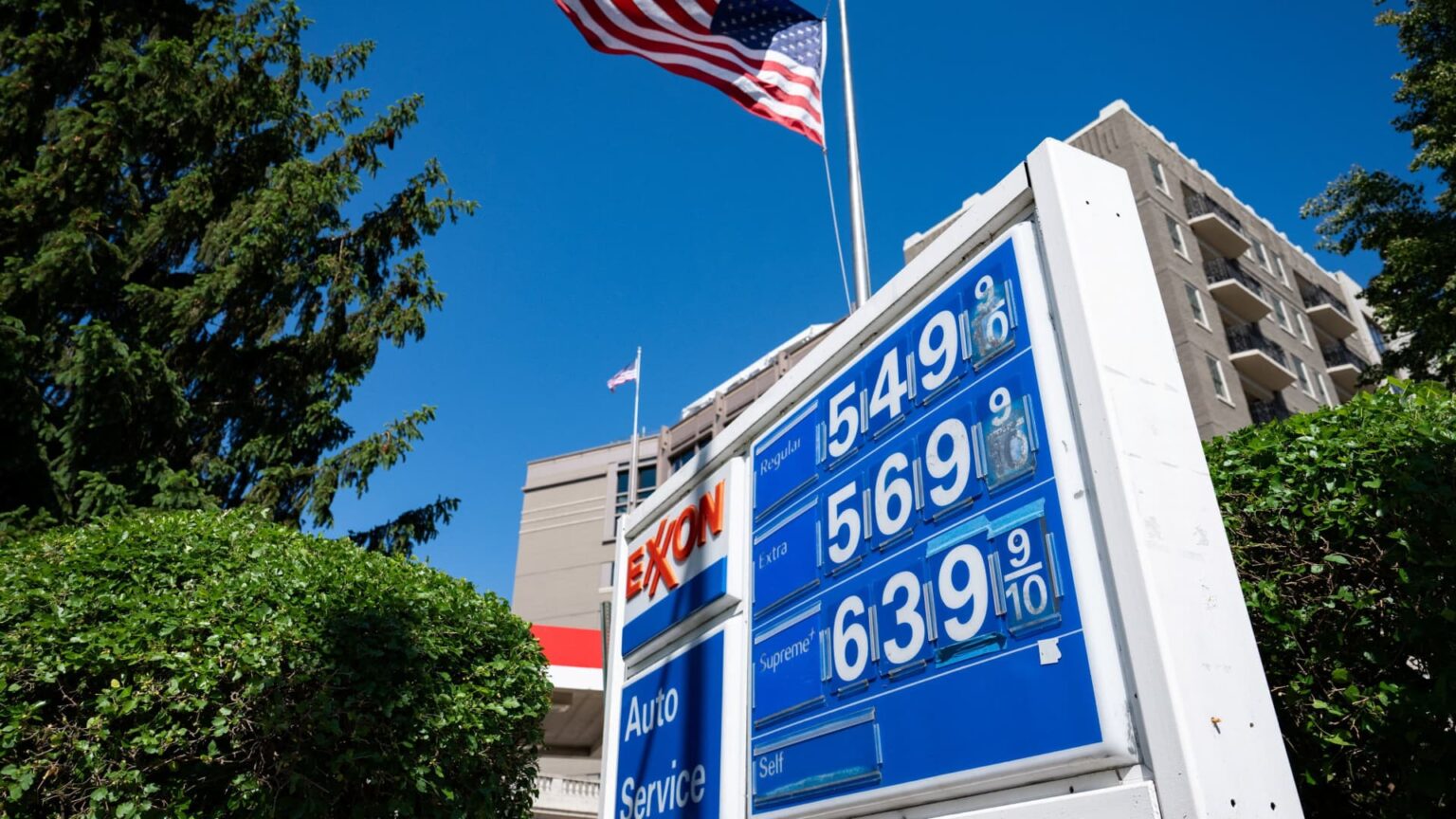

A gas station sign displays prices in Washington, D.C., U.S., May 1, 2026.
Annabelle Gordon | Reuters
Lower-income consumers are compensating for higher gas prices by buying less while those in higher income brackets haven’t changed their behavior much at all despite soaring costs, according to research released Wednesday by the Federal Reserve of New York.
In fact, during the March energy price spike, households earning less than $40,000 a year increased gas spending by the least of all income groups. The group accelerated nominal gas spending by just 12%, the product of cutting consumption by 7%, according to a blog post by New York Fed researchers.
By comparison, high-income households, defined as those earning more than $125,000 a year, raised their spending by 19%, as they only cut real gas consumption by 1%.
“Thus, the K-shaped consumption pattern in both nominal and real gasoline spending was strongly evident in March 2026,” researchers Rajashri Chakrabarti, Thu Pham, Beck Pierce, and Maxim Pinkovskiy said in the post.
The so-called K-shaped economy has been a byproduct of the post-Covid period. Economists say those at the lower end of the spectrum have seen significantly less growth than their wealthier peers, who have benefited from a surge in asset values, such as stocks and real estate.
Inflation also has been a major contributor to the disparity in growth rates.

Consumer prices have risen about 28% since March 2020, when the pandemic was first declared, according to Bureau of Labor Statistics data. At the same time, average hourly earnings have grown only 30%, meaning wages have been essentially flat.
Fed Chair Jerome Powell has pointed out repeatedly that the current era of inflation has had a much larger impact on those least able to afford higher prices. Prices have been running ahead of the Fed’s 2% inflation target for the past five years.
The latest Fed research shows the disparate impacts of the K-shaped economy have been felt significantly during the run-up in prices at the pump. Energy prices have climbed 56% in the post-pandemic economy. For the March period, after the start of the Iran war, prices at the pump rose nearly a dollar a gallon, to an average $3.81, and are now at $4.30, according to the Energy Information Administration.
“With the current energy price shock, a K-shaped pattern in gasoline consumption has opened up much more than before,” the New York Fed paper said.
“Higher-income households have reduced real gas consumption only modestly and increased gasoline spending considerably compared with 2023. In contrast, lower-income households increased spending by much less and decreased real consumption by much more, potentially by carpooling or substituting to public transit where available,” the researchers added.
The study further found that the trend is similar directionally to the energy spike when Russia invaded Ukraine in 2022, “even though the gap in consumption trends during the current episode is quantitatively larger.”
The study used a panel of 2,000 respondents and found that gasoline spending overall increased by 15% in March.