


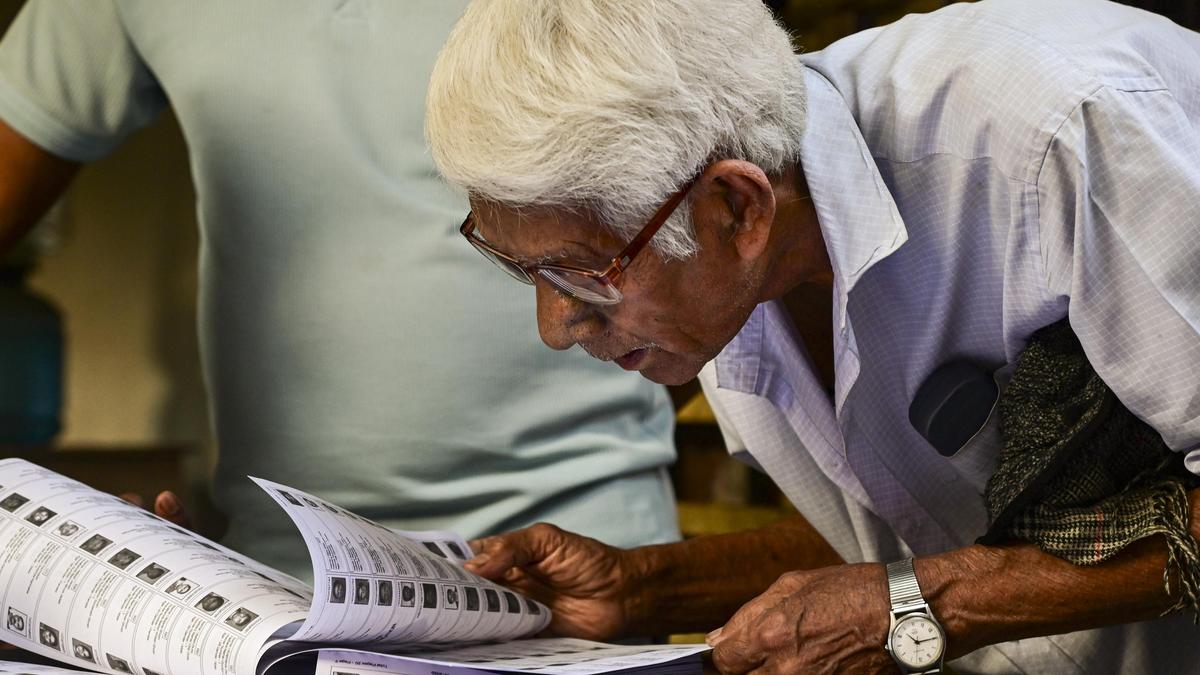
A voter checks his name on the electoral roll after the Election Commission published West Bengal’s post-SIR voter list in Kolkata on February 28
| Photo Credit: PTI
Tamil Nadu finished its single-day poll on April 23 with a record turnout of over 85%, surpassing the earlier best of 78.29% in 2011 and a huge 12% higher than the 73.63% turnout in the last Assembly election. The base for the turnout was a trimmed-down electorate of 5.67 crore. While factoring in the high-octane political contest and mobilisation, the turnout rate would arguably be lower if the State electoral roll had retained “ghost electors” — the dead, shifted, absent, and duplicate names — that existed as of October 2025, when the special intensive revision (SIR) kicked in. Similar trend is seen in West Bengal, with a turnout of 92.88% in the first phase. Assam, Puducherry, and Kerala also delivered record turnouts earlier this month, all following the pattern of shrunken electorates. Therein lies a story.
In the run-up to its 75th Foundation Day on January 25 last year, also called the National Voters’ Day, the Election Commission (EC) announced a grand celebration ‘in light of the fact that India’s total electorate is approaching the 100-crore mark.’ That was a well-made observation by available arithmetic. The electoral database then stood at 99.1 crore, including 21.7 crore young voters aged 18-29. The steadily rising electoral gender ratio had further jumped from 948 in 2024 to 954. With an estimated population of 1.4 billion, India went into the last Lok Sabha elections with 96.88 crore registered voters. International observers have long watched in awe the elephantine Indian electorate, with the United States a distant second and countries such as Brazil and Indonesia trailing far behind. As the SIR completed its second phase earlier this month, India’s grand list of electors appears poised to be significantly reversing its advance, though it may still be celebrated for other reasons.
Published – April 27, 2026 08:30 am IST



