


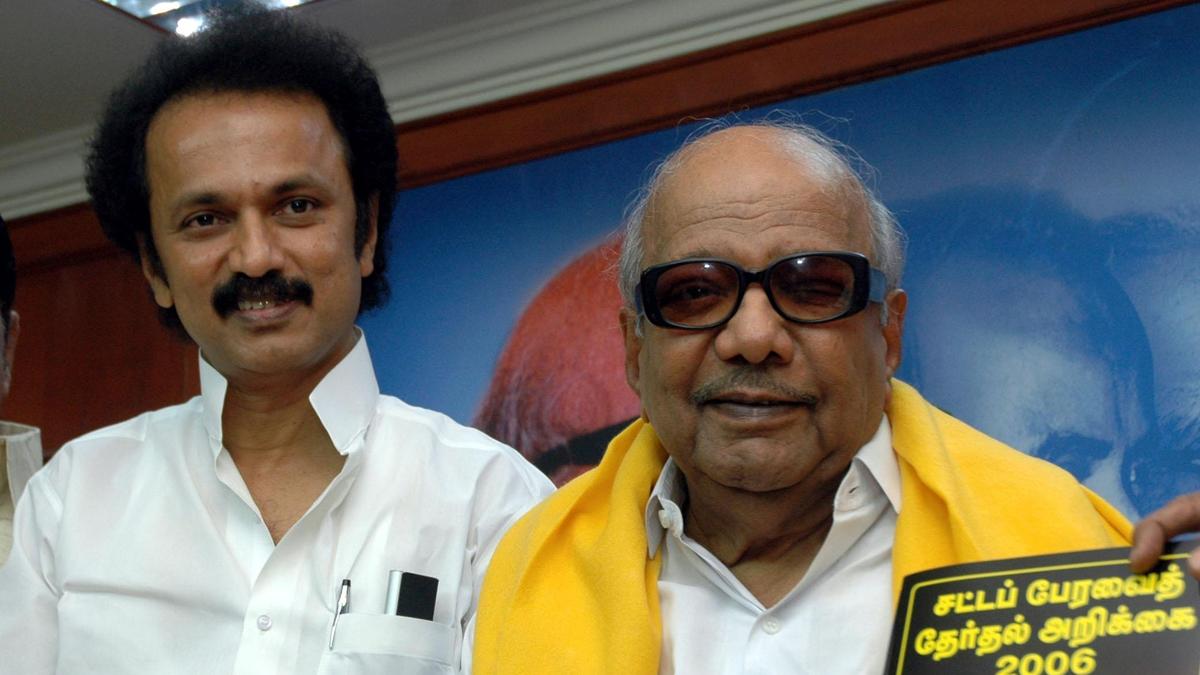
Then DMK president M. Karunanidhi and leader M.K. Stalin at the release of the party’s election manifesto for the 2006 Tamil Nadu Assembly election, at Anna Arivalayam, in March 2006
| Photo Credit: M. Vedhan
The preparation of election manifestoes has, all along, been viewed as a ritual that every political party has to go through at the time of elections.
However, this perception was demolished during the 2006 Assembly election when the Dravida Munnetra Kazhagam (DMK)’s manifesto became the talking point. Then Union Finance Minister P. Chidambaram had termed the DMK’s manifesto the “hero” of the poll, a perception that DMK chief M. Karunanidhi, too, had endorsed.

That the DMK first tasted power in the 1967 Assembly election could be ascribed to an enticing promise it had made to the people. At a time when the electors were reeling under the problem of acute shortage of rice, the Dravidian organisation had come up with an assurance that in the event of capturing power, it would supply three measures of rice at ₹1. Naturally, this became an instant hit among the public. Even though doubts were expressed by critics of the DMK, including leaders of the then ruling Congress party, about the feasibility of such a scheme, the reply of the proponents of the rice scheme was this: “Three measures is the ideal. At least, one measure is a sure deal!”

The reason for the 2006 manifesto of the DMK to be called the “hero” was that the document had certain offers to make, which no one could brush aside easily. The offers included the supply of rice through the public distribution system at ₹2 a kg, free distribution of colour television sets and cooking gas stoves with domestic gas connections, waiver of all cooperative loans to farmers, and two acres of free land for the landless.
Even though the manifesto had prompted AIADMK chief and Chief Minister Jayalalithaa to come up with the proposal of providing 10 kg free rice, along with another 10 kg rice at ₹3.5 per kg, and the Desiya Murpokku Dravida Kazhagam (DMDK) to announce a scheme of 15 kg free rice every month, it was only the DMK that beat others in the numbers game. What should not go unnoticed is that the DMK then had a formidable alliance – the Congress, two Left parties, the Pattali Makkal Katchi, and a few other minor parties.
In every other subsequent election, the winner had come up with a scheme of freebies or two that the runner-up did not, or was seen duplicating the other’s proposal. For example, the AIADMK, in 2011, had promised people of implementing the free distribution of a mixie, a table fan, and a wet grinder. Five years later, 100 units of electricity would be given free for the domestic category. In 2021, it was the turn of the DMK to unvevil the scheme of monthly cash support to women.
A host of other factors, especially the arithmetic strength, influence the electoral prospects of any political coalition. But when assurances that form part of a manifesto get the attention of the public, they naturally add more vigour to the formation concerned. However, it is too simplistic to arrive at the conclusion that the manifesto alone makes or mars the poll prospects of any party.
Published – March 27, 2026 05:42 pm IST



