


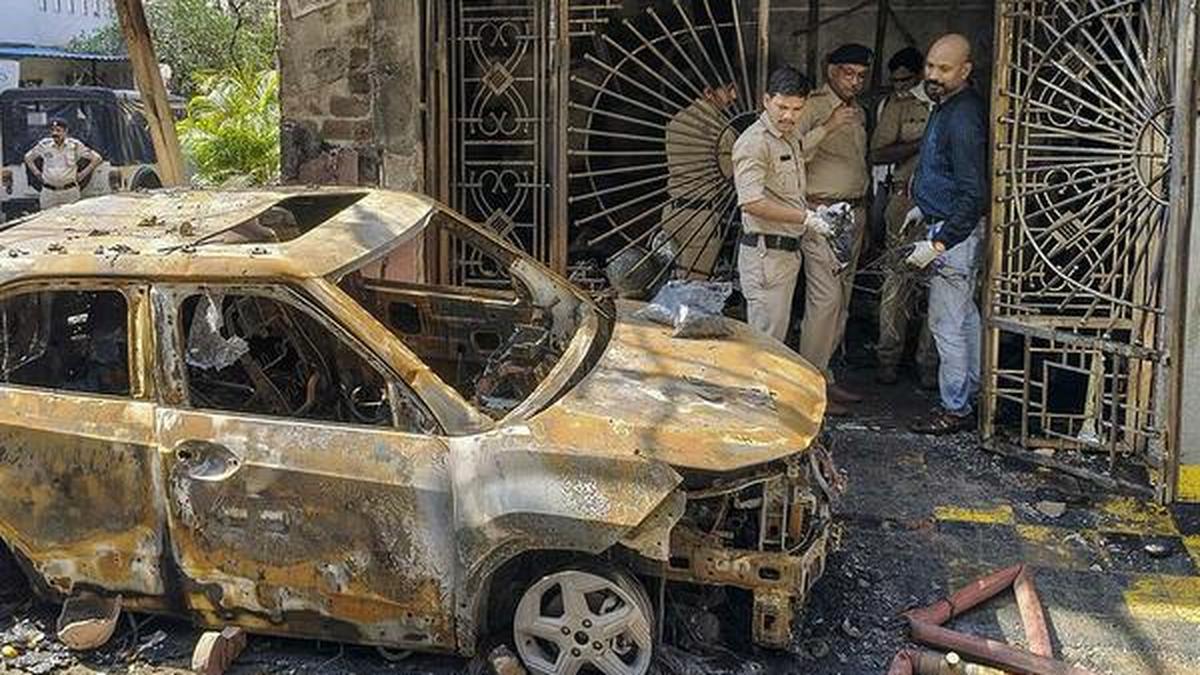
Policemen stand near the wreckage of a car that caught fire, subsequently engulfing a house nearby, in Indore, March 18, 2026.
| Photo Credit: PTI
The story so far: A fire tore through a house in Indore on March 18, killing eight people including two children. An electric vehicle (EV) charging point outside the house appeared to have sparked the blaze. An investigation is underway.
Are EV batteries safe?
Nearly every EV on the road today runs on lithium-ion batteries, which use the same chemistry powering millions of smartphones and laptops. They pack more energy than lead-acid batteries and are generally safe when managed well.
A common cause of EV battery fires is an event called a thermal runaway. A lithium-ion battery packs thousands of cells tightly together, each generating heat as it charges and discharges.
Normally, an onboard computer called the battery management system keeps the temperature within a safe range. But if something goes wrong, one cell can overheat, causing neighbouring cells to overheat in a chain reaction that can outpace the cooling system.
This process also releases a toxic cocktail of gases, including hydrogen fluoride, in a flammable vapour that eases the ‘path’ to a fire.
What causes thermal runaway?
Manufacturers protect battery packs by packing them inside shells of reinforced steel or aluminium. However, a hard impact — like from a strong impact to the undercarriage — can deform the casing and puncture or deform the cells inside, leading to a short circuit.
Charging a battery beyond its designed capacity can force charge to build up in the ‘wrong’ places inside cells. Reputable EV manufacturers include safeguards in their charging systems to prevent this but third-party or damaged chargers may not pay attention to these limits. And regularly changing a battery overnight with such a charger can increase the risk.
As the battery expands and contracts during use, rare manufacturing defects like a small protrusion of metal can bring the positive and negative electrodes in touch, causing an enormous current to flow between them. This releases heat that then spreads through the pack. Extension cords or domestic wiring in old buildings can also overheat when they can’t handle the sustained current.
Do external conditions matter?
In hot weather, like during summers in India, the cooling system can struggle to shed heat. Parking an EV in direct sunlight for long periods or charging it immediately after a long drive can add to the thermal stress.
As batteries age, their internal components also degrade. So users who ignore warning lights or skip inspections can miss early signs of swelling or chemical decomposition.
Flooding also threatens batteries. The contaminated water after heavy rains can infiltrate a battery pack and cause short circuits. Several EV fires have occurred in the days after vehicles were submerged in floodwater.
EVs are not uniquely dangerous. Petrol cars catch fire too, and more often, as they carry flammable fuel next to an engine running at a high temperature. The difference is that EV battery fires burn hotter, spread faster, and are harder to put out (as the battery releases oxygen as it burns). Firefighters often have to use lots of water or specialised fire blankets to douse the source and cool it down.
The Indore incident was made worse by the fact that LPG cylinders were stored in the building, a sports bike was parked inside, and electronic door locks jammed when the power failed.
What are industry, users doing?
Most EVs today have channels alongside the cells filled with a coolant that absorbs their heat and dissipates it into the air. Scientists are currently developing a new form of cooling where the coolant evaporates as it absorbs heat and releases it into the air, improving heat transfer and handling temperature spikes better.
Manufacturers are also exploring batteries that use a solid electrolyte rather than the current liquid, reducing the risk of a thermal runaway, while refining firewalls inside existing designs so that if one cell fails, the fire doesn’t spread.
Users can also take precautions by using the charger that came with the vehicle or one certified by the manufacturer, avoiding routine unattended charging, ensuring home electrical systems meet the necessary standards for high-power appliances, and having EV batteries inspected after any significant impact. Since heat is a common trigger, experts have recommended letting batteries cool after a long drive before charging and also keeping the charging area clear.
Finally, the Bureau of Indian Standards released updated safety norms for EV batteries in 2023 after a spate of fires the previous year prompted a government review. As part of its AIS-156 standard, the Automotive Research Association of India also requires tests to check how heat propagates in a battery and requires battery packs to give a vehicle’s users at least five minutes to escape before a fire.
Published – March 19, 2026 04:04 pm IST



