


:
On the afternoon of January 31, 1976, Prime Minister Indira Gandhi convened a meeting of the Union Cabinet. The Internal Emergency proclaimed seven months ago, severely curtailing political and civil liberties in India, was still in force. Earlier that day, Tamil Nadu Governor K.K. Shah – who once even jocularly remarked his initials stood for Kalaignar Karunanidhi – had sent a lengthy report to the Union government.
Shah, in his report, said he was satisfied that a situation had arisen in which the government of the State could no longer be carried on in accordance with the provisions of the Constitution. The government was headed by Chief Minister M. Karunanidhi.
The Cabinet recommended the acceptance of Shah’s report. That night, President Fakhruddin Ali Ahmed issued a Proclamation under Article 356 of the Constitution, dissolving the Tamil Nadu Assembly and placing the State under President’s Rule. The State government headed by Karunanidhi was “deemed to have vacated office” following the Presidential Proclamation.
Governor’s report
“This is the first time that Tamil Nadu has been brought under President’s Rule. Though the five-year term of the State Assembly was due to expire on March 21, the Centre has taken this action to dissolve it because of the serious situation that has arisen in the State in terms of the Governor’s report,” The Hindu’s New Delhi Correspondent G.K. Reddy reported on the front page of its edition dated February 1, 1976.
“The Governor is understood to have reported that the DMK government had indulged in serious acts of maladministration, corruption and misuse of power for partisan ends, setting at naught all canons of justice and equity, which were the hallmark of any democratic administration. He also complained that the DMK administration had disregarded the instructions of the Central government in relation to the Emergency, while misusing the Emergency powers for its own purposes. Under the guise of demanding greater autonomy, he pointed out that the DMK had been encouraging secessionist activities in the State,” the report said.
Soon, the Commissioner of Police, Madras, issued a prohibitory order banning meetings, demonstrations, processions and assembly in the capital city for a period of 14 days. The order would not apply to functions relating to worship, marriage or funeral. The Home Guards were called out.
MGR hails move
M.G. Ramachandran, the general secretary of the ADMK (as AIADMK was known then) hailed the “courageous” action of the Prime Minister in dismissing the “corrupt DMK Government.” “Our party would support the Prime Minister in any of her actions such as this to safeguard democracy in the country,” he said in a press statement. He also urged the Centre to institute a Commission of Inquiry into the charges of corruption.
In Vellore, on hearing about the government’s dismissal, ADMK MP G. Viswanathan (now VIT chancellor) took out a procession from the party office to the Municipal office and garlanded the statue of former Chief Minister C.N. Annadurai and distributed sweets to the public.
Karunanidhi, however, said the people of Tamil Nadu were staunch believers in Gandhian and Annadurai’s ideals. He urged them to maintain peace. He thanked the people and government officials for the cooperation extended to the DMK government during the past nine years.
One-man commission
On February 3, the Centre announced the appointment of Justice R.S. Sarkaria, a judge of the Supreme Court, as one-man Commission of Inquiry to inquire into the allegations against Karunanidhi and some members of the erstwhile DMK Ministry.
The Central government appointed P.K. Dave, Secretary of the Ministry of Petroleum, and R.V. Subramanian, Secretary of the Department of Power in the Ministry of Energy, as Advisers to the Governor in administering the State.
“The general expectation in Delhi is that a spell of President’s Rule in Tamil Nadu would do a lot of good by reviving its old reputation for efficient administration. The choice of the two Advisers clearly indicates the Centre’s desire to concentrate on the implementation of the economic programmes, while maintaining law and order in the State,” a report in The Hindu said.
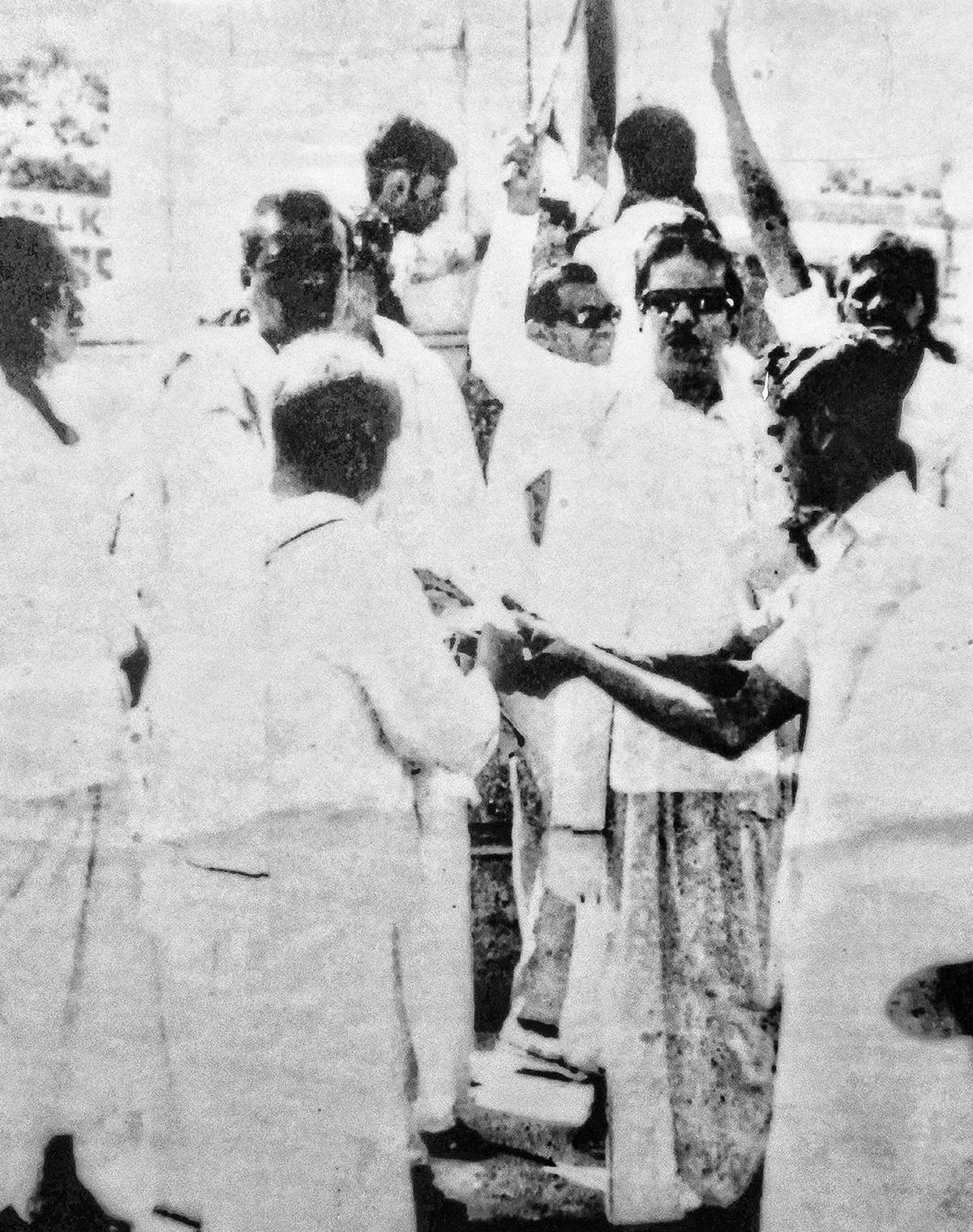
M. Karunanidhi staging a protest against the Emergency rule, on Mount Road in Madras (now Chennai).
| Photo Credit:
VEDHAN M.
It said, according to reports reaching Delhi, the two Advisers took over in Madras soon after the President signed the Proclamation. “They lost no time in coming to grips with the law and order situation to ensure a smooth switch over from the DMK administration to President’s Rule. The Centre has taken all possible precautions to maintain peace and tranquility in the State, which is the primary responsibility of any government,” it said.
‘Brahmin flavour’
Incidentally, some months later, the then Rajya Sabha Deputy Chairman, Godey Murahari (Congress), had told a senior U.S. diplomat there was an increasing “Brahmin Flavour” to the State government under the President’s rule.
According to a Kissinger-era WikiLeaks’ U.S. cable — that became public in April 2013 — Murahari, who made several trips to Tamil Nadu, had warned then Congress president D.K. Barooah and Union Minister of State for Home Om Mehta about this. “They agreed that it had been an error to send two Brahmin advisers,” Murahari had told the diplomat, referring to Dave and Subramanian. Murahari had claimed due to reshuffling of IAS officers, 12 of the 14 Government Secretaries and 80 per cent of District Collectors were Brahmins. He felt Subramaniam was “consciously working in this direction.” Even local Congress (R) leaders were disgruntled over this.
The U.S. Consul General, while acknowledging the tilt in favour of Brahmin officers, had, however, informed the American Embassy in New Delhi that Murahari’s views could not be accepted “in total”.
Published – January 31, 2026 05:00 am IST



