


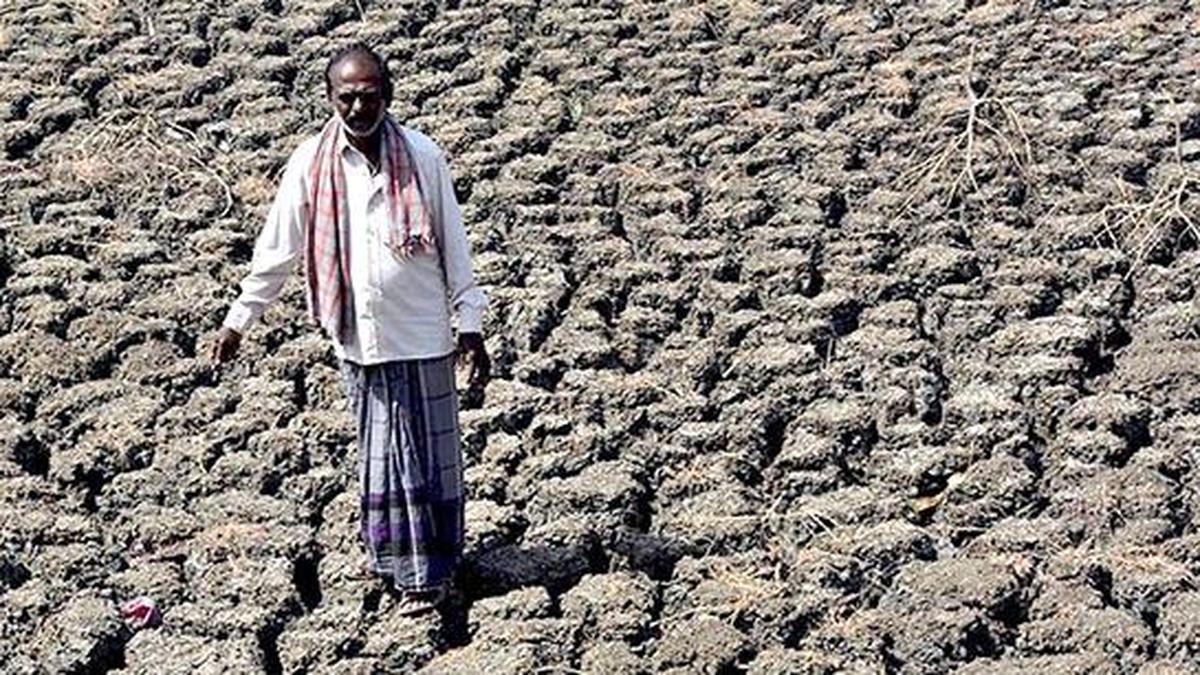
A farmer showing his land to the Drought Assessment Team in Belagavi district on 27th February, 2019.
| Photo Credit: P. K. Badige
Karnataka, which incurred a cumulative loss of over ₹1.22 lakh crore due to natural disasters between 2015 and 2021, has prepared a roadmap and set 2030 as the time frame to cut such losses by 75%.
The Karnataka State Disaster Management Authority (KSDMA) has prepared the road map for a ‘’disaster-resilient Karnataka’’ to reduce mortalities, economic loss and casualties.
Vulnerability profile
The preparation of the Karnataka State Disaster Risk Reduction (KSDRR) Road Map 2025-30 entailed drawing up a vulnerability profile as per which 80% of the State’s geographical area is prone to drought, 22% is prone to moderate earthquake and 24% of the geographical area in the State was prone to cyclone, heavy winds etc. Human-induced disasters like road and industrial accidents too are considered for risk assessment and disaster mitigation.

The KSDRR report, released recently, has set short, medium and long-term plans and stipulates 2029-30 as the year by which the economic loss, infrastructure damage, human and animal mortality and casualties, were to be reduced by 75% of the baseline established in 2026.
The study, which went into the preparation of the KSDRR Road Map, points out that not only does the State experience disasters of various types and intensities but estimates that nearly 61.10 million people are at risk.

There is hardly any economic sector which has not been affected by the frequent occurrence of natural disasters but the brunt of it is borne by agriculture.
While the cumulative loss across various sectors has been pegged at over ₹ 1.22 lakh crore, the loss between 2015-2021 in agriculture was pegged at ₹ 1.02 lakh crore. The crop loss affected over 1.84 lakh hectares while the loss in horticulture was pegged at ₹10102.81 crore.
Road infrastructure damages
Afte agriculture, it is the damage to roads which was the highest and affected 1.12 lakh km of roads during the assessment period and the loss incurred was pegged at ₹17,296 crore.
A study of drought affected districts indicated that between 2001 and 2022, Kalaburagi, Gadag, Davangere, Belagavi were afflicted by drought 14 times while a majority of the remaining districts reported drought on at least 13 occasions.
Climate change impact
The report was also a pointer to the extremities of nature and the impact of climate change in many districts in recent decades, as prolonged spells of drought were followed by severe floods. This included the districts of Raichur, Ballari, Kalaburgi, Yadgir, Bidar etc.
The socio-economic impact of natural disasters on various departments — from agriculture to education and tourism — has been studied in detail and broad action plans suggested for mitigation.
Timeline for targets
The road map proposes a department-wise action plan for effective and timely response and better recovery in case of any natural or man-made disaster. It stipulates that by 2026, all departments, districts and gram panchayats should prepare disaster management plans with baseline data of the year 2025-26.
During 2027-28, the State will collaborate with various stakeholders for technology transfer, knowledge management, etc. for risk reduction.
Published – December 14, 2025 05:51 pm IST



