


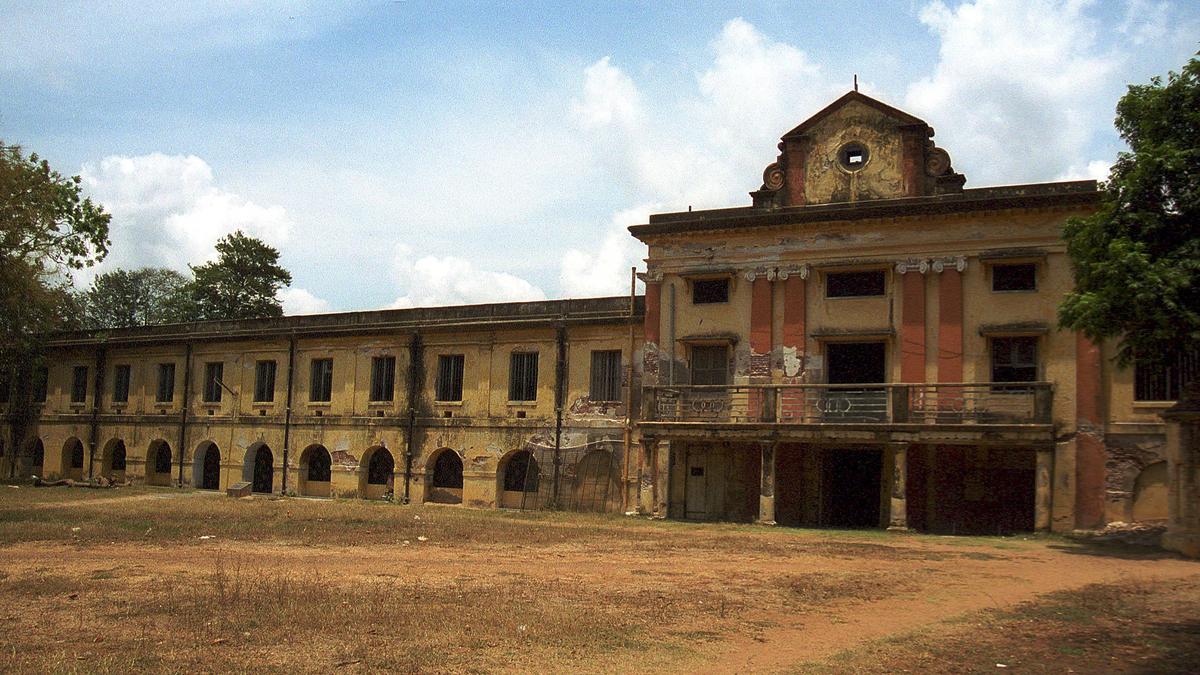
St. George’s Anglo Indian School in Chennai was established in 1715 by Rev. William Stevenson, the chaplain of St. Mary’s Church, Fort St. George. File
| Photo Credit: S. Thanthoni
In 1872, the Church of Scotland Mission, which had set up several schools in the Madras Presidency, had recorded how a couple of schools were shut down over mounting debts. It also pointed to the lack of female teachers in the other institutions that were still running. William Stevenson, the Secretary of Free Church of Scotland Mission recorded this in an April 10, 1872 letter addressed to J.C. Loch, the President of the Municipal Commission. This letter found a citation in the Results of the Educational Census of Madras 1871 published subsequently.
Sharing statistics about the performance of the Free Church of Scotland Mission’s schools in Madras – the first of which was established 35 years earlier, he noted that definite records had been maintained only during the previous 11 years. The increase in the student numbers on rolls in 1871-72 was only about 30 per cent as compared to the record of 1860-61.
Stevenson noted with concern that the Triplicane Boys and Girls Schools were given up in 1866. “The mission was compelled to do this, as it had fallen into debt,” he wrote. In the early years of the Mission’s history, the grand source of income was subscriptions given by friends in India. “The sum received in this way now is almost inappreciable. As much or rather more is sent from Scotland than was in former days, but now in India fees and Government grants have taken the place of voluntary contributions. The time of difficulty was when the one was failing and the other had not yet supplied the want,” he pointed out.

In later years, some of the other schools that were up and running had witnessed a vast increase in the amount collected from fees. “Perhaps the Rupees 1,440 collected last year in the girls’ schools is a sign of as much progress as the Rupees 12,000 collected in the two boys’ schools. In both cases, testimony is borne to the high position the schools occupy in Madras, and to the growing appreciation of education among the natives,” Stevenson said.
While notable progress was made in the area of female education, there was concern over the lack of availability of female teachers to tutor the girls. “One of the great wants in connexion (as spelt in the letter) with the female education is a supply of competent female teachers. To meet this want, there is a Normal class connected with two of our girls’ schools – the boarding school and the day school. From these 12 native Christian young women went up to the last Teachers’ Examination and gained certificates. When such efficient female teachers shall have supplanted the male teachers in girls’ schools, a great improvement will have been effected,” he said.
At the same time, he mentioned that although the Parcherry school is put down amongst the girls’ schools, boys too were attending it. It was a mixed school for the very poorest classes. “The Chetty girls’ school is drawing out the most conservative part of the population, who have done nothing hitherto for the education of their girls,” Stevenson added.
Incidentally, under the auspices of Stevenson, schools were established at Madras (present day Chennai) and at Cuddalore.
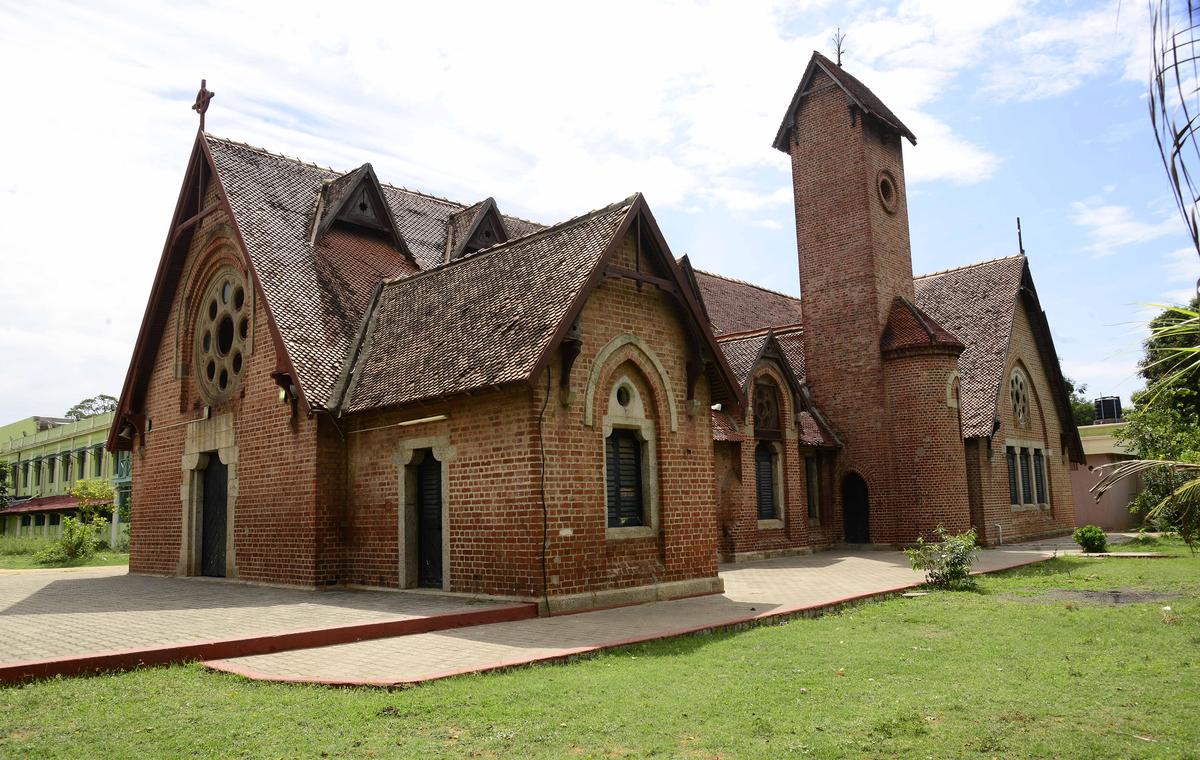
A view of St. Mary’s Chapel at St. George’s Anglo Indian School and Orphanage, the oldest English-medium school in Asia. File
| Photo Credit:
R. Ravindran
The Educational Census noted that the lack of any adequate provision for providing female teachers is now the “one great blot” on our educational system.
“It is certain that the native public have retired from the old position of antagonism to female education, but few things are more saddening in this connexion than the sight of a girls’ school whose every teacher is a man, only too frequently some old and illiterate Brahman who teaches merely for a living and has no shadow of sympathy with the work for which he is an unwilling agent. It cannot be that female education should be either really healthy or fully popular until the teachers of the girls are themselves females. Yet, with the exception of the Government Female Normal School and this training class of the Free Church Mission, absolutely nothing has been systematically done towards this great end. Even of the two named-one, the Government Female Normal School, is a mere name, without any practical value whatever,” the Census report recorded.
Published – February 04, 2026 05:30 am IST



