

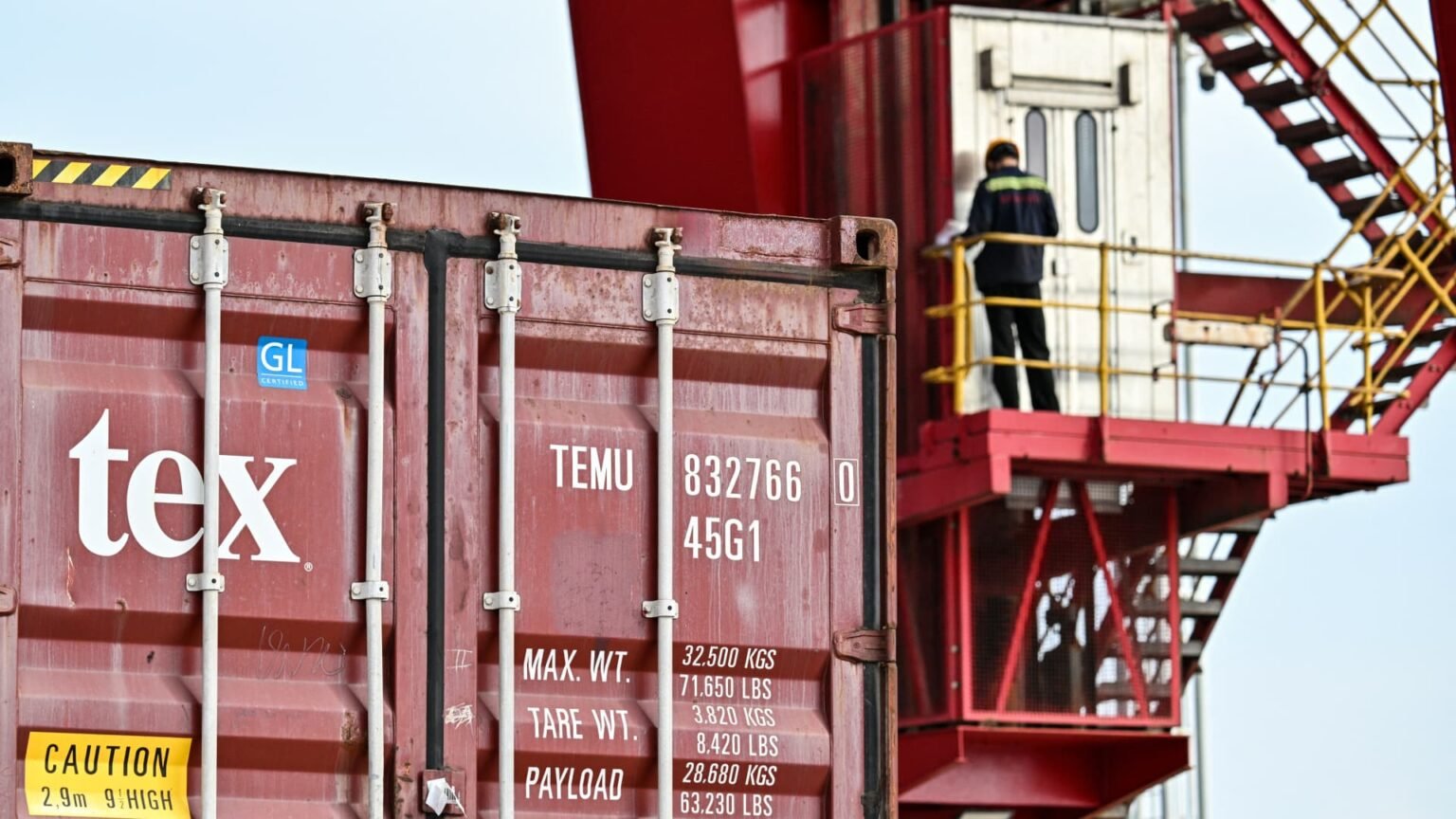

A worker is seen on a container truck at the Port of Ningbo-Zhoushan in Ningbo, in China’s eastern Zhejiang Province on September 22, 2026.
Hector Retamal | Afp | Getty Images
BEIJING — The trade deficit that escalated tensions between China and the U.S. in recent years has yet to shrink significantly, and the world’s second-largest economy faces deep challenges. But China’s efforts to build up self-sufficiency have reduced the threat to its domestic market from global trade developments.
U.S. President Donald Trump and Chinese President Xi Jinping are expected to meet this week for their second in-person summit of the year. U.S. concerns about artificial intelligence have gained prominence in the days ahead of the meeting.
But the best that businesses are hoping for is an extension of a trade truce reached last fall. Even then, tariffs have done little to dent America’s appetite for Chinese goods.
While an escalation in trade tensions last April briefly sent the U.S. trade deficit with China to its lowest level since 2017, surging demand for AI-related parts have helped send it higher again so far this year, according to China Customs data accessed through Wind Information.
And even as the U.S. has diversified away from China, it’s hard for the world to shake its dependence on the Asian country.
Reliance on China
Asia still accounts for more than 60% of U.S. imports, the same as before “Liberation Day,” pointed out Jens Eskelund, president of the European Chamber of Commerce in China.
He estimated between half and three-quarters of container traffic from China to Southeast Asia subsequently heads on to other destinations.
That’s all sped up the pace at which the world relies on China-made goods.
Eskelund said he previously expected China to account for 40% of global container exports in the year 2030 — but the milestone was reached this summer.

How did the world get here?
“Probably the China shock only really started in 2022, because I think everything was distorted by the pandemic,” Eskelund said. “China was first in the pandemic, and first out of the pandemic, and for that reason China actually could allow its exchange rate to rise, and export prices to rise.
“China could do that because China was the only game in town,” he said.
China’s real estate market began its downturn in 2022, dragging down domestic demand. Chinese companies ramped up global expansion, and exports.
“There is a direct, perfect correlation between the drop in export prices and the acceleration in export in volume terms,” Eskelund said.
U.S. tech companies’ buildout of data centers to power AI has supported demand for Chinese goods.
But think tank CF40 estimated that for the first time this year, AI-related exports fell significantly in August from a year ago.
Macquarie’s chief China economist Larry Hu last week also pointed out that the recent performance of the PHLX Semiconductor Index — which he said tends to be predictive of how China’s high-tech exports will grow in the next six months — “does not bode well for China’s export outlook over the next year.”
Still, economists don’t expect China’s policymakers to do much.
Within tech-related manufacturing, industrial robot output rose by 34.6% year-on-year in August, while smartphone output fell by 22.3%.
“Because there are always high-flying subsectors for the government to point to, policymakers do not appear to feel much urgency to introduce additional easing measures, absent a sharp deterioration in the labor market,” Goldman Sachs’ chief China economist Hui Shan said in a Sept. 20 report.
She pointed out house prices have already seen a 30% decline over a six-year timeline, typical of historical large-scale property downturns in other parts of the world. “Weak labor markets and still-falling rents are likely to prolong the downturn in many parts of China,” she added.
The number of loss-making companies is also on the rise, accounting for 24% of industrial firms in China in 2025.
Fierce competition
The economic slowdown has only pushed companies in China to compete even more fiercely with each other, and their foreign rivals.
The American Chamber of Commerce in Shanghai said this month that three-quarters of members responding to a survey saw Chinese rivals as more advanced, and that the perceived gap in product quality narrowed by 6 percentage points from last year.
For the first time since 2022, domestic competition has surpassed geopolitical tensions as the top challenge for members, the chamber said.
It’s all spilling over internationally, as European Union officials are starting to follow the U.S. in scrutiny of China-origin exports. EU Trade Commissioner Maroš Šefčovič, who urged “tangible results” from China on trade by October, is expected to travel to Beijing next month.
The European Union has the largest trade deficit with China of any economy, Eskelund pointed out.
In addition to competing through lower-cost goods, Chinese companies have also come to dominate global supply chains for critical minerals. This also supports Beijing’s self-sufficiency goals.
“There’s no sense in which China’s strategy seems to be at all dependent on actions that the rest of the world might take,” said Chad Bown, senior fellow at the U.S.-based Peterson Institute for International Economics.
It’s “this strategy of a one-way dependence of the rest of the world on China that it’s going to weaponize.”
—CNBC’s Anniek Bao contributed to this report.



