


Prime Minister Narendra Modi has shifted his official workspace to ‘Seva Teerth’, a new state-of-the-art complex near Raisina Hill, ending nearly eight decades of the PMO (Prime Minister’s Office) functioning from the colonial-era South Block.
On Friday (February 13, 2026), the Prime Minister reached the Seva Teerth Complex in a motorcade with Union ministers Manohar Lal and Jitendra Singh and top PMO officials, and inaugurated the complex. The shift came on a day that marked 95 years since the formal inauguration of New Delhi as India’s modern capital in 1931.

Here’s everything you need to know about the new Prime Minister’s Office, and it’s key characteristics.
What ‘Seva Teerth’ means?
The word “Seva” translates to “service,” while “Tirtha” signifies a sacred place or a crossing point that aids individuals in overcoming obstacles and achieving their aspirations.
Together, they transform the idea of governance, moving from ‘satta’ (power) to ‘seva’ (service) and from authority to responsibility, PTI reported, citing officials.
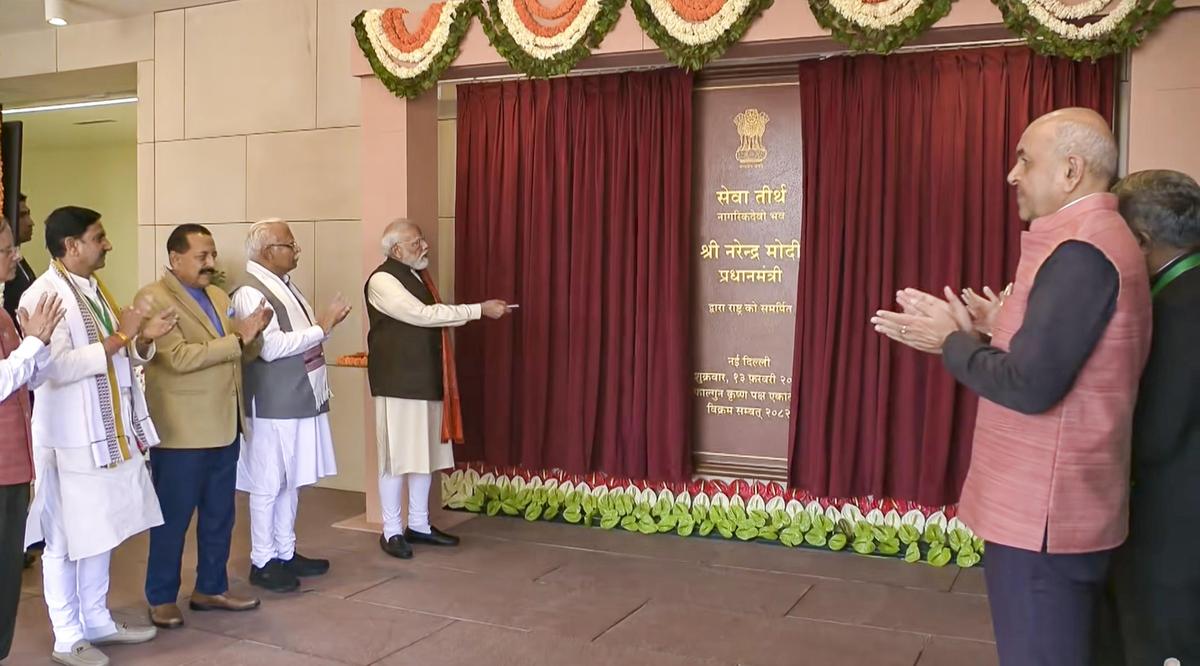
Prime Minister Narendra Modi during inauguration of the ‘Seva Teerth’, the new building of the Prime Minister’s Office, on the 95th anniversary of the national capital, in New Delhi on February 13, 2026.
| Photo Credit:
PTI
In a series of posts on X, Mr. Modi said: “With an unwavering resolve to serve the people of India and guided by the sacred spirit of Nagrikdevo Bhava, Seva Teerth is humbly dedicated to the nation. May Seva Teerth always stand as a radiant symbol of duty, compassion, commitment to the principle of India First. May it inspire generations to walk the path of selfless service and tireless dedication to the welfare of all.”
Seva Teerth architecture
‘Seva Teerth’ draws architectural influences from the temples of Karnataka, dating back to the reign of Chalukyas, and Buddhist stupas.
As part of the Central Vista Project, Seva Teerth integrates the PMO, the Cabinet Secretariat, and the National Security Council into a single hub. The facility features modern open workspaces, the high-tech ‘India House’ for international summits, and 4-star green building standards.
Clad in white and red sandstone, the buildings trace their referencing material traditions to historic Indian civic and institutional architecture, officials said in a PTI report
This palette lends the structure a dignified, durable and timeless quality while anchoring it within a recognisable cultural context.
Metal-clad domes, inspired by Buddha stupas, are introduced as contemporary accent elements, providing visual prominence while ensuring durability and ease of maintenance.
The entrance portal draws inspiration from the stone screen-work of Chalukyan temples dating back to the 11th-13th centuries, while the floral stone motif is derived from square-based geometric patterns traditionally found in temple panels.
Key features of Seva Teerth
Seva Teerth, along with the Kartavya Bhavan-1 and 2 (designed as the central secretariat buildings), represents a significant advancement in the architecture and functionality of governance spaces. Some of the key features of the newly inaugurated buildings:
1. Digitally Integrated Offices
2. Structured Public Interface Zones

3. Centralised Reception Facilities
4. Collaboration and Efficiency
5. Smart Access Control Systems:
6. Surveillance Networks
7. Emergency Response Infrastructure
The construction is also environmentally friendly, adhering to state-of-the-art security, encrypted communication systems, smart access control, and green building standards.
(With PTI inputs)
Published – February 14, 2026 03:39 pm IST



