


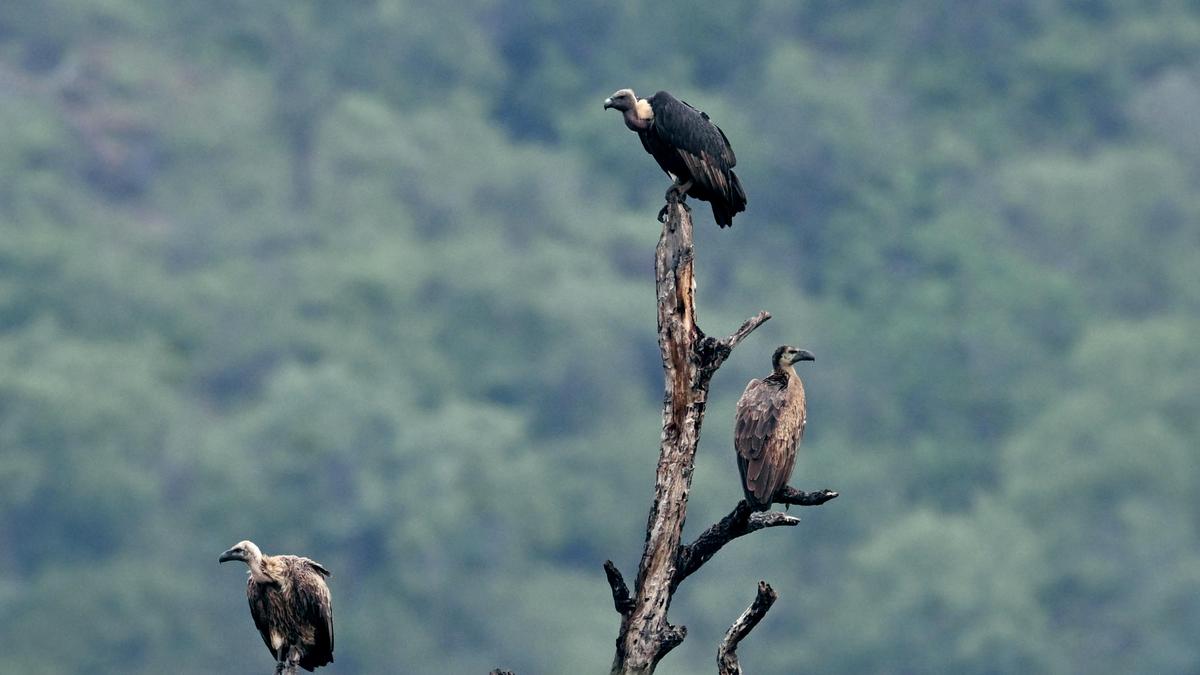
Vultures at Sathyamangalam Reserve Forest in Erode district. File
| Photo Credit: B. Jothi Ramalingam
The Tamil Nadu Forest department has informed the Madras High Court of having begun the process of establishing Vulture Safe Zones (VSZs) in the State in order to create a safe environment for the species that is free from threats, especially the use of toxic veterinary non-steroidal and anti-inflammatory drugs (NSAIDs), like diclofenac, used to treat cattle, which have been a major cause of vulture mortality.
In a status report placed before the first Division Bench of Chief Justice Manindra Mohan Shrivastava and Justice G. Arul Murugan, Principal Chief Conservator of Forests-cum-Chief Wildlife Warden (PCCF-cum-CWC) Rakesh Kumar Dogra said, the first of the VSZs would be established around Moyar River Valley in the Nilgiris Biosphere Reserve as per the ‘Vision Document for Vulture Conservation (VDVC) in Tamil Nadu 2025-30’.
The status report was filed in response to a public interest litigation (PIL) petition filed by Vandalur-based K. Surya Kumar, through his counsel S.P. Chockalingam, to save the carrion-eating vultures, which were facing mass deaths and near-extinction, primarily due to the presence of NSAIDS in the carcass they feed upon. Mr. Dogra said, strict vigil would be kept to prevent the use of the banned NSAIDS by veterinarians to treat cattle.
He said, a field-level monitoring committee chaired by the Field Director of Mudumalai Tiger Reserve (MTR) had already been constituted for establishing the VSZs and that it would comprise the district forest officers of the Nilgiris, Gudalur, Coimbatore, and Erode, besides the deputy directors of MTR in Masinagudi and Udhagamandalam as well as the deputy directors of Anamalai and Sathyamangalam Tiger Reserves.

The committee would also consist of a representative from Advanced Institute for Wildlife Conservation (AIWC) in Vandalur. “Necessary instructions have been issued to the above committee to take action and to create and submit a map, duly marking the vulture nesting and habitat usage sitesm and for monitoring carcass hotspots, which meet our conditions for declaring an area as a Vulture Safe Zone,” Mr. Dogra told the court.
He also said: “The committee will put in place a system for taking samples of carcasses and get them analysed for the purpose of finding traces of the banned NSAIDs, besides organising inspection of the retailers with the help of the Drugs Controller for taking legal action. A 100-km radius around the Moyar vulture nesting population will be monitored for two years and scientific data will be generated.”

The status report, filed through State Government Pleader A. Edwin Prabakar, further read: “A sampling of around 800 carcasses will be done during this period for testing the prevalence of the banned NSAIDs. Similar action would also bе requested from the neighboring States of Karnataka and Kerala. A specific request would be sent to them after a detailed mapping is done by the committee.”
After taking the status report on file and perusing the VDVC 2025-30 prepared by the AIWC, the Chief Justice’s Bench granted time till February 2, 2026, to Mr. Chockalingam to go through the documents and make suggestions, if any.
Published – January 14, 2026 10:56 am IST



