


On the day of polling in Tamil Nadu (April 23, 2026), a senior civil servant, serving in New Delhi, visited Chennai to attend a wedding. At the marriage hall, what he heard was a loud message in favour of Tamilaga Vettri Kazhagam (TVK) founder C. Joseph Vijay. The official was surprised as he was under the impression that the Dravida Munnetra Kazhagam (DMK) would coast to victory.
On the same day, a Madurai-based activist, who helps students prepare for competitive examinations, went to his native village near Rajapalayam in Virudhunagar district to cast his vote. When he met youngsters in the village and enquired about their choice, the only reply that came was: “Vijay, Vijay, and Vijay.”
Normal expectation
Though many long-standing observers of Tamil Nadu politics were aware of Mr. Vijay’s growing support, everyone invariably thought the TVK would put up a show as good as the Desiya Murpokku Dravida Kazhagam of Vijayakant, which in 2006 won one seat with a vote share of about 8.4%. Or, at best, a performance similar to that of the Praja Rajyam Party (PRP), founded by K. Chiranjeevi, in the undivided Andhra Pradesh in 2009, when it bagged 18 seats with a vote share of 16.3%.
With some exceptions, opinion and exit pollsters, too, had predicted a similar outcome for the TVK. However, the voter behaviour, going by empirical evidence, came in the way of observers accurately forecasting the incoming “Vijay tide”. A psephologist said that when he received the findings of a study he had commissioned, he was so stunned that he refrained from making them public.
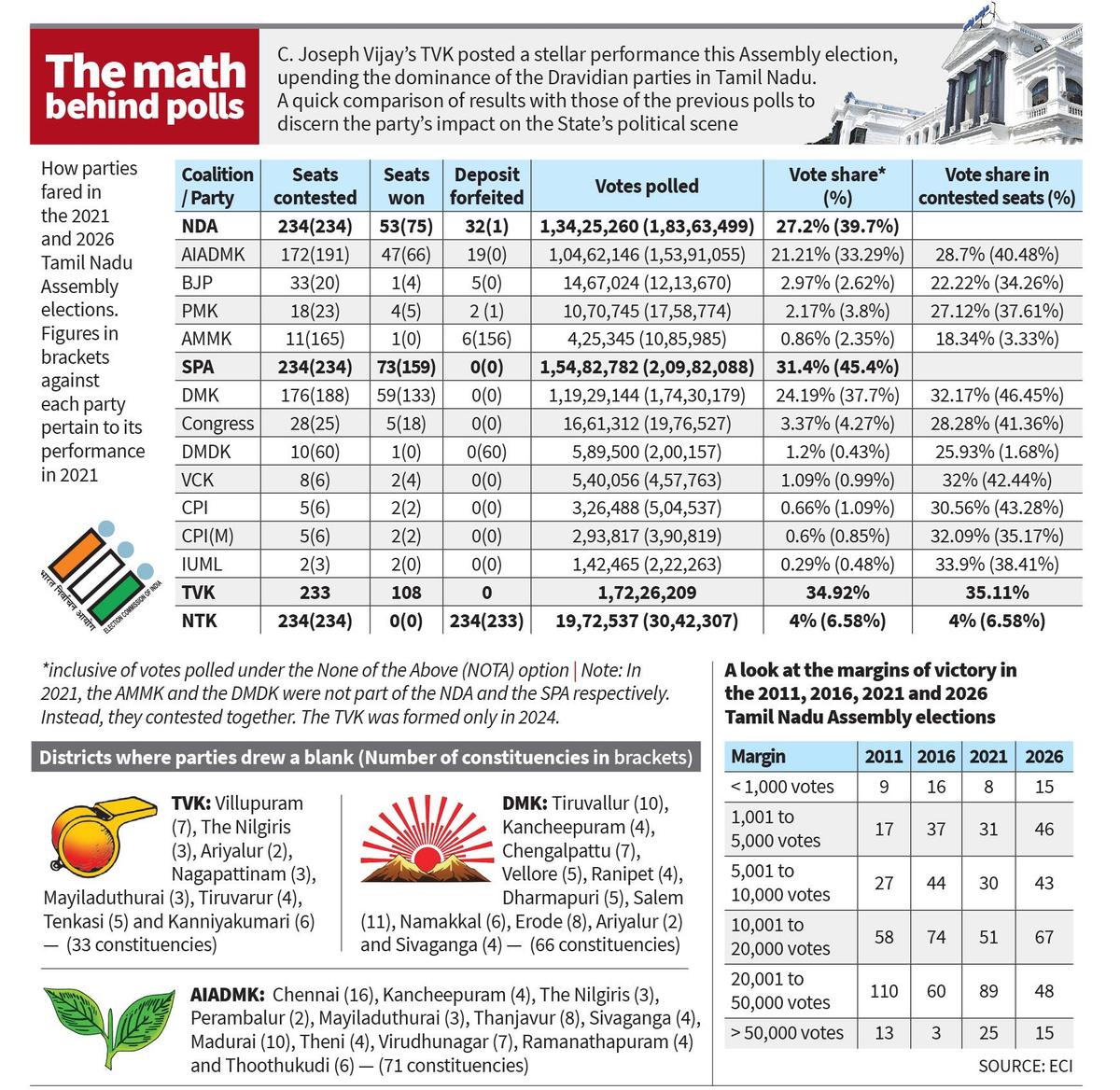
Even as sections of the intelligentsia were deliberating upon the pros and cons of Mr. Vijay’s presence in the scene, around 1.72 crore voters had made up their mind — they were voting for Mr. Vijay; they were not too bothered about who the TVK candidate was in their constituency. As Mr. Vijay had appealed to supporters once at a rally, the people saw him in every candidate he put up.
No majority though
In an uncommon way, the new party, in its electoral debut, had posted a stellar performance, earning a vote share of about 35%, a feat that even AIADMK founder M.G. Ramachandran could not manage in 1977, though his party had secured a majority of its own.
The only weak spot in the script is that the TVK has not been able to secure an absolute majority. It is worth recalling that MGR and his party did not go it alone in the 1977 Assembly election. Instead, the party took the support of the Communist Party of India (Marxist) and the All India Forward Bloc (AIFB), both of which had secured 13 seats together. It was because of this tie-up that the AIADMK, despite garnering about 30.4% of the votes polled, romped home with 130 seats, 12 more than the required number of 118.
Coincidentally, the AIADMK’s vote share in the contested seats in 1977 and the TVK’s in 2026 was a little more than 35%. In the case of the former, it was 35.36% and the latter, 35.11%.
In hindsight, it could be argued that had Mr. Vijay gone in for a pre-poll tie-up with other and smaller parties, a course of action he had hinted at during the inaugural rally of his party in Vikravandi in October 2024, he would not be experiencing the situation he is facing now.
Yearning for change
It is not charisma or cine appeal alone that has gone in favour of Mr. Vijay and his party. For years now, several sections of people had been tiring of the traditional Dravidian majors — the AIADMK and the DMK — and had been wanting to move on. So long as M. Karunanidhi and Jayalalithaa were alive, attempts to forge an alternative to the two parties were not successful.
Vijayakant was the only leader who had given them a considerable degree of anxiety. But he could not sustain his party as an independent force after the 2009 Lok Sabha election. Apart from the Naam Tamilar Katchi (NTK), headed by Seeman, the previous Assembly election saw two more players — the Makkal Needhi Maiam (MNM) led by Kamal Haasan and the Amma Makkal Munnetra Kazhagam (AMMK) — trying unsuccessfully on their own to present themselves, independent of each other, as an alternative to the major Dravidian parties. In fact, the combined vote share of the NTK, the MNM, and the AMMK was around 11.5%.
The ground for a new force was prepared, to a certain extent, by former State president of the Bharatiya Janata Party (BJP) K. Annamalai. He had vigorously sought to project his party, for about three years (2021-2024), as the alternative to the DMK and the AIADMK. Mr. Annamalai hogged the limelight by showcasing himself and his party as the “real Opposition” and not the AIADMK, the principal Opposition party in the outgoing Assembly.
New campaign style
The failure of the BJP-led National Democratic Alliance to get even a single seat in the 2024 Lok Sabha election in Tamil Nadu slowed Mr. Annamalai down. It was around the time that Mr. Vijay entered the scene in a full-fledged manner. Unlike Mr. Annamalai, who has not shied away from interacting with the media and exchanging views, whether right or wrong, with others on social media platforms, the TVK founder does not exert himself much, which can be discerned from the fact that he has not yet addressed a single press conference.
Unlike AIADMK general secretary Edappadi K. Palaniswami and DMK president M.K. Stalin, he did not go around the State extensively for the campaign. Yet, the lack of conventional ways of campaign or outreach did not make any adverse impact on his followers and supporters.
Contrary to the initial perception that Mr. Vijay was a huge draw only among certain sections of the people and in certain pockets, the performance of his party has shown that the TVK has made inroads into a large number of districts. Parts of the Cauvery delta and the southern belt, along with Villupuram, are the areas where the TVK is yet to acquire a strong foothold.
In fact, a Madurai-based observer of politics told this correspondent that Mr. Vijay’s presence had disrupted caste- or community-based bodies as youngsters of all the castes or communities seemed to be carried away by his charm. Leaders of these organisations were finding it difficult to come to terms with the reality of declining influence among their communities.
Slew of freebies
Apart from political reasons, economic reasons have played their part in tilting the scale in favour of the TVK. Following in the footsteps of the DMK and the AIADMK, the fledgling party promised a slew of freebies — ₹2,500 monthly grant for women up to 60 years of age; free government bus travel for them across the State; six free cooking gas cylinders per family per year; the provision of one sovereign of gold and a superior quality silk sari as a gift for brides; ₹15,000 per year as a grant for the mother or guardian of schoolchildren; and 200 units of free electricity every month for the domestic category.
The TVK also assured farmers that crop loans taken by those owning up to five acres of land from cooperative societies would be waived in full and 50% of the loans would be waived for those having more than five acres.
A combination of factors has contributed to the success of Mr. Vijay and his team. Given the composition of the incoming Assembly and the fact that he does not have a majority of his own, it is not realistic to expect that he will be able to implement all the assurances, even if he remains in office for a full term of five years.
Core and chronic issues
The manifesto talks about making the State a $1.5-trillion economy by 2036 and accelerating industrialisation. However, emphasis on welfare schemes — a line pursued by the DMK and the AIADMK — should not come in the way of the new party addressing core and chronic issues such as regional disparities, bottlenecks in enhancing agricultural production and productivity, as well as reservations among sections of potential investors about Tamil Nadu as their first destination.
Not just Gen Z but also the older generations expect that having achieved a spectacular success in politics, Mr. Vijay would chalk out his path in a manner that addresses the aspirations of a wide range of people, leading to the widespread improvement in the quality of life.



