


When Parliament passed the Transgender Persons (Protection of Rights) Amendment Bill, 2026 this week, the debate, at least on paper, was about definitions. Who counts, who qualifies, who can be recognised, and under what conditions. The amendment moves further away from self-identification and toward verification, placing gender within a system that can be assessed, confirmed, and, if necessary, refused.
It is presented as administrative clarity. But if you listen closely to the conversations happening outside Parliament, what it sounds like is something else entirely: a familiar demand to explain yourself before you are allowed to be taken at your word.
For many trans people, that demand has never been limited to the state. It has long shaped how they move through public space, how they are read, and perhaps most acutely, how they are loved.
Because trans bodies, in India, are rarely allowed to exist without interpretation.
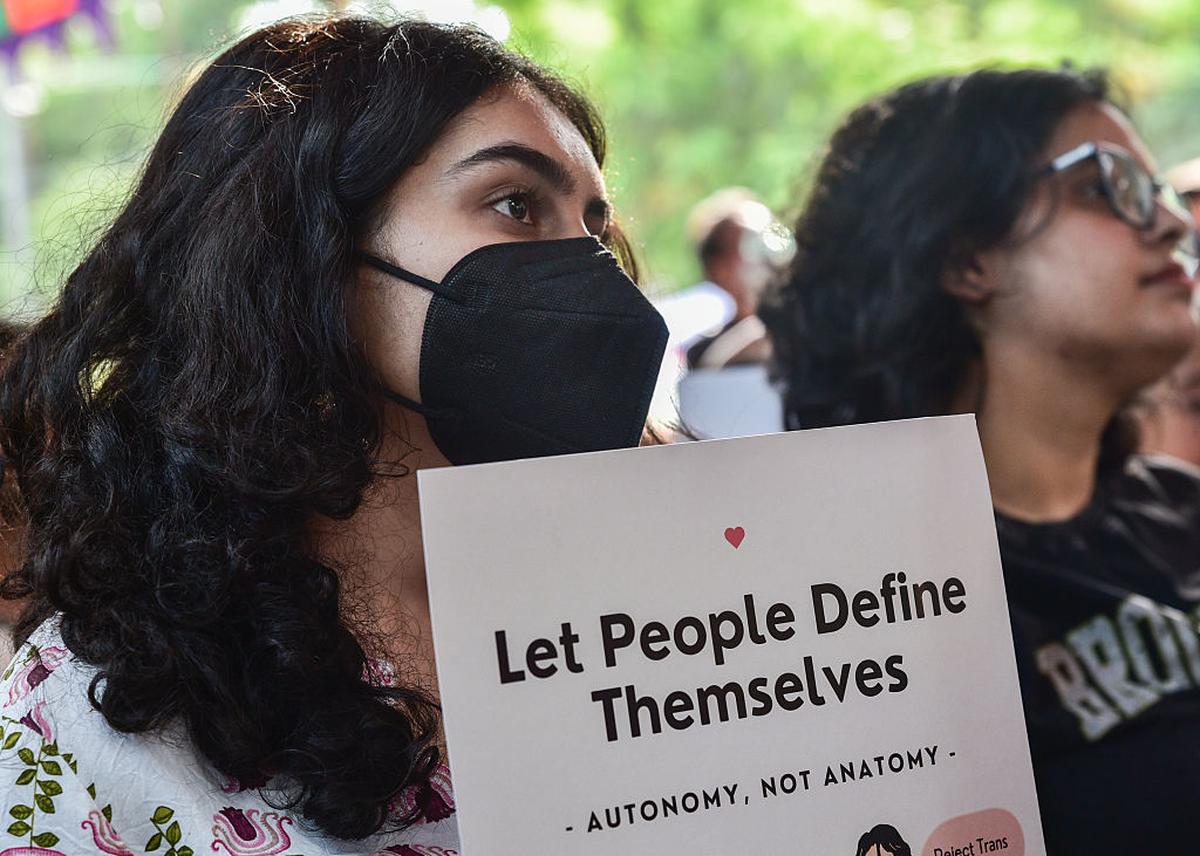
Members and supporters of the transgender community gather for a protest against the Indian government’s proposed amendments to the Transgender Persons (Protection of Rights) Act in Parliament
| Photo Credit:
NurPhoto
A trans woman I spoke to in 2019 described the feeling of being watched on a night out in Delhi — not in the way anyone might notice someone attractive, but in a way that felt almost investigative. “You can tell when someone is just looking at you,” she said, “and when they’re trying to figure you out.”
That distinction became painfully clear one evening at a bar. A man had been watching her for most of the night—holding eye contact just long enough to have been read as interest. She hesitated, then decided to walk up to him.
“I thought let me not overthink this for once,” she told me. “Let me just go say hi like a normal person would.”
What followed was not normal.
His expression hardened and he told her—loud enough for his friends to hear—to back off. There was a brief moment where it felt like the situation might escalate.
“It was like I had exposed him,” she said. “Like he could look, but I wasn’t supposed to respond.”
She left soon after, more shaken than she expected to be. “One second I was someone he was interested in, and the next I was something he needed to distance himself from publicly.”
That movement from desire to disavowal is something that comes up often.
Another trans woman, who has been in what she describes as a “relationship, but only technically,” for close to two years, spoke about a man who insists on defining their dynamic as casual, even as he behaves in ways that suggest otherwise. He calls, he checks in, he gets visibly upset when she pulls away, but resists any attempt to make the relationship visible or defined.
“He’ll say, ‘I told you from the start, no strings,’” she said, “but the minute I treat it like there are no strings, it becomes a problem.” “I asked him once, ‘What exactly am I to you?’” she told me. “And he said, ‘Don’t make it complicated.’”
She laughed when she recounted this, but not because it was funny. “It’s only complicated when I ask for clarity,” she said. “Otherwise, everything is very convenient.”
What she was describing, without naming it directly, was a kind of containment. A relationship that is allowed to exist, but only within boundaries that protect the other person from having to account for it.
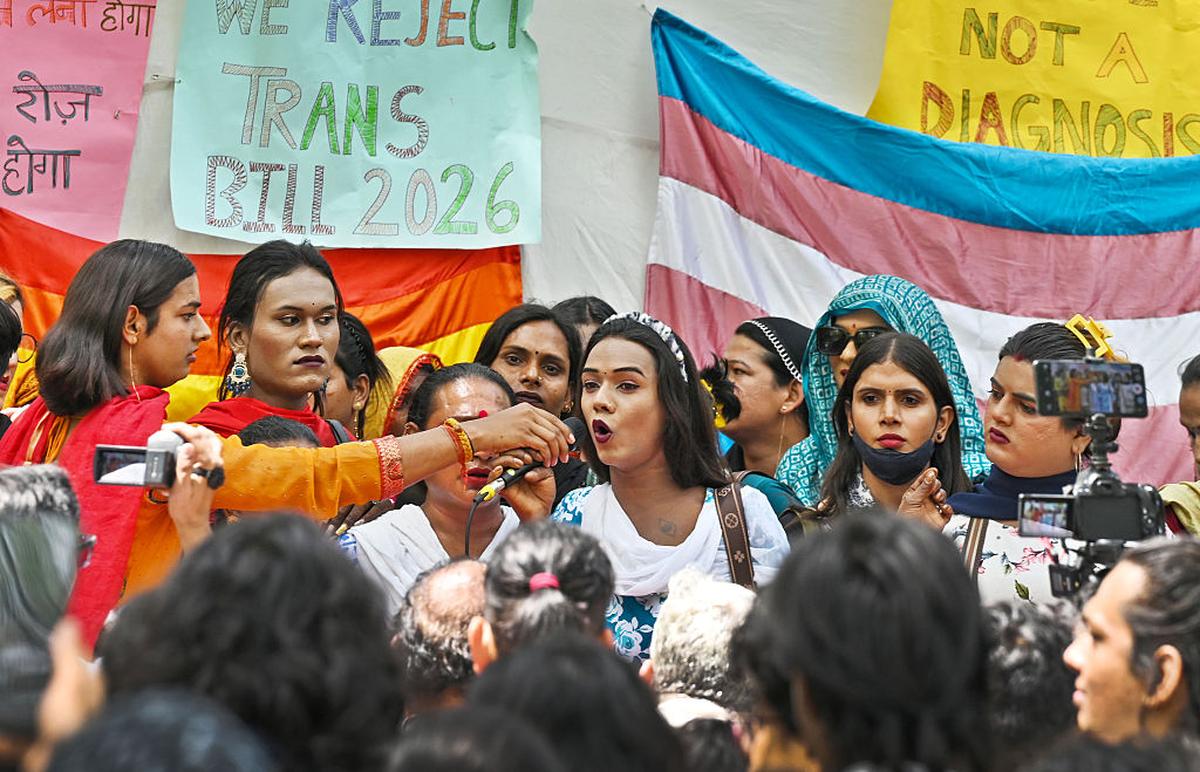
Members of the LGBTQ+ community gathered to protest against the Transgender Amendment Bill 2026, raising slogans and holding placards demanding equality, dignity, and protection of their fundamental rights, at Jantar Mantar, on March 26, 2026 in New Delhi.
| Photo Credit:
Getty Images
If that is one way trans people are kept at a distance, another is through a kind of proximity that is not quite connection.
On dating apps like Tinder, Bumble, and Grindr, several trans users described interactions that felt like sorting mechanisms.
A trans woman in Mumbai put it this way: “If I say I’m trans upfront, that becomes the entire conversation. If I don’t, then I’m ‘hiding’ something. There’s no version where I just get to be someone you’re talking to.”
She described a pattern that has become almost predictable—initial interest, followed by a turn toward questions that come across as interrogation.
“They’ll say, ‘I’m just trying to understand,’” she said, “but understand what? You don’t ask anyone else these things on a first conversation.”
This isn’t incidental. Research emerging from India’s queer digital spaces has begun to map patterns that users themselves have long described. A 2021 academic study, “Gay Dating Platforms, Crimes, and Harms in India” by Rahul Sinha-Roy, examines how geosocial apps like Grindr can become sites of coercion, extortion, and abuse, particularly because anonymity and stigma make users more vulnerable.
Alongside this, broader research on violence in Indian digital spaces, by ScienceDirect — a source for scientific, technical, and medical research — including studies on technology-facilitated abuse has shown how online interactions can extend into offline harm, with marginalised users facing heightened risk.
What these studies make clear is something trans users already know: that these platforms are not insulated from the biases of the society they exist in. They replicate them, sometimes more efficiently.
A trans man I spoke to described meeting someone through Bumble and being struck, not by anything exceptional, but by the absence of tension .“We just… spoke,” he said. “About work, about how bad traffic was that day, about where to eat. It didn’t feel like I was being assessed.”
He paused for a moment before adding, “I kept waiting for the point where it would turn into a conversation about me being trans. It just didn’t.”
They’ve been seeing each other for a few months now, and what stands out to him is how little of the relationship is organised around explanation.
“It’s not that she doesn’t know,” he said. “It’s that it’s not the most interesting thing about me to her. ”Because for many trans people, the experience of dating is shaped by these subtler negotiations. Being desired, but not publicly. Being accepted, but conditionally. Being visible, but only as long as that visibility can be managed.
And this is where the law begins to echo the personal. It is framed as governance, as order, as the need for systems that can distinguish between what is valid and what is not. But when applied to identity, it begins to take shape as scrutiny. As many trans people will tell you, has a way of seeping into everything.
And perhaps that is where the real shift lies. Not in definitions or documentation, but in the difficult work of allowing people to exist without turning them into questions that need answering.
A fortnightly guide to love in the age of bare minimum



