


On a wintry day in January, when the sun sometimes eludes India’s Gangetic plains, Sukhendu Lal Saha, 73, a retired bank employee sits on a sofa in his cramped first-floor living room of a newly constructed house down a lane of Nepalgarh locality in the heart of Kishanganj, a town in Bihar bordering Bangladesh.
Outside his modest house hang three nameplates: one with his own name, the other two of his sons, with their workplaces under their names — State Bank of India and Microsoft. “After being settled here, we put our focus on our children’s education,” says Saha.
Saha, who says he is generally a content man, is worried about the tension in Bangladesh. He takes frequent pauses as he speaks: “As many as 30 family members of mine still live in Feni district (in Bangladesh).<SU> I had last spoken to a family member from my late mother’s side a couple of years ago. I watch the TV news or read about what is happening to our people in the newspapers,” says the septuagenarian. He adds after a long pause, looking upward, at the ceiling, limiting in its closeness: “Every day we pray for their safety.”

Early in 2026, the Bangladesh Hindu Buddhist Christian Unity Council said in a statement that in December 2025 alone, 51 incidents of communal violence had been reported. Parliamentary elections are scheduled in the country on February 12, after mass protests resulted in the ousting of Prime Minister Sheikh Hasina and her Awami League. In the political transition following the Monsoon Revolution, the research and advocacy group Human Rights Watch has recorded violence, particularly targeting vulnerable genders and religious minorities.
Finding a home
Kishanganj town is about 350 km away from Bihar’s State capital, Patna, but only 23 km away from the Bangladesh border. Nepalgarh itself is named after Nepal, just 60 km away.
Before the 1965 Indo-Pakistan war, 65 to 70 families had migrated from Bangladesh, recalls Saha. He remembers leaving with his parents when he was in Class 6, after a bull they owned was allegedly eaten by a neighbour. Feeling persecuted for their religion, several families fled.
Prof. N.K. Shrivastava, who heads the Department of History in N.D. College affiliated to Purnea University in northeast Bihar, says, “The atrocities against the Hindus made some families flee to India. Many who had property and businesses stayed.”
In December 1963, a relic that Muslims believe is a strand of the Prophet Mohammed’s hair was stolen from Kashmir’s Hazratbal shrine. While it was recovered in less than a month, the backlash for its theft was felt by Hindus in what was then East Pakistan.
In India, the new migrants were given space in various refugee camps across the country: in Tripura, Maharashtra, Chhattisgarh, and Karnataka. In Bihar, each migrant family was provided about 8–10 kattha (about 10,800-13,600 sq. feet) land in Nepalgarh, along with a loan of ₹4,000 for house construction or setting up a new business.
“Some families who couldn’t afford to make a dwelling here or begin some business for a new life migrated from here, selling off their land to the locals,” says local politician Shankar Das, 50, whose family had migrated from Bangladesh.
His relative Kumar Vishal, who is also the local ward council chief, says, “Several of those who came from Bangladesh are still here, and today 1 kattha of land is worth ₹30 lakh.”

Remembering things past
Ameebala Das, 74, had migrated along with her husband, Krishna Chandra Das and others from Cox’s Bazar of Chattogram (formerly Chittagaon) in Bangladesh in the 1960s. “It was a life full of trouble,” Das remembers. “I wore one cotton saree for days, and we only had flour, which I kneaded with water stored in an earthen pot. When we were crossing the border, all our gold, silver, and other possessions were snatched away by those manning it.”
In India, “After being temporarily shifted from one refugee camp to another, we finally got our nest in Nepalgarh in 1964. Since then, we have been here,” she says, in an almost inaudible voice. Gradually, her husband opened a kirana (provisions) shop in the locality to earn a living, and the family survived the ordeal. She got her daughter and son married and today lives with his family in a small structure with a tin gate
. Her husband died in 2011. She remembers that she left behind 67 family members in Bangladesh. Her family says they’d telephone until about two weeks ago. Now, they are unable to reach them.
Prayers for peace
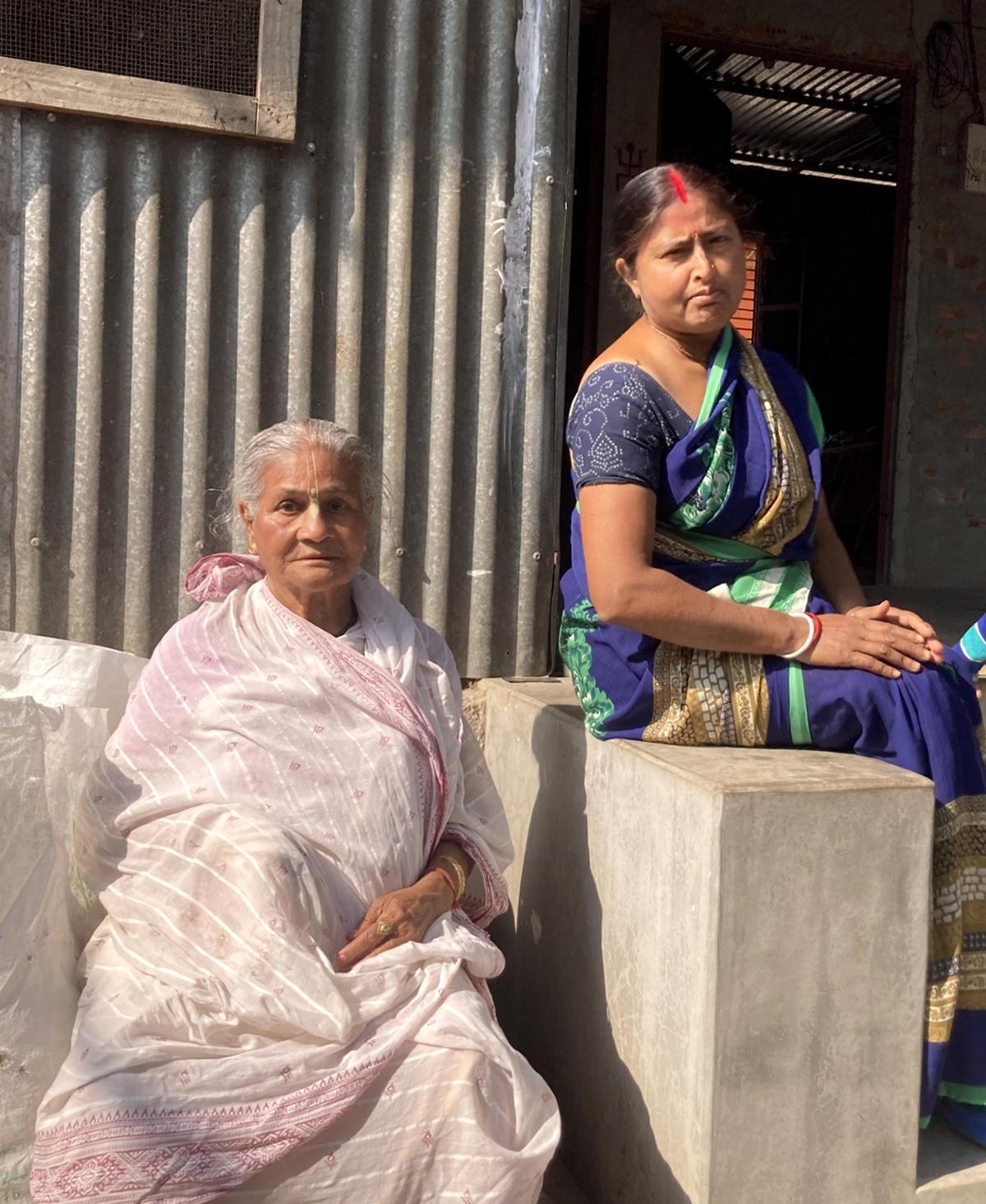
Pochhapoti Sutradhar, who settled in Nepalgarh locality of Kishanganj in the 1960s after she migrated from Bangladesh.
| Photo Credit:
Amarnath Tewary
A few steps away, on the other side of the only pond the locality has, Pochhapoti Sutradhar, 85, lives with her three sons in a tin-roof dwelling. Under her cotton saree, she is moving the beads of her jhaap mala, reciting prayers, the sandalwood paste tilak cracking on her wrinkled forehead.
“I remember that we had come to India in 1964 from Sylhet (in Bangladesh). We were in different camps in India for five years. Then we finally came here in 1969. Since then, we have been piecing together our life,” she says. She remembers that her family had crossed the border into Tripura. She has five sons and two daughters, all born in India.
Her oldest son died in an accident; the youngest lives in Kerala with his family; and the three others work as masons; while her daughters<SU>are home makers.
“Yes, 50 to 60 relatives from my father’s side, my mother’s side, and my husband’s family are still in different parts of Bangladesh. Only two weeks ago, I had spoken to one of them over a video call, but I have not been able to reach them since then,” she says. “I know through my sons, grandsons, granddaughters, daughters-in-law that something is going wrong in Bangladesh today. I worry for the safety of my family members.” She resumes moving the beads, this time faster, still under the cover of her cotton saree. She too calls upon god to protect them. Her third daughter-in-law, Jayanti Sutradhar, says the networks have been blocked.
Almost all the households of Nepalgarh speak in Bengali at home, Hindi outside. Some of the households have cars; though more have bikes. Life has been a struggle though.
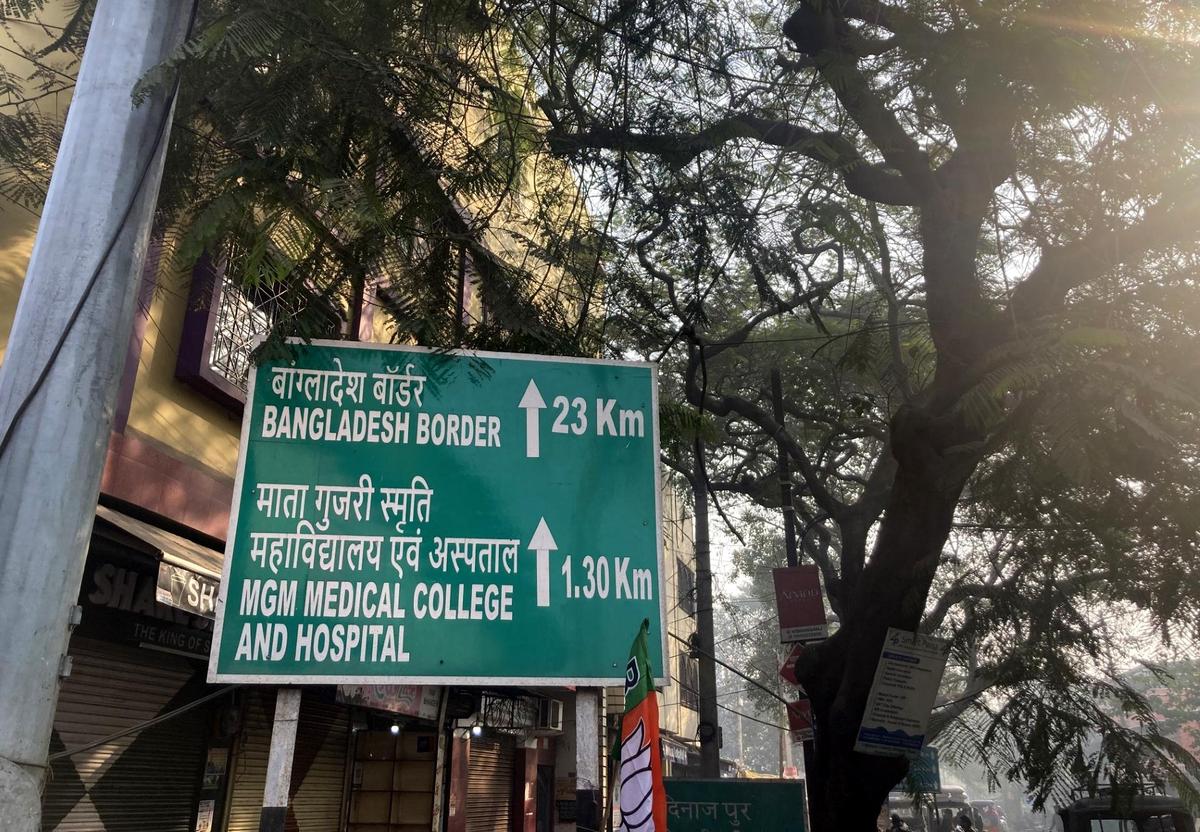
A signboard in Kishanganj.
| Photo Credit:
Amarnath Tewary
Saha recalls, “When we were settled here, the area was out of the city and infested with bushes and weeds, but see today we have concrete lanes and street lights. Thanks to Chief Minister Nitish Kumar,” he adds. He points towards a patch of land adjacent to his house, which he had bought a few years back. He grows spring onions and a few vegetables. “This is my retirement days’ time-pass,” he adds, with a hearty laugh.
“Whatever is happening in Bangladesh is not good. Killing of any human being should not be acceptable,” Saha says.
According to Bangladesh’s 2022 census, the Hindu population is approximately 13.13 million, about 7.95% of the country’s total population.
amarnath.tewary@thehindu.co.in
Edited by Sunalini Mathew




