


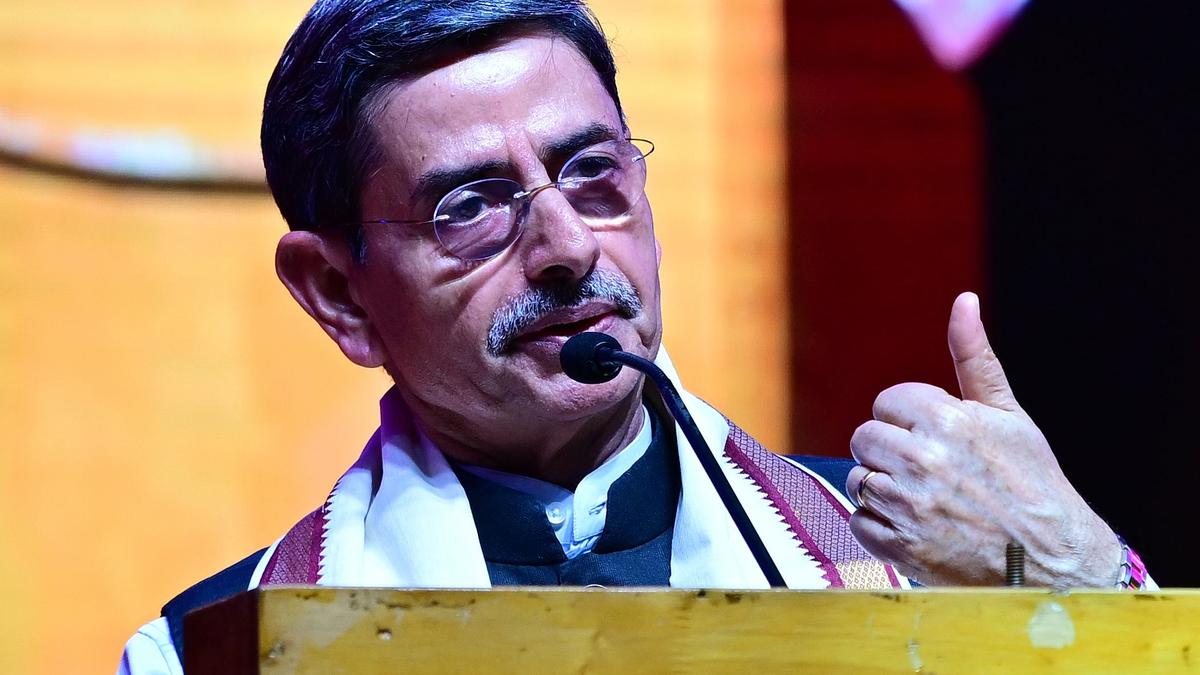
In a letter to the Assembly Speaker, Governor R. N. Ravi said the proposed amendment would operate beyond the tenure of the present and into the tenure of the incoming government, effectively binding its fiscal policy choices in its very first year of office.
| Photo Credit: FILE PHOTO
The Tamil Nadu Assembly on Friday “rejected” Governor R.N. Ravi’s position on the need for the House to reconsider the Tamil Nadu Fiscal Responsibility (Amendment) Bill, 2024, which was passed on February 22, 2024, but returned by the Raj Bhavan.
Speaker M. Appavu read out Mr. Ravi’s letter, dated August 25, 2025, which had listed the reasons for returning the Bill. The House readopted the Bill.
In a letter to the Speaker, Mr. Ravi said, “The Bill seeks to postpone the achievement of zero revenue deficit and 3% fiscal deficit by another year (now targeting 2026-27 and 31st March 2026 respectively), going beyond the period specified by the Fifteenth Finance Commission, which set targets for 2021-22 to 2025-26.”
‘Room for new govt.’
He further wrote, “The next general election to the Tamil Nadu Assembly is scheduled to be held in less than a year from now. The proposed amendment will directly operate beyond the tenure of the present and into the tenure of the incoming government, effectively binding its fiscal policy choices in its very first year of office and also being beyond the recommended period of the Fifteenth Finance Commission. In a parliamentary democracy, it is a well-recognised convention that major policy decisions by way of statutory change, especially in the sphere of long-term financial policy, are ordinarily avoided in the immediate pre-election period unless there is a compelling necessity. This is to ensure that the newly elected government has the autonomy to determine its own fiscal framework in terms of the fresh mandate from the people.”
The Governor said, “The original targets under the Tamil Nadu Fiscal Responsibility Act were enacted in alignment with the national framework for fiscal discipline under the Fiscal Responsibility and Budget Management (FRBM) Act, 2003, and successive Finance Commission recommendations.” But the amendment proposed effectively altered the roadmap agreed with the Commission. “This can threaten long-term fiscal sustainability and compliance with the targets outlined by constitutional bodies like the Finance Commission and potentially undermine the credibility of the State’s financial management,” he said.
“Fiscal responsibility laws are meant to be binding, and exceptions are usually made only in extraordinary situations (natural disasters, severe economic crises, etc.) by the elected government. Such repeated extensions would dilute statutory commitments to fiscal discipline, postponing the targets especially beyond the Fifteenth Finance Commission period and beyond the term of the present government,” Mr. Ravi said.
Thennarasu’s take
Finance Minister Thangam Thennarasu, however, said Tamil Nadu was a pioneer in ensuring that a law was passed to ensure fiscal responsibility. “Even in the year this Act was passed, we can see that policy goals were set beyond its term. Successive governments have upheld fiscal responsibility even while changing the developmental and economic goals. In the past, amendments to the Tamil Nadu Fiscal Responsibility Act were made before the election year,” he said.
“Enacting legislation is a continuous process. The legislation that is being enacted must take into account — irrespective of the government — financial situation, continuation of policy decisions, and long-term social and economic goals. It doesn’t end with one term of a government,” he said.
DMK MLA Ezhilan Naganthan, VCK MLA S.S. Balaji, CPI MLA T. Ramachandran, CPI(M) MLA Nagaimaali, and legislators T. Velmurugan, and E.R. Easwaran also criticised the Governor’s observations.
Published – October 17, 2025 11:26 pm IST



