


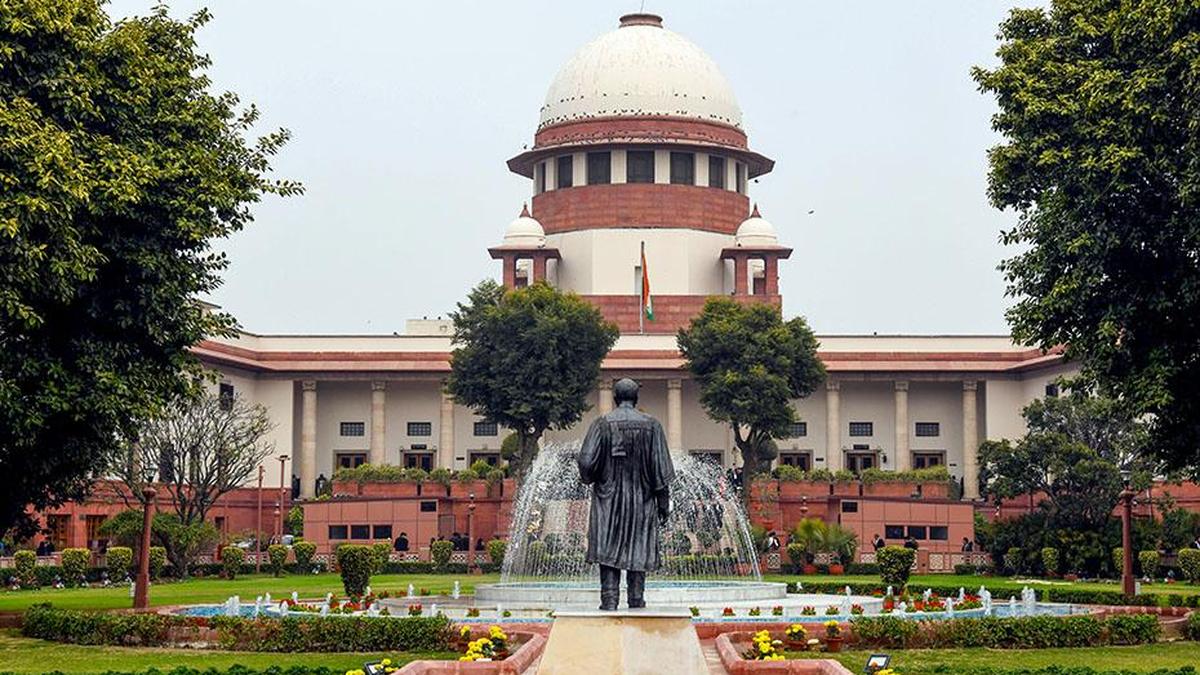
Representational view of the Supreme Court of India
| Photo Credit: ANI
The Supreme Court on Tuesday struck down provisions of the Tribunal Reforms Act, 2021, as a “slightly tweaked reproduction” of an ordinance declared unconstitutional by the apex court.
The top court had declared that the Tribunal Reforms (Rationalisation and Conditions of Service) Ordinance of 2021 amounted to executive interference in the appointments made to key tribunals and their administration and functioning. The Tribunal Reforms Act was enacted within days of this Supreme Court judgment.
Tuesday’s (November 18, 2025) judgment by a Bench of Chief Justice of India B.R. Gavai and K. Vinod Chandran was based on petitions filed by the Madras Bar Association and Congress leader Jairam Ramesh challenging the 2021 Act as a sly revival of the ordinance.
Mr. Ramesh had argued that the 2021 Act, besides abolishing nine key tribunals, raised a serious threat to judicial independence by giving the government wide powers regarding appointments, service conditions, salaries, etc, of the members of key tribunals. The petitioners had submitted that the 2021 Act was passed without parliamentary debate amidst ruckus in the House.
‘Approach falls foul of Constitutional supremacy’
The Bench observed that the government, instead of addressing the issues raised by the July 2021 Supreme Court decision, chose to re-introduce the ordinance provisions through a statute.
“Such an approach is impermissible and falls foul of Constitutional supremacy,” Chief Justice Gavai, who authored the judgment, observed.
The apex court directed the Centre to establish the National Tribunal Commission in four months from the judgment.
The Bench said the Commission was needed as an “essential structural safeguard” to ensure independence, transparency and uniformity in the functioning, appointment to, and administration of tribunals.
The Supreme Court agreed with Mr. Ramesh’s arguments that the provisions of the 2021 Act were a “transgression of the constitutional limits of Parliament’s legislative power and undermines the power of judicial review and the Supremacy of the Constitution, which are basic features of the Constitution”.
He had said the very objective behind the creation of tribunals was to reduce the burden and growing backlog on the judiciary as well as to bring technical expertise to the field of law governed by such tribunals, as alluded to by the Swaran Singh Committee Report of 1976.
On Tuesday, Chief Justice Gavai said the continued recurrence of such issues was adding to the court’s pendency.
Published – November 19, 2025 12:51 pm IST



