



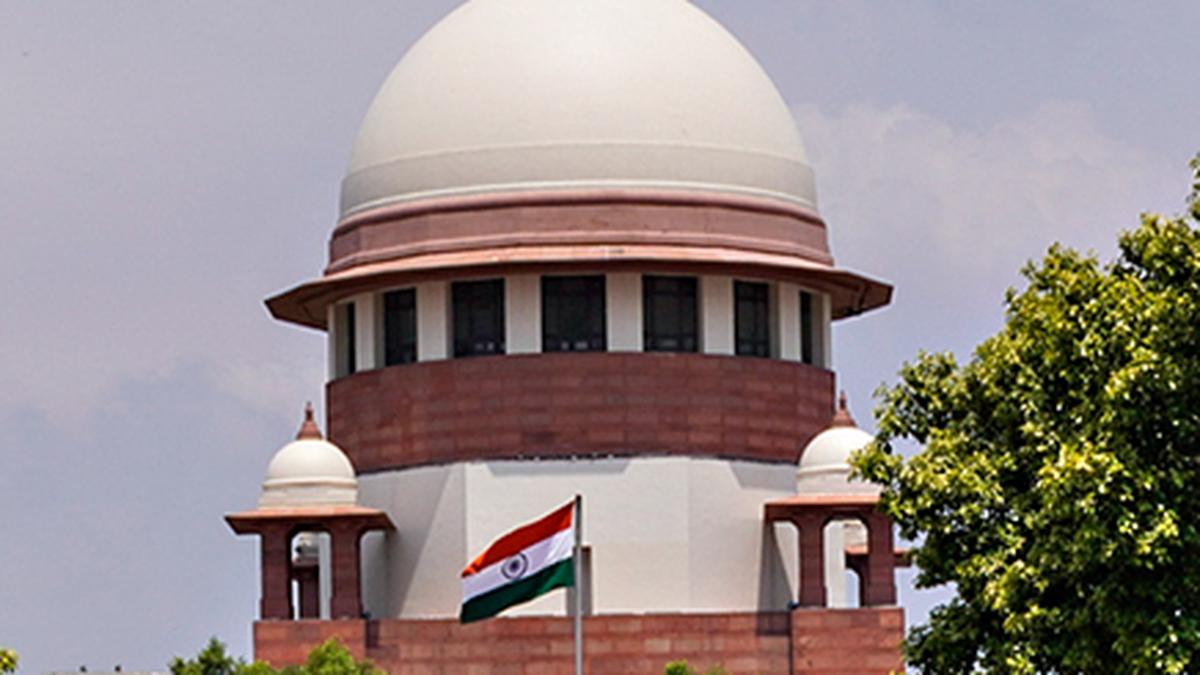
Supreme Court of India. File
| Photo Credit: The Hindu
The Supreme Court on Thursday (September 18, 2025) adjourned till next week the hearing of a plea by three transgender doctors seeking implementation of one per cent horizontal reservation for transgender candidates in postgraduate medical admissions under NEET-PG 2025–26. The examination was held on August 3, and the results were declared on August 19.
Senior advocate Indira Jaising, appearing for the petitioners, urged a Bench of Chief Justice of India (CJI) B.R. Gavai and Justice K. Vinod Chandran to pass an “innocuous order” earmarking two seats under the all India quota and two under the State quota for transgender candidates.
The Chief Justice said such a direction could create uncertainty in the admission process. “We cannot keep seats everywhere in limbo. You are asking for two seats in the all India quota, two in the State quota,” he remarked.
The Bench also noted the submission of the National Medical Commission counsel that counselling had not yet begun for the postgraduate medical courses and that no immediate urgency warranted such an order. “Counselling has not started. We will keep this matter for next week high on board,” the CJI said.
The plea relies on the Supreme Court’s 2014 landmark ruling in NALSA v. Union of India, which recognised transgender persons as a “third gender” and mandated their inclusion through affirmative action in education and public employment.
During the proceedings, Ms. Jaising informed the court that petitioner Kiran A.R. had withdrawn from the case and that only petitioners 2 and 3, from the OBC and general categories respectively, would continue with the plea.
Appearing for the Union government and medical authorities, Additional Solicitor General Archana Pathak Dave submitted that Solicitor General Tushar Mehta wished to personally address the broader issue of reservation for transgender persons. The Bench then posted the matter for hearing on September 23.
The top court had earlier observed that if there was a judicial direction mandating a quota for transgender persons, it ought to be implemented. Addressing the Solicitor General, the Chief Justice had remarked, “If the 2014 judgment requires reservation to be provided, you have to comply. Why don’t you implement it within the 15% quota?”
Notably, 85% of seats in government medical colleges are reserved under the State quota, while the remaining 15% fall within the all India quota.
Affirmative action
The petitioners have also challenged the April 16 notice and April 17 information bulletin issued by the National Board of Examinations in Medical Sciences, contending that the omission of such a quota contravenes the court’s 2014 ruling, which mandated affirmative action and reasonable accommodation for transgender persons in education and public employment.
“As a result of the impugned notice, the petitioners are left with a right without remedy, whereby there are now no reservations for transgender persons in postgraduate medical education despite the binding declaration of the law by this court,” said the plea, filed through advocate Paras Nath Singh.
The plea argued that in the absence of horizontal reservation, transgender students would be deprived of equal opportunity, as no specific reservation is currently extended to them to ensure representation in postgraduate medical education, despite the community facing entrenched social barriers. It added that the 2014 verdict had recognised the fundamental rights of transgender persons under the Constitution, including the right to self-determination of gender identity.
In March 2023, a Supreme Court Bench led by then Chief Justice D.Y. Chandrachud had refused to entertain an application seeking clarification on whether the NALSA judgment mandated horizontal reservation.
Published – September 18, 2025 09:33 pm IST



