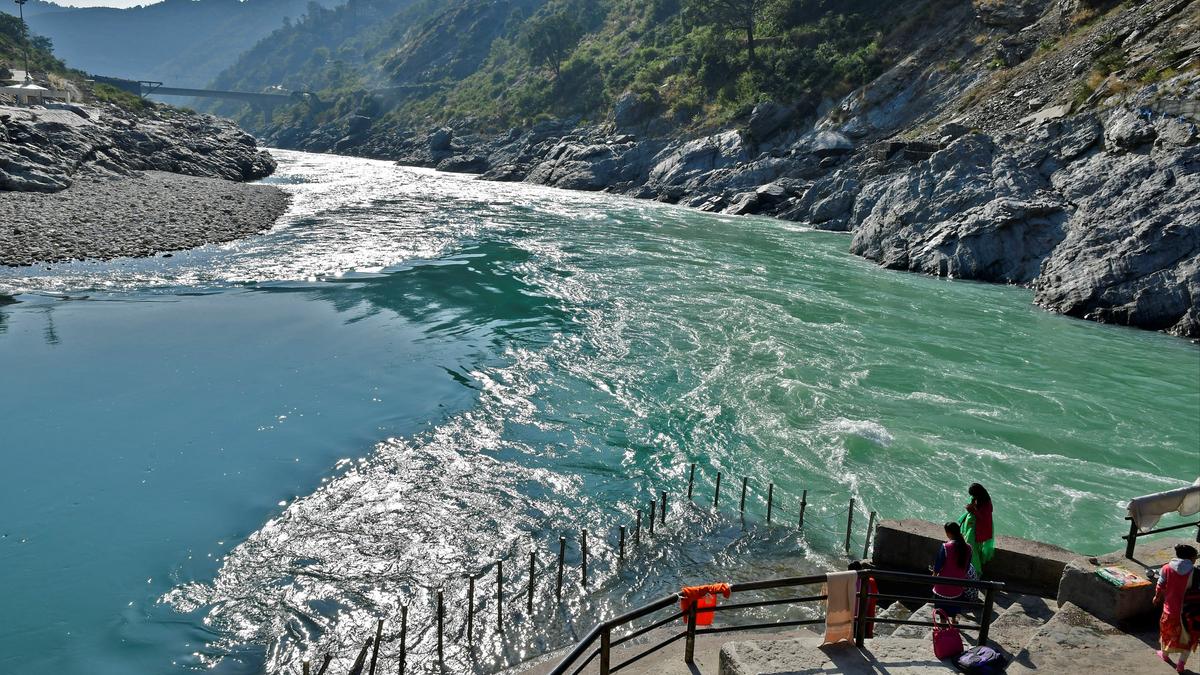
A bird’s eye view of confluence of Alaknanda and Bhagirathi rivers in Devprayag, a point from which the river is called the Ganga.
| Photo Credit: AKHILESH KUMAR/The Hindu
The Ganga river sustains a population of more than 600 million people and is central to South Asia’s economy and culture — and it’s drying at a rate unseen in more than a millennium, per a new study by researchers from IIT Gandhinagar and the University of Arizona. The study reconstructed the river’s streamflow and found that the decline in flow since the 1990s could be unprecedented. The authors have linked this drying to a combination of weaker summer monsoons, human-driven changes in land and water use, and broader climate shifts.
If the findings are validated by more research, the Ganga has entered a period of droughts more prolonged and intense than the great arid spells of the 14th and 16th centuries. The Ganga basin accounts for 40% of India’s GDP.
The researchers combined tree-ring records from the Monsoon Asia Drought Atlas with hydrological models, thus filling a crucial gap in long-term flow records. The researchers were thus able to reconstruct streamflow dating to 700 AD. Then they validated this reconstruction against historical droughts and famines, including that in Bengal in the 18th century, and against modern data. Finally, they compared these reconstructions with climate model projections to test whether the current drying could be explained by natural variability alone.
Between 1991 and 2020, they found, the basin experienced multiple four- to seven-year droughts, which were far rarer than in the previous millennium. The 2004-2010 drought was the most severe in 1,300 years. Overall, the post-1990s drying was estimated to be 76% more intense than the worst 16th century drought. Statistical analyses confirm that this decline couldn’t be accounted for by climate variability; instead, they pointed to weaker monsoons linked to rapid Indian Ocean warming and aerosol pollution, groundwater pumping reducing baseflow, and land-use changes.
According to the team’s paper, published in PNAS on September 23, the findings question the reliability of current global climate models, most of which don’t reproduce the observed drying trend. Indeed, even as some climate models project wetter conditions in the future, the inability to simulate recent drying means planning can’t bank on optimistic forecasts alone but must also involve adaptive water management that accounts for both natural and human drivers.
The study also underscored the vulnerability of the basin’s population, from declining streamflow threatening agriculture to the Bay of Bengal’s marine ecosystem, which depends on river discharge.
Published – September 23, 2025 03:12 pm IST