


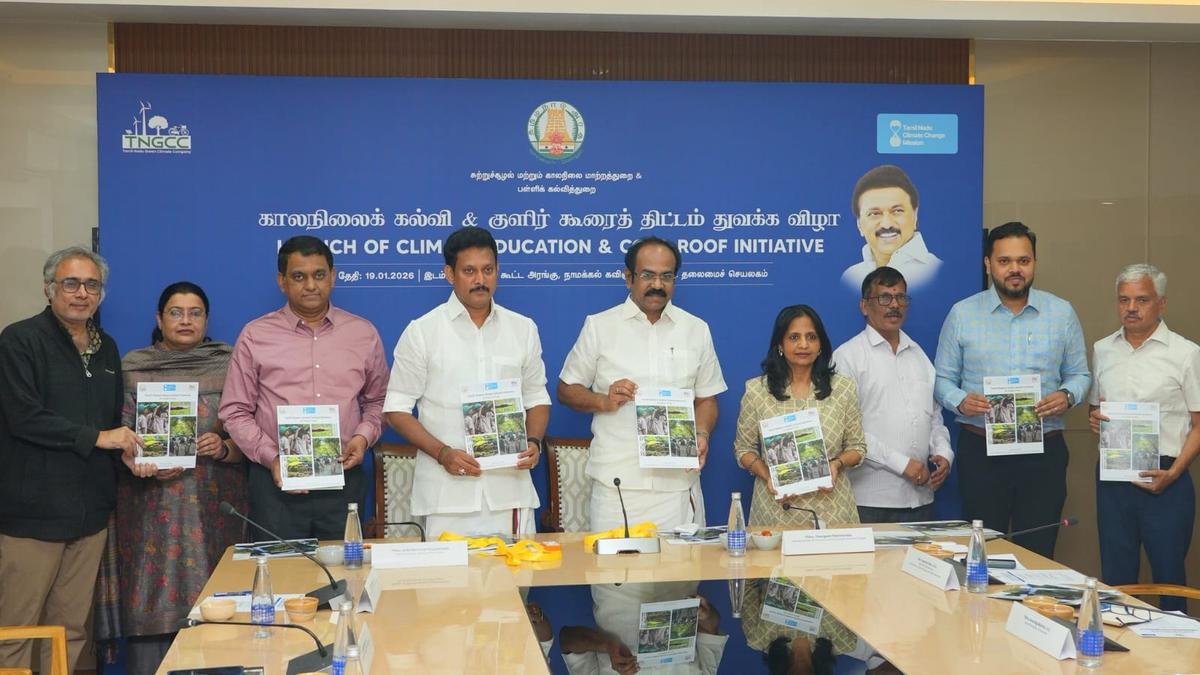
Finance and Environment Minister Thangam Thennarasu, School Education Minister Anbil Mahesh Poyyamozhi, and Additional Chief Secretary Environment Climate Change and Forest Government of Tamil Nadu Supriya Sahu releasing the report on Monday.
| Photo Credit: Special arrangement
Rooftop solar installations at Tamil Nadu’s ‘Green Schools’ have reduced grid electricity consumption by about 46% per school, saving an average of around 3,572 units annually, according to the report of an impact study released on Monday.
Finance and Environment Minister Thangam Thennarasu and School Education Minister Anbil Mahesh Poyyamozhi released the report, prepared in collaboration with the Indian Institute for Human Settlements (IIHS), at the launch of the State government’s Climate Education and Cool Roof Initiatives across 300 ‘Green Schools’.
The Green School programme has been expanded from 25 pilot schools to 300 government schools across multiple phases, covering almost all districts. The study, done in 97 schools, found that each school saved roughly ₹26,000 a year in electricity costs, apart from the value of on-site solar generation. Nearly half the participating schools have also carried out structured climate awareness campaigns among students.
If the model is extended to all government schools, the study estimates that electricity savings may offset up to 91% of the current power consumption of government and aided educational institutions and hospitals.
Climate education
Alongside the release of the study, the government operationalised climate education initiatives under the Tamil Nadu Climate Change Mission.
A ‘Training of Teachers’ module on climate education was released, and a certified residential training programme for school teachers was inaugurated. The programme aims to train 4,000 teachers from all 38 districts as volunteer climate ambassadors, with at least 50% drawn from government and aided schools. The first residential training batch of 210 teachers will begin in Salem on January 20.
According to an official release, the State has also expanded its Cool Roof initiative to address rising heat stress in classrooms. Many concrete-roofed schools record indoor temperatures of 38°–40°C during summer, affecting student comfort and learning outcomes.
A pilot project at the Punthalaivar Kamarajar Government Girls Higher Secondary School in Ambattur in Chennai showed an average reduction of 3°–4°C in indoor classroom temperatures and a 4°–5°C drop in ceiling surface temperatures. During school hours, classroom temperatures reduced to around 27°C.
As part of the rollout, cool roofs were inaugurated at the Chennai Girls Higher Secondary School in Shenoy Nagar and Chennai Higher Secondary School in Thiruvanmiyur. Green School certificates were awarded to the Kamarajar school in Ambattur and the Kollumedu Government Higher Secondary School in Tiruvallur district.
Two other publications were also released, including one developed with the United Nations Environment Programme (UNEP) on scaling passive cooling in schools, and another outlining design strategies such as shading, ventilation, and greening to improve thermal comfort and reduce energy demand.
Senior officials from the Environment, Climate Change, and Forests Department, School Education Department, Tamil Nadu Pollution Control Board, State Council of Educational Research and Training, IIHS, and the UNEP were present.
Published – January 19, 2026 10:41 pm IST



