


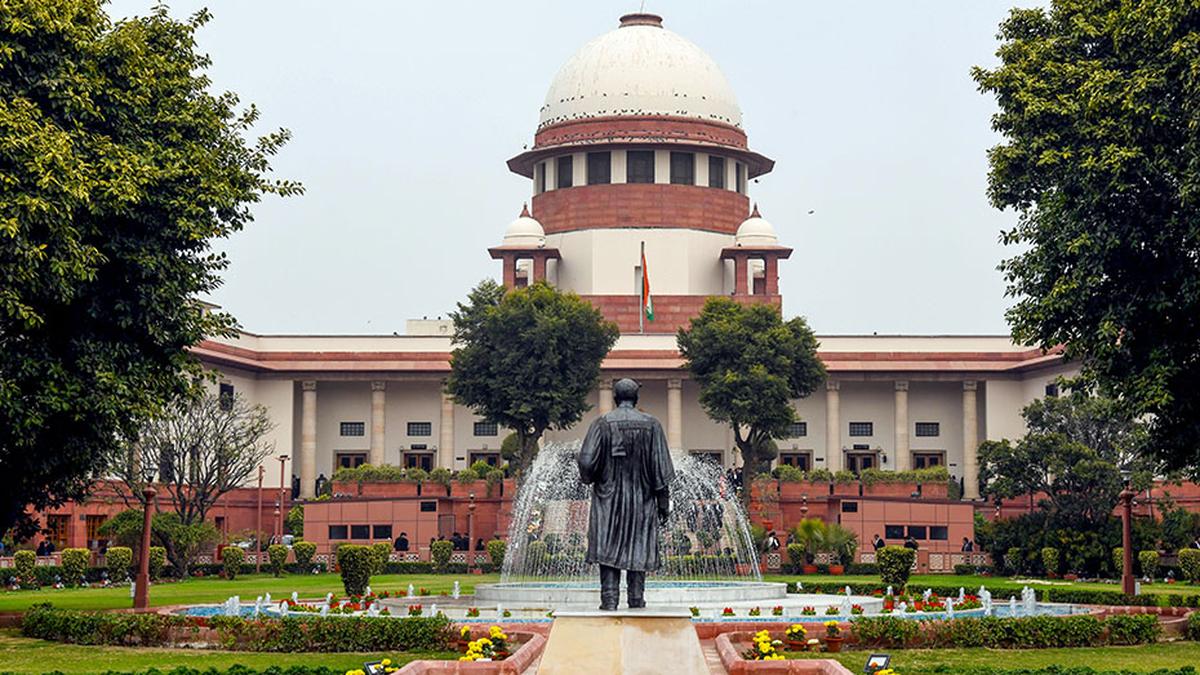
A view of the Supreme Court of India building, in New Delhi. Image for the purpose of representation only.
| Photo Credit: ANI
The Supreme Court on Thursday decided to examine a petition contending that Foreigners Tribunals apply an “incorrect standard of proof” by insisting that women in Assam, who are illiterate, marginalised, marry at a young age, and hail from rural areas, produce documentary evidence of their parental information and birth to establish Indian citizenship.
A Bench led by Justice Surya Kant issued notice to the Union government, Assam, the Election Commission of India (ECI), and other authorities on a petition filed by Meherunnessa, who has challenged a Gauhati High Court judgment upholding a Foreigners Tribunal finding that she was a foreigner who entered the State after March 25, 1971 – the cut-off date in Section 6A of the Citizenship Act.
“An exclusionary and discriminatory legal position would have a disproportionate impact on illiterate, marginalised, rural women and amount to ‘indirect discrimination’ which is prohibited under Articles 14, 15, and 21 of the Constitution,” the petition argued.
The 2019 High Court decision had concluded that the woman, now in her mid-fifties, “failed to make proof of the most crucial aspect, that is, in establishing linkage to her projected parents and/or the grandfather”.
An interpretation of the Foreigners (Tribunals) Order, 1964, which excludes oral evidence, would drive vulnerable women like the petitioner further towards statelessness and de-nationalisation, Meherunnessa, represented by senior advocate Kapil Sibal, and advocates Rupali Samuel and Yash S. Vijay, submitted.
The petition said she was born in 1969 in Mazdia village of Barpeta district, Assam, making her an Indian citizen by birth under Section 3(1)(a) of the Citizenship Act. It submitted that her family had been living in Assam since “time immemorial”. The names of her father and grandfather were included in the 1951 National Register of Citizens. She referred to a land purchase document from March 1956 in the name of her paternal uncle. Her family members’ names also figured in electoral rolls issued by the Election Commission of India. The petition swore that “her grandparents, parents or any other family member, have never visited any foreign country, including Bangladesh”.
She said she and her children were rendered “stateless” after a certificate issued by the gaon panchayat secretary of Mazdia village was rejected, while depositions of her brother Hamid Khan and paternal uncle Muslem Khan were dismissed as either untrustworthy or inadmissible. She argued that the lower courts relied on “minor inconsistencies” in the spellings of her parents’ names in the records to disprove her citizenship.
The petition contended that the High Court erred in relying solely on documentary evidence to prove linkage with her parents. The Evidence Act, 1872, and the Bharatiya Sakshya Adhiniyam, 2023, unequivocally render oral evidence of the existence of a relationship between two persons admissible and relevant. It said the High Court had failed to consider the petitioner’s socio-economic background while weighing evidence in her case.
“The petitioner, like many other women, has faced severe hardship in producing documentary proof of her parental information and birth. Unfortunately, her circumstances were not unusual for most women in India in the 1960-80s… Gender-based stereotypes in society have resulted in women being historically and customarily excluded from education, land rights and participation in public life in Assam as in other parts of India and the world,” the petition argued.
It said a substantial number of women in Assam were married before the age of 18 and before completing schooling. They subsequently moved to their husband’s home. According to the India Child Marriage and Teenage Pregnancy Report released by the National Commission for Protection of Child Rights, Assam is among the 12 States with child marriage rates higher than the national average. Such women are unable to have their names entered in voters’ lists along with their parental families and do not possess educational board certificates, the petition added.
Published – September 25, 2025 06:17 pm IST



