


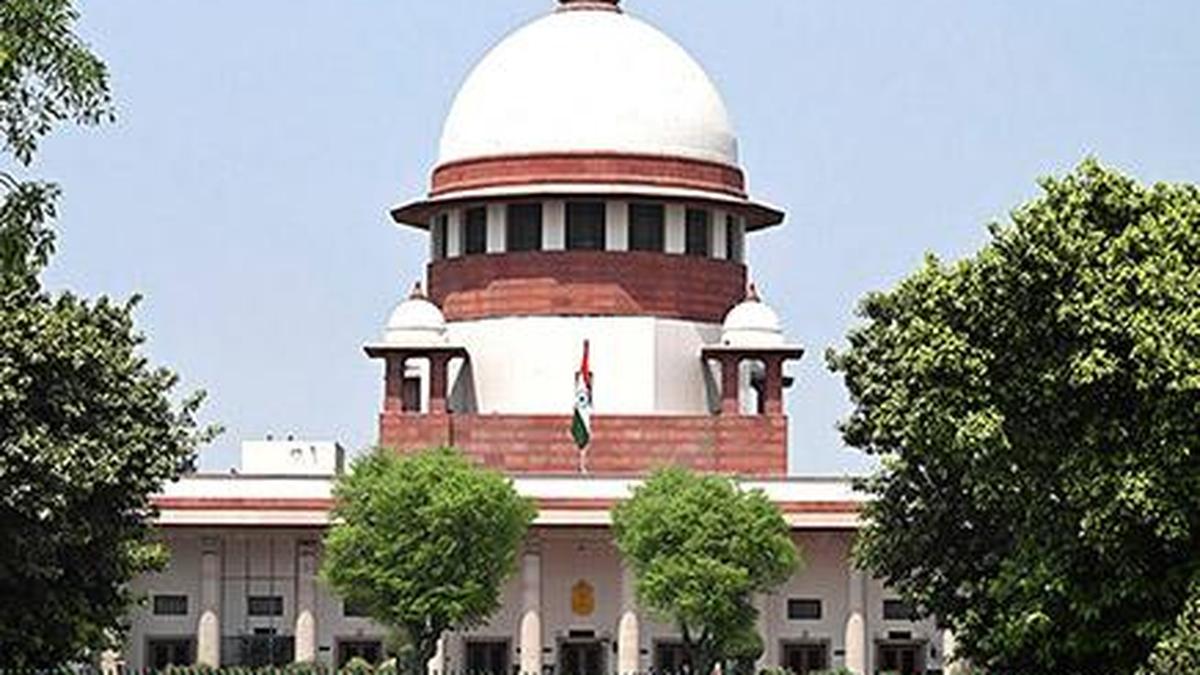
A view of Supreme Court of India, in New Delhi.
| Photo Credit: Sushil Kumar Verma
The Supreme Court on Thursday said that “migration” stated in the Special Intensive Revision (SIR) order could include illegal crossings into India, underscoring the Election Commission of India’s reason to verify citizenship.
“The cities in India are more urbanised, economically viable for our neighbouring populations. Will not the movement of these populations across the international border amount to ‘migration’?” Justice Joymalya Bagchi, part of a Bench headed by Chief Justice of India Surya Kant, asked.
The question was directed at senior advocate Raju Ramachandran and advocate Prasanna S., appearing for Tamil Nadu Communist Party of India (Marxist) leader P. Shanmugam.
Mr. Ramachandran was arguing that the citizenship verification drive conducted in the name of SIR was not one of the reasons stated by the Election Commission (EC) on June 24, 2025, to justify the need to embark on the exercise, which is now in its second phase across 12 States and Union Territories covering 51 crore people.
The senior counsel said that rapid urbanisation and “frequent migration of population from one place to another on account of education, livelihood and other reasons” were the motives stated by the EC on June 24 for holding the SIR.
“But migration can be trans-country,” Justice Bagchi observed.
Chief Justice Kant noted that an SIR was being held after two decades and said there were limits to judicial interference in the process. The SIR was not an “annual feature”.
Mr. Ramachandran responded that it was precisely because of the 20-year gap that the EC should have applied its mind more carefully. He said the June 24 SIR order was Bihar specific, yet the EC had copy-pasted the same reasons for conducting the exercise in industrialised States like Tamil Nadu.
He questioned why the EC had embarked on a mission to verify citizenship when an adequate statutory mechanism was already in place.
“If there is already a concerned person who is acting by law against suspicious people in the neighbourhood, why does the EC act like a more suspicious neighbour or a nosy parker? The Constitution does not give the EC power to play a vigilante role, an inquisitorial role,” Mr. Ramachandran submitted.
The court asked whether the EC could not, through the SIR, check one of the constitutional imperatives, citizenship, necessary for inclusion in the electoral roll. The CJI queried whether the EC could use Aadhaar and other documents to verify the genuineness of a claim to be included in the electoral roll.
“The EC should begin by trusting the public at large, not distrust them,” Mr. Ramachandran said.
Published – December 11, 2025 10:01 pm IST




