


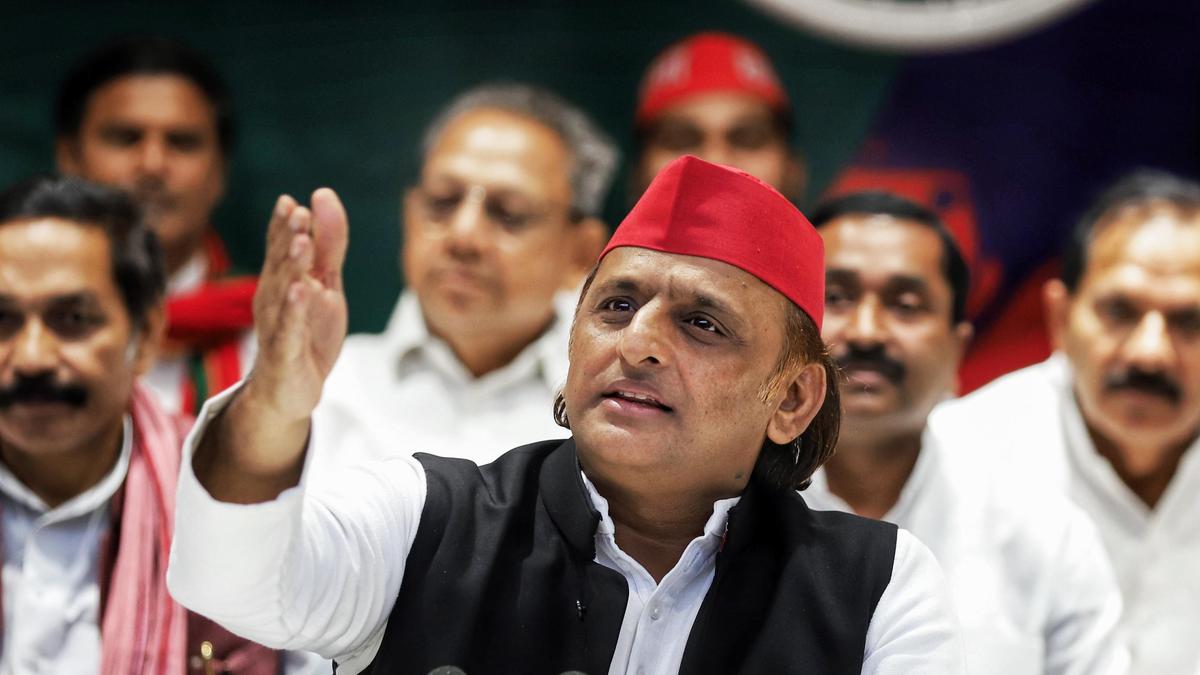
Samajwadi Party national president Akhilesh Yadav.
| Photo Credit: ANI
Aiming to counter the ruling BJP’s centralised narrative in Uttar Pradesh, the Opposition Samajwadi Party (SP) is preparing localised manifestos for specific regions for the upcoming Assembly election. The manifestos will focus on developmental needs of a particular area rooted in local demand, opportunities, livelihood challenges, and social dynamics.
While the party will release a State-level manifesto, it will also release localised region-centric manifestos. Party strategists entrusted with the responsibility argue that each region of the State has different geographical, economic challenges and opportunities, and addressing it will be the focus of the SP’s localised manifestos.

The party has started looking into the potentiality of various regions to outline policies, promises, and vision for improvement that are tailored to local needs and possibilities. It is proposed to have manifestos for regional clusters such as Agra, Bundelkhand, Devi Patan division and districts of Purvanchal (Eastern U.P.).
“It is true that Akhileshji, the national president of the Samajwadi Party desires that local manifestos are prepared for 2027. The rationale behind this is that U.P. is a huge State, and different regions have their own problems and issues as well different potential for development. These need to be attended to meet the aspirations of the people living there,” said Alok Ranjan, a retired 1978-batch Indian Administrative Service (IAS) officer and former U.P. Chief Secretary, who is closely working with the SP president on policy issues.

When asked how many local manifestos the party will prepare, Mr. Ranjan replied, “The number of such manifestos has not yet been finalised. However, the needs of each district would be reflected in the manifestos. It is proposed to have manifestos for regional clusters like Agra, Mathura, Vrindavan, Noida, Greater Noida, Bundelkhand, the least developed districts of Devi Patan division and districts of Purvanchal etc.”
Party insiders’ believe that localised engagement has the potential to overcome the BJP’s macro-nationalism narrative based on nationalism and mandir. It will help the SP to maintain its traditional voter base and present an agenda that is grounded in essential needs, local aspirations, livelihoods, and social justice, they said.

“We are looking at a granular exercise; the party will release a State-level manifesto, but localised region-centric manifestos will also be released. We are looking into the specifics and potential of various regions to outline our policies, promises, and vision for improvement that are tailored to the local needs and potential. For example, an Eastern U.P. district like Ballia has agriculture-related potential while Gautam Buddha Nagar is more industry-centric due to its geographical proximity to Delhi,” said Ram Pratap Singh, national spokesperson of the SP.
Regional disparity has become visible in the State on multiple occasions, even during the global investors summit, 2023, when just five out of 75 districts in U.P. received more than 50% of the total investment proposals. Gautam Buddha Nagar adjoining Delhi received 27.16% of the total investment proposals, while Ballia, close to Bihar, received a mere 0.06%.
Published – October 24, 2025 09:18 pm IST



