


‘Paruveta Utsavam’, the annual socio-religious procession from the forest fringes of Ahobilam to 33 villages nearby over about 40 days, has been happening uninterruptedly for over six centuries.
The procession stands as a symbol of equality and religious harmony. The idol of Lord Narasimha is taken to every street and household and the lion-headed God is believed to bless the devotees irrespective of their caste and religion.
The Government of India is all set to showcase the same to United Nations Educational Scientific and Cultural Organisation (UNESCO) to get it recognised as an ‘intangible cultural heritage’.
A legacy of communal harmony
The Chenchu tribespeople of Ahobilam, located in the heart of Nallamala forest, has a centuries-old association with the ancient Narasimha Swamy temple belonging to Sri Ahobila Mutt, which is its hereditary trustee.
According to Hindu folklore, the lion-headed God married Chenchu Lakshmi from the tribal community after slaying the demon-king Hiranyakashipu and rescuing his devotee Prahlada. The ancient temple not only has several places connected to the mythological episodes behind ‘Narasimha Avatar’, but the region is also richly intertwined with anecdotes and tales from scriptures.
With a sense of kinship and attachment to the God who married a girl from their clan, the Chenchu tribespeople firmly believes in perpetuating the ancient tradition, which was passed on to them by their forefathers over the past six centuries. As Chenchu Lakshmi is their sister, the Lord is treated as their brother-in-law who comes home for the Sankranti festival.
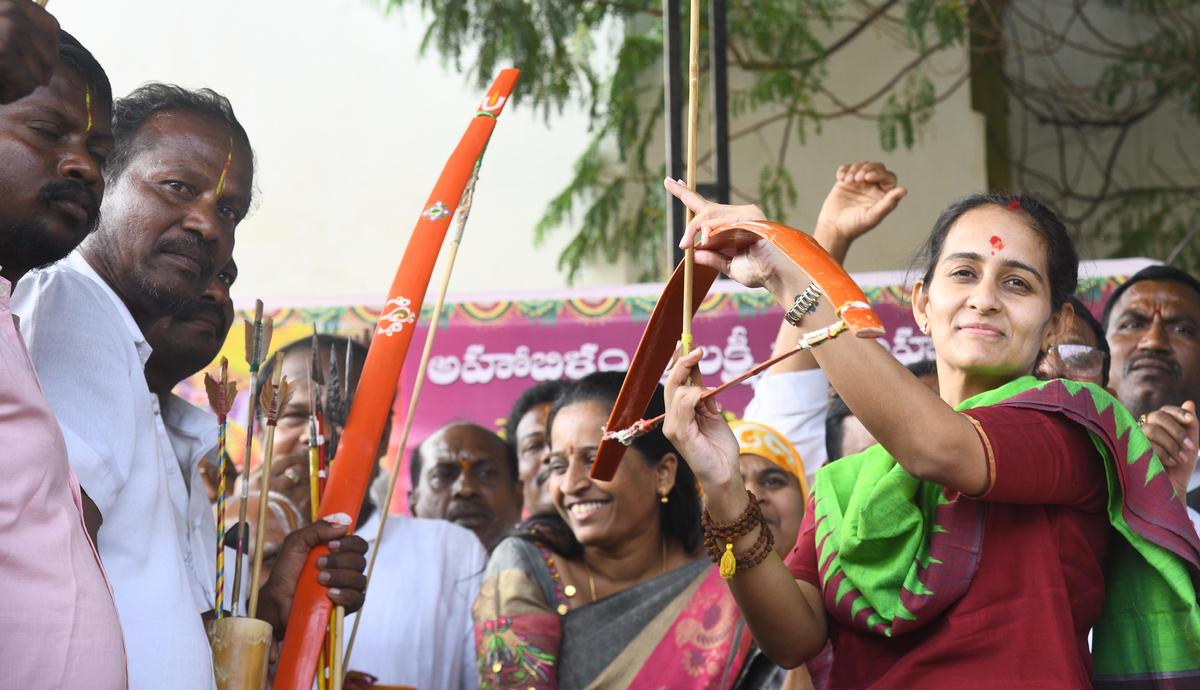
Member of Parliament (Nandyal) Byreddy Shabari with the 100-year-old bow gifted to her by the Chenchu community recently. Photo: Arrangement
Following in the footsteps of their ancestors, most families lead a simple life in the Ahobilam jungle, which is a part of the Nagarjunasagar Srisailam Tiger Reserve (NSTR).
The most senior member of the community is bestowed the right to aim the first arrow to the palanquin as a mark of farewell to the deity of Narasimha or Nrusimha as the God begins his 40 day sojourn. This year, 56-year-old Mokula Chinna Gurrappa from the Chenchu community of 150 households at Bandlagadda tribal hamlet (Chenchugudem) had the honour.
On January 16, he firmly aimed his arrow at the palanquin carrying the deity’s idol during the ‘Ambu Kottuta’ event. Two arrows are shot at the palanquin, in a symbolic representation that the procession is under their watchful eyes for the next 40 plus days. Following him, scores of tribal family heads, who arrived at the temple wielding bows, aimed their arrows at the palanquin to show their allegiance.
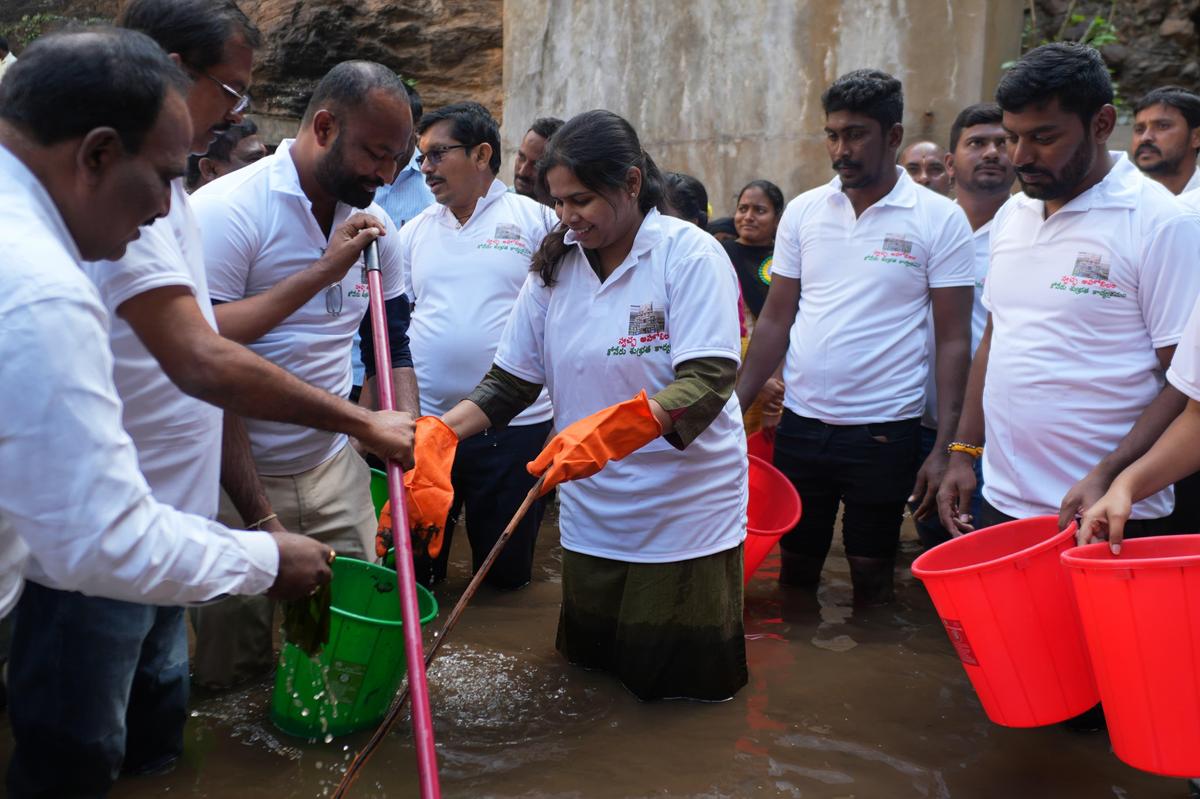
Allagadda MLA Bhuma Akhilapriya cleaning up the temple tank during a special cleanliness drive taken up by INTACH at Upper Ahobilam recently. Photo: Arrangement
This kicked off this year’s ‘Paruveta Utsavam’, and the palanquin carrying the idols of Prahlada Varada and Jwala Narasimha moved out of the forest fringe village of Ahobilam to the nearby villages, including the Allagadda town.
Mock hunting tradition
‘Kanuma’, the third of the three-day Sankranti festivities, is observed in temples across South India as ‘Paruveta Utsavam’, a mock hunting ritual, symbolising the ancient tradition of hunting as a pastime on festive occasions. It is apparently meant to bridge the gap between formal temple worship and community celebration.
The earliest inscriptional evidence of the temple festival dates back to the Kakatiya period during the reign of Prataparudra Mahadeva. Another inscription about the event, found on the west wall of the main shrine in Lower Ahobilam, dates back to 1546 AD, marking the Vijayanagara rule.
Sankranti is considered a time of both happiness and grief for the residents of Ahobilam, as Lord Narasimha goes out on a sojourn at nearby villages for a 40-day camp and returns only on the 41st day for his wedding.
As the folklore has it, the Lord goes to the 33 nearby villages and invites the public to his marriage, which is marked by a grand ‘Kalyanotsavam’ (celestial wedding). It is this sojourn that is enacted now in the form of a ‘Paruveta’ to the nearby villages. The divine wedding is attended by lakhs of devotees who converge on Ahobilam.
The palanquin is carried from village to village strictly by the palanquin bearers hailing from the Bestha Gangaputraa (fisherfolk). They walk for kilometres on rocky terrains, slushy soil and even cross waterbodies.
Once the idol arrives at a village, the responsibility of taking care of the divine delegation shifts to the local village head or chieftain. The palanquin is placed on a pedestal called ‘Telupu’, which is installed at the village centre. Ahead of the procession’s arrival, the Telupu is cleaned up, neatly white-washed and painted, mostly in brick red and white.
In fact, the villagers refrain from celebrating Sankranti along with others and conduct it only on the day the idol enters their village.
Stress on equality
The procession is marked by religious harmony as well. Though it goes through predominantly Muslim localities, no tense situation has arisen so far. In fact, every household in the village gets involved in the festivities, irrespective of their caste, sect or religion. “Narasimha is our village God, and we are glad to offer him garlands every year,” says Mohideen, a resident of Bachepalle.
While the Archakas (priests) are traditionally Brahmins, members of the Vadla Kammara community build the palanquin, those from the barber community play the musical instruments, the washermen community bears the torch throughout the procession and members from Scheduled Caste communities lead the procession. All of them are duly honoured at every village.
The palanquin moves ahead with equal grace through every village and household and is cheerfully received by all the residents. Similar zeal is expressed by the communities representing the merchants, artisans and agricultural labourers.
When it is the pilgrim who has to travel to receive blessings in most popular temples like Tirupati and Varanasi, it is the Lord who reaches the doorsteps of the devout to shower his blessings, a tradition unique to this ritual.
Festival of two states
According to government records, royal patronage was given to the event by the Kakatiya and Vijayanagara kings. After the bifurcation of Andhra Pradesh in 2014, this is the only festival that is honoured by both Andhra Pradesh and Telangana.
While the Andhra Pradesh recognised ‘Ahobilam Paruveta Utsavam’ as a State festival in March 2024, the Telangana government sends a sacred silk clothing to the temple on the occasion every year as a mark of reverence.
Moreover, the local community has dispatched one lakh postcards to the Rashtrapathi Bhavan, inviting President Droupadi Murmu to the festival next year. “We have requested her to participate in the event in 2027 and shoot the first arrow at the palanquin,” says Member of Parliament (Nandyal) Byreddy Shabari.
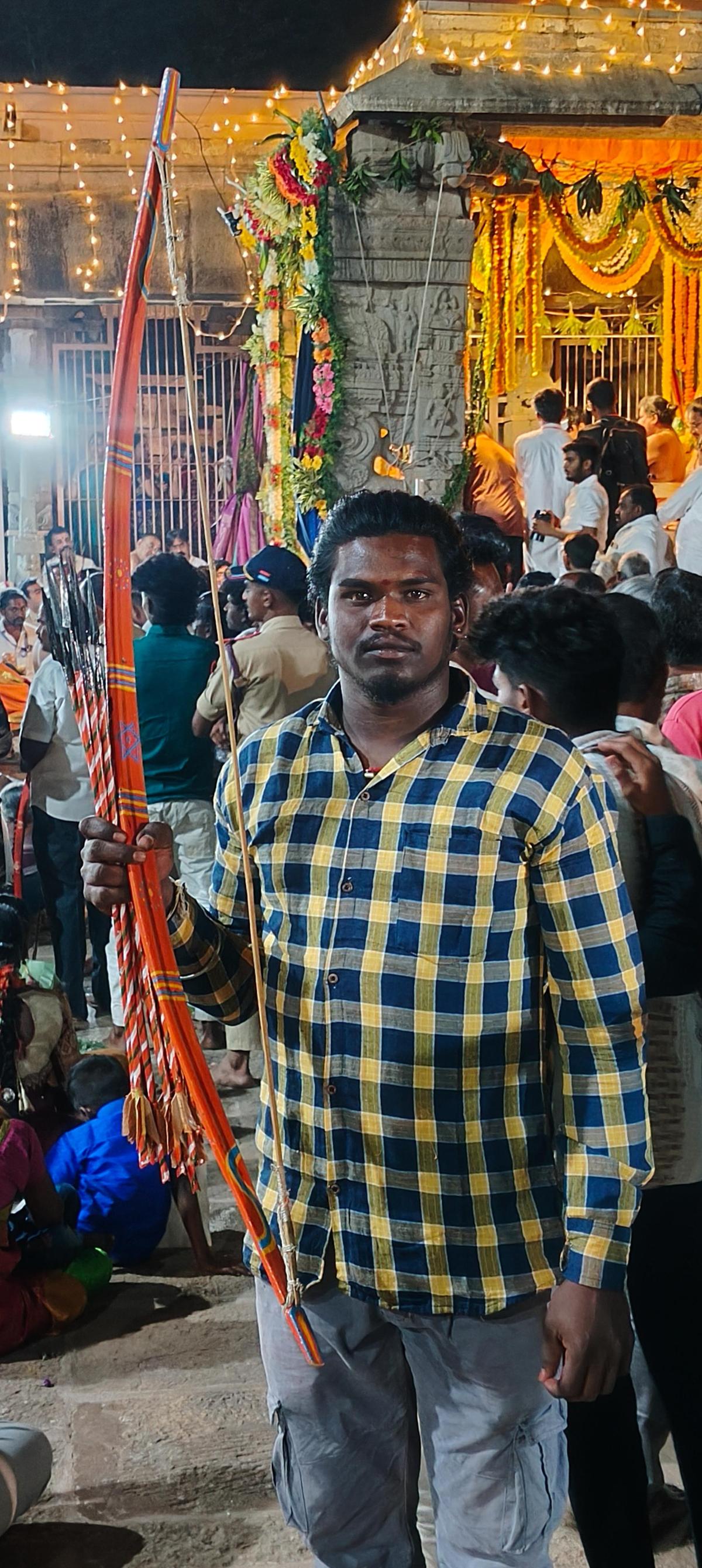
A Chenchu tribal youth with a bow and arrows participating in the Paruveta Utsavam at Ahobilam temple during the Kanuma festivities.
| Photo Credit:
A.D. RANGARAJAN
The government has developed civic infrastructure around Ahobilam in view of the heavy crowds and plans to invite delegates from the Centre for the annual Brahmotsavam scheduled in mid-February.
Allagadda MLA Bhuma Akhila Priya, who was the Minister for Tourism, proposes a two-pronged strategy to present Narasimha idols made by local sculptors to delegates in State events. In fact, ‘Allagadda stone carving’ has a Geographical Indication (GI) tag and the sculpture is famous across South India.
There is also a doctoral research by Ewa Debicka Borek of Jagiellonion University, Krakow (Poland), titled ‘Hunt without hunting: The reflexivity of all the stories behind Paruveta in Ahobilam’, which shows its global repute.
UNESCO tag
The Nandyal chapter of Indian National Trust for Art and Cultural Heritage (INTACH), headed by its convenor M.V. Sivakumar Reddy, has appealed to the Union Ministry of Culture to put the festival on the representative list of the ‘Intangible Cultural Heritage’ (ICH), akin to Gujarat’s Garba dance and Kolkata Durga Puja.
“The proposal is with Sangeetha Natak Akademi, and we expect the UNESCO tag to be accorded this year,” says Sivakumar Reddy. In fact, all the 33 panchayats involved in the festival have made unanimous resolutions seeking UNESCO tag and forwarded the same to the government.
The UNESCO tag is expected to bring global repute to the ancient festival, which is synonymous with unshakeable faith and egalitarian outlook.



