


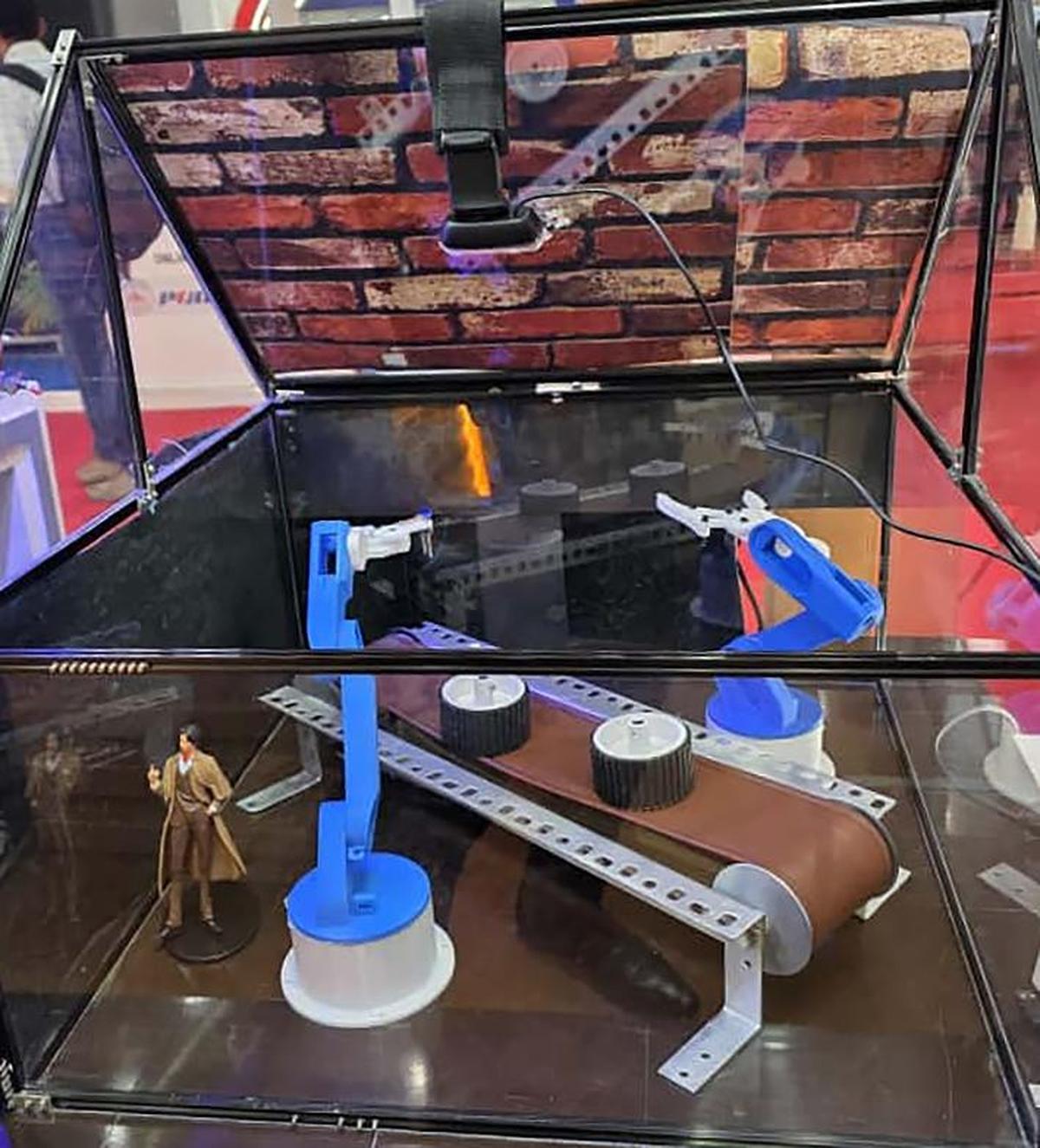
Researchers at IIIT-Bangalore have developed a computer-vision system that can spot flaws automatically on factory lines by comparing each product with a single perfect reference sample.
| Photo Credit: SPECIAL ARRANGEMENT
Imagine if a factory could check every product on its assembly line by only comparing it to one perfect photograph without training, huge datasets, and expensive Artificial Intelligence (AI).
A team at the International Institute of Information Technology Bangalore (IIIT-B) has built a computer-vision tool that can catch even hairline scratches, dents and tiny alignment mistakes using a single reference image. The system was also showcased at the Bengaluru Tech Summit 2025.
The team comprising Jyotsna Bapat, Sasirekha G.V.K and H. Sanjeev from Integrated MTech built this for factories that struggle with one recurring problem: inconsistent human inspection and expensive AI-based inspection.
Workers get tired, lighting changes across shifts, and small factories do not have the thousands of labelled images needed to train modern AI models. Most cannot afford GPUs or specialised camera rigs either.
This tool starts with a ‘golden reference image’ – a high-quality photo of what a perfect product looks like. Every new product on the line is compared to this one image. Before comparison, the system adjusts each new product to match the reference exactly, using a technique called ECC alignment. In simple terms, it ‘lines up’ the new photo with the perfect one until every pixel falls into place. It can correct small rotations or tilts automatically, so factories don’t need precision fixtures or robotic arms.
The researchers say the idea came from watching how small and mid-sized industries struggle with quality checks. Even when companies install AI systems, maintaining them becomes expensive and time-consuming because models need to be retrained whenever the product design changes or when new defects appear.
The IIIT-B team wanted something simple- a tool that workers could understand, that runs on a basic computer, and that does not break when lighting changes. Their biggest challenges included stabilising the ECC alignment for noisy textures, designing a noise mask that works on reflective surfaces, and ensuring that the final output was easy for factory staff to interpret.
While aligning, the system also learns the camera’s natural behaviour, its grain, its tiny vibrations, its sensor noise, and how reflections look on that surface. This becomes a baseline noise mask, which tells the software what is normal for the camera and what is an actual defect. This is crucial because low-cost cameras often produce false alarms when light shifts slightly or when metal surfaces reflect differently. The baseline mask filters such issues.
Once alignment is done, the system enhances brightness using CLAHE (a method that evens out lighting), subtracts one image from the other pixel by pixel, checks how structurally similar they are, and then highlights only the differences that matter. These differences are shown as a colour-coded defect map, making it easy for even non-technical factory staff to understand where the flaw is.
Because of this careful filtering, the tool can pick up defects as small as a few pixels, even those that the human eye might miss. It works on flat parts, slightly curved surfaces, metals, reflective or semi-reflective materials, and parts that shift slightly on conveyor belts.
Factories can detect multiple defect types at once including scratches, dents, foreign particles, texture irregularities, shape mismatches or rotation errors.
The tool has been tested on different categories of products under different lighting conditions. According to the team, it consistently achieves up to 98% accuracy with low false positives and processes each image in under 13 seconds on a regular CPU. No GPU is required, and no AI retraining is ever needed. The strictness can be adjusted depending on how sensitive a factory wants the detection to be, helping avoid unnecessary rejection of good items.
The tool, they believe, can help industries reduce inspection time, cut down wastage, and make quality control more predictable. It also brings advanced automation within reach for small and medium industries that often cannot afford deep-learning-based inspection systems.
Published – November 29, 2025 09:50 pm IST



