


“My crop is ready for harvest, yet a single night is enough to lose everything,” says Rajendran (65), his voice heavy with concern as he surveys his groundnut field near Ragimanupenta village in Bangarupalem mandal of Chittoor District. Speaking in Tamil, the farmer turns to elephant tracker Subramani and asks, “Nethu iravu antha ‘kamnaatingala’ sattham kettingala?” — “Did you hear them last night, the sound of those kamnaatingala (widows)?”
“They crossed the ridge again. I found fresh tracks near the canal,” the farmer says. In response, the elephant tracker crouched down to study the soil. “Aamaam, oru chinna koottam—ainthu, illa aaru. Tamil Nadu pakkam irundhu vandhirukkaanga. Indha thadavai konjam neenda neram thanguraanga” — “Yes, a small herd—five, maybe six. They’ve moved in from the Tamil Nadu side. This time, they are staying longer,” says Subramani.
“We have alerted the Kumki team — a group of specially trained elephants and their mahouts deployed by the forest department to manage wild herds,” the tracker says calmly. He adds, “They will guide the elephants back before they reach the fields. But you must remain cautious.”
The farmer’s gaze drifted toward the forest edge. His voice, heavy with worry and almost as if pleading with the universe, carried a simple message: “We don’t want trouble. We just want to protect what we’ve grown.”
The tracker assured the farmer saying: “They are only looking for food and a path. If we understand their movement, we can avoid conflict.”
Human-elephant conflict
The saga of Asian elephants venturing into human habitats from the forests bordering the tri-States of Andhra Pradesh, Tamil Nadu, and Karnataka—particularly affecting the A.P. districts of Chittoor, Tirupati, and Annamayya—is no longer merely a story of fear and panic. It has become one of devastating losses: human lives, livestock, crops, and even wild elephants, coupled with endless sleepless nights for families living along the forest fringes.
The elephants, which began reappearing in the tri-state junction in the early 1980s after a hiatus of eight decades, adopted a natural corridor linking the forests of Karnataka and Tamil Nadu. Till 2000, their movement remained seasonal and relatively predictable. But over the years, the corridor shrank, leading to herds straying across the erstwhile Chittoor district.
Rapid expansion of agriculture, massive road construction with expressways and national highways, and mushrooming human settlements gradually fragmented their habitat. What was once a continuous stretch of forest turned into disconnected patches, forcing elephant herds to adapt in ways that often brought them closer to human habitation.
People from the agrarian belt—stretching from Bangarupalem to Kuppam, along the fringes of the Koundinya Wildlife Sanctuary, the Maharaja Kadai forests of neighbouring Tamil Nadu, and the forest stretches bordering Karnataka—vividly recall the past.
“There was a time we didn’t sleep at all during the crop season,” recalls R. Muniswamy (63) of Ramakuppam mandal, standing beside a patch of land that once bore the brunt of repeated raids by wild elephants. “Our family members would take turns staying awake at night. If elephants charged into our fields, everything would be gone before dawn. We had no way to stop them. It was the early 2000s,” he says.
Fear and uncertainty
With frequent crop losses, villagers began viewing elephants as forces of destruction. Fear became part of daily life, especially during harvest seasons.
A 60-year-old forest watcher in Palamaner observes: “It was clear-cut. Conventional responses such as chasing away elephants with firecrackers, drums, or vehicles were outdated. In most cases, such measures only aggravated elephant movement.”
“Earlier, their routes were known,” says M. Pattabhi, Forest Range Officer (Chittoor). “Now they move unpredictably. They split into smaller groups, stay longer near villages, and often return to the same areas. That unpredictability creates tension.”
Till 2010, the narrative in the forests of Palamaner and Kuppam divisions—the core belt of the Koundinya Wildlife Sanctuary—was dominated by anxiety and conflict. Now, it is a progressive story of adaptation: of a landscape learning, slowly and imperfectly, to live with these gigantic beasts, and of people discovering ways to coexist with the wild rather than confront it.
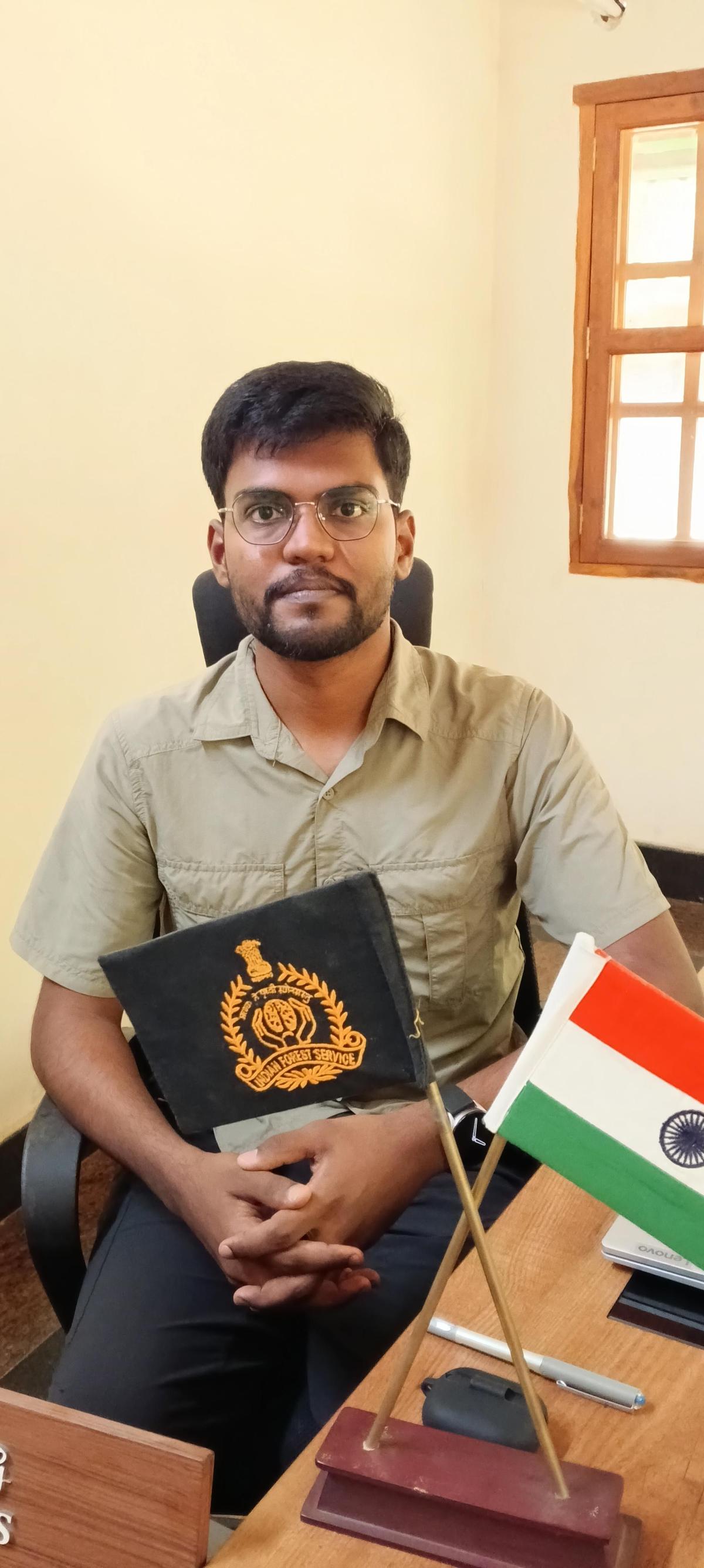
G. Subburaj, District Forest Officer, Chittoor. Photo: Special Arrangement
The Kumkis
To create a more organised system for tackling crop-raiding herds, the Forest Department introduced kumki-based operations around 2005, though they gained momentum only a decade later. “The idea was simple in concept but complex in execution. We needed well-trained elephants, guided by skilled mahouts, to influence the movement of wild herds and gently steer them away from human settlements,” explains G. Subburaj, District Forest Officer (Chittoor).
This initiative led to the establishment of the Naniyala Kumki camp in Ramakuppam, within the Kuppam Assembly constituency, which soon became the operational hub for elephant management in the Koundinya sanctuary belt, spread over 500 square km.
The Naniyala camp houses two majestic and highly experienced kumkis—Jayanth and Vinayak—both in their late 60s. “Jayanth leads,” says his mahout, his voice carrying both pride and familiarity. “When he moves forward, wild elephants take notice. He doesn’t panic. Instead, he instils fear in the wild herds. Jayanth is capable of intimidating a herd of twenty. That confidence matters.”
The mahout describes Jayanth’s presence as large yet composed, and highly responsive to commands. He explains that Jayanth can alter the behaviour of an entire herd. Often deployed in front-line situations where direction must be established, Jayanth takes the lead while Vinayak complements him.
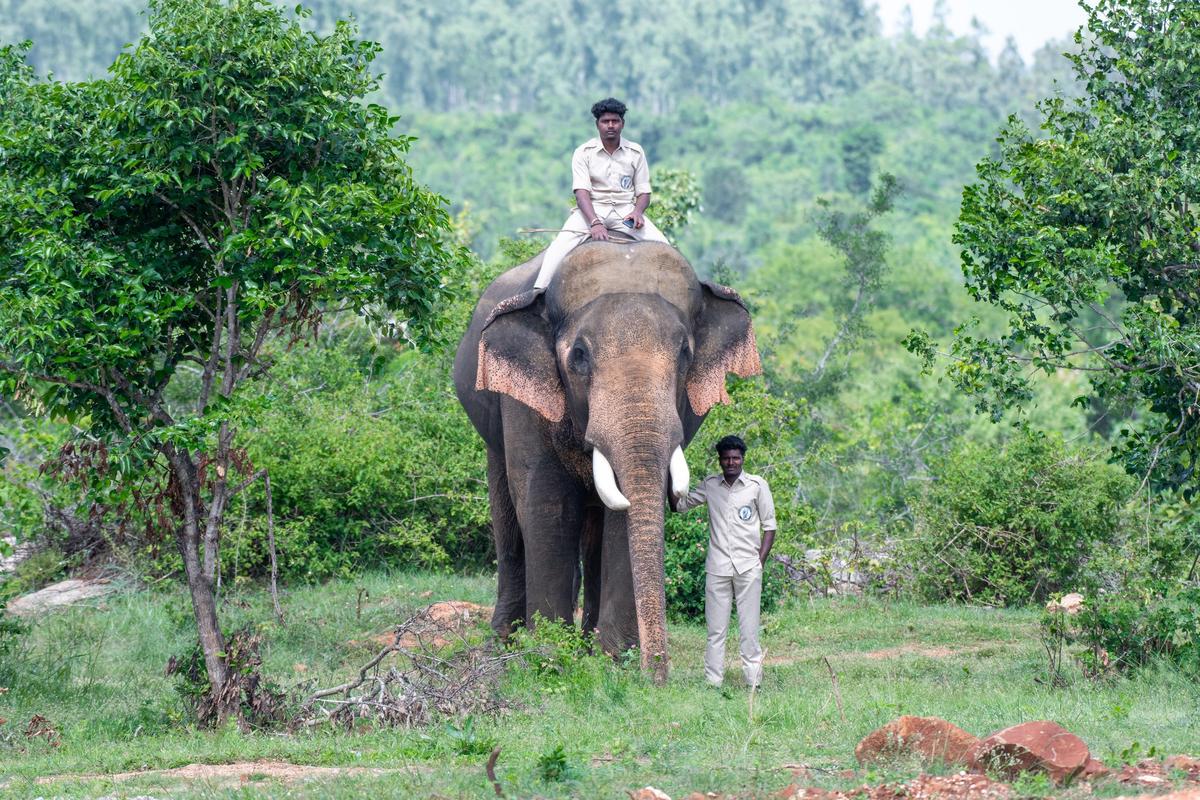
Vinayak at Naniyala Elephant camp in Ramakuppam.
| Photo Credit:
BY ARRANGEMENT
“Vinayak is more observant,” explains another handler. “He carefully scans the forest terrain and adjoining fields. If the herd charges suddenly or becomes aggressive, Vinayak adapts quickly. He is ever ready to swing into action and restore balance. In fact, both Jayanth and Vinayak rarely charge at their wild counterparts. When the duo advances, the wild elephants often retreat voluntarily into the forest, leaving the fields. The challenge is that they wait for the duo to move away and then return stealthily,” he adds.
Together, they form a coordinated unit. Their combined efforts have transformed many potentially volatile encounters into controlled, measured operations. On more than half a dozen occasions, the duo prevented wild herds from crossing the Chennai–Bengaluru railway tracks. In another instance, when a group of elephants from Tamil Nadu began rampaging through crops from Puttur to Nagalapuram—over 200 km from their entry point—the Jayanth–Vinayak duo successfully drove them away after a month-long operation.
In addition to the Naniyala camp, established about two decades ago, the department later set up a more recent facility. As elephant movement spread into newer pockets of Chittoor district, the limitations of a single camp became evident. A second kumki camp was established at Palamaner about eight months ago. Deputy Chief Minister Pawan Kalyan inaugurated the camp amid much fanfare, but its true significance lies in its long-term vision of coexistence.
Together, these centres represent a paradigm shift in how elephant movement is managed across the three vital districts of southern Andhra Pradesh. Crucially, they mark a transition from reactive measures to a more structured, humane, and long-term approach to coexistence.
Four Kumkis join the fight
Four elephants—Krishna, Abhimanyu, Ranjan, and Deva—were brought from Karnataka to form the core of this new unit at Palamaner. “These elephants are still under training,” says Forest Range Officer (Palamaner) R. Narayana. “They are learning to respond to as many as 64 commands, to work in teams, and to operate in field conditions. It takes time, but they are progressing well.”
Each elephant brings a distinct personality to the camp. “Krishna is quick to grasp commands and shows strong learning ability. Abhimanyu is calm and dependable, often preferred in situations requiring steady control. Ranjan has an unpredictable streak, but his responsiveness in critical moments makes him valuable. Deva, despite being blind in one eye, has adapted remarkably well, relying heavily on his bond with handlers,” the Forest Range Officer says.
“They are like individuals, not just animals,” says kavadi (mahout’s assistant) Hari. “You cannot treat them all the same. You have to understand each one,” he adds.
Behind every kumki operation lies a relationship built on trust. Each elephant is paired with a mahout and a kavadi, who spend years working closely with it. The bond is not formed overnight; it is built through routine, patience, and constant interaction.
“They understand our tone, not just commands,” says Nadeem, an experienced mahout at the Palamaner camp. Born into a family of traditional mahouts and having worked in Mudumalai and Bandipur reserves for years, he adds: “Even a slight change in voice, they notice. That connection is very important.”
“When I take leave to visit my family in Mysore, I feel like returning to my elephant the moment I reach home. Something grips my heart. I begin to feel uneasy, worrying that in my absence, Deva might feel lonely or may not eat well,” Nadeem says.
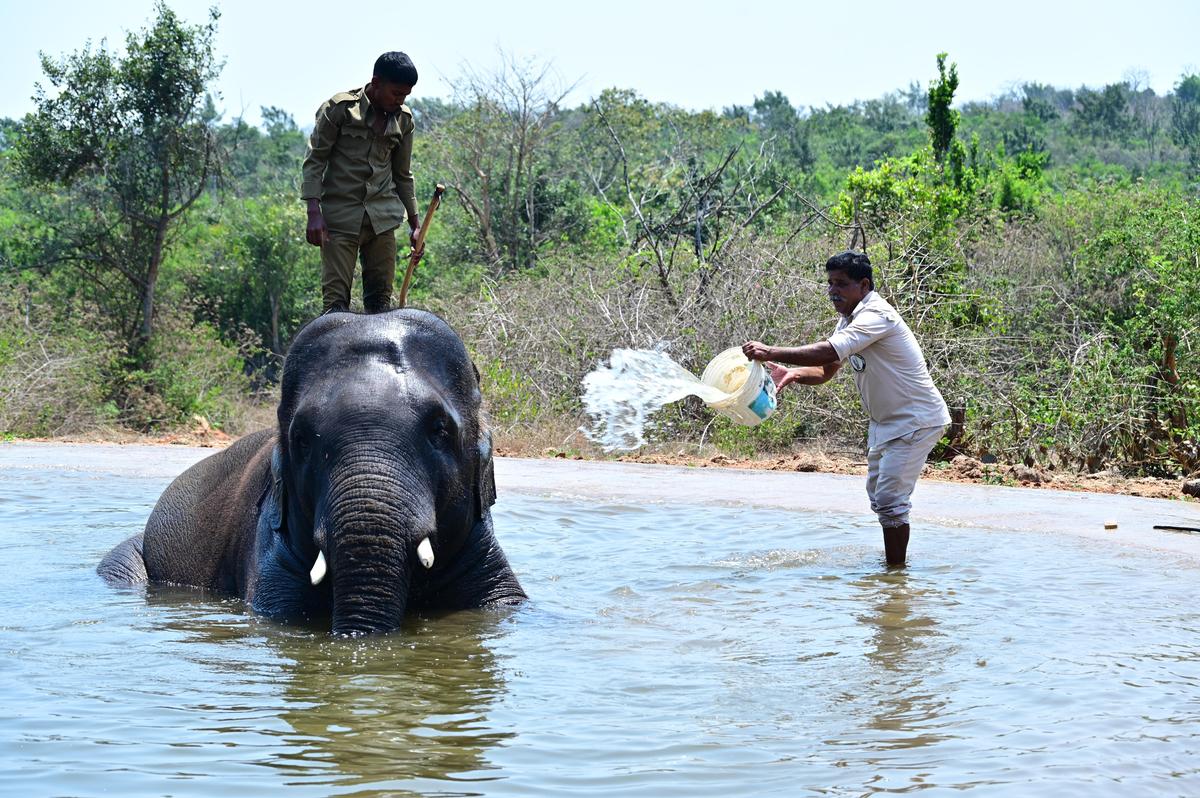
Mahout and his Kavadi giving a bath to Kumki elephant Krishna at Palamaner camp.
| Photo Credit:
BY ARRANGEMENT
Care and activities
Daily life at the camp revolves around a disciplined routine, with feeding occupying a significant portion of the day. Ragi balls, sugarcane, jaggery, and green fodder form the staples, supplemented by natural grazing. “An elephant spends most of its day eating,” explains the camp’s senior zoologist, Bhuvan. “We follow that natural pattern.”
Water plays an equally important role. “In the afternoons, especially during summer, they need to cool down. Once they enter the water, they relax completely. After that, they become much more focused. Moments like these reveal a different side of the animals—they turn playful, calm, and almost childlike. For the mahouts, such moments are reminders that beyond their operational role, these are living beings with their own rhythms and moods,” says Bhuvan.
Despite the growing importance of kumki elephants, a significant gap remains in public participation. In 2021–2022, then District Forest Officer Ravi Shankar introduced an adoption programme, allowing individuals and organisations to contribute towards the upkeep of elephants. However, the response was zero. “We still have the system in place,” says a senior forest official in Chittoor, “but awareness is still low. No one has come forward.”
Maintaining a kumki elephant is resource-intensive. Daily fodder alone requires substantial expenditure, and this is further compounded by veterinary care, staff salaries, and infrastructure maintenance. Visitors often come to the camps, observe the elephants, and express admiration—but that admiration rarely translates into sustained support.
“Each elephant needs continuous care,” DFO Subburaj says. “This is not a one-time contribution. It requires long-term commitment. A kumki camp is an institution built to last.” Despite ground-level challenges, something fundamental is changing in the way people view elephants.
“Earlier, we only saw them as a danger,” says a woman farmer who lost her husband in a wild elephant attack near Ramakuppam a few years ago. “Now we understand that they are also trying to survive. The problem is not just them—it is the situation. They roam not to disturb humans, but to find food.”
Officials believe that kumki operations have played a major role in this transformation. The sight of trained elephants guiding wild herds without violence has reshaped public perception. “When people see that elephants can be managed without harming them, they feel more confident,” says Fayaz, a mahout at the Palamaner camp.
As evening descends over the camps, the pace slows. The elephants return from their routines, their massive silhouettes blending into the fading light. For the mahouts, it marks the end of another day of quiet and demanding work. For farmers in nearby villages, it means a night with a little less uncertainty. It reflects a slow but meaningful transition from conflict to coexistence.
Joint effort
“This is not just about managing elephants,” says Subburaj. “It is about creating a system where both people and wildlife can survive together. This cannot function in isolation. Public support is crucial—awareness, adoption, participation. All are interconnected. It is the responsibility of the wider community to stand by these magnificent elephants, not just admire them,” adds the DFO.
The forests between the Koundinya Sanctuary and Sri Venkateswara National Park are still evolving. With more than a hundred wild elephants in the region, the challenges are far from over. Corridors remain fragmented, and pressure on land continues to grow. Yet, within this changing landscape, the kumki camps stand as a symbol of possibility.
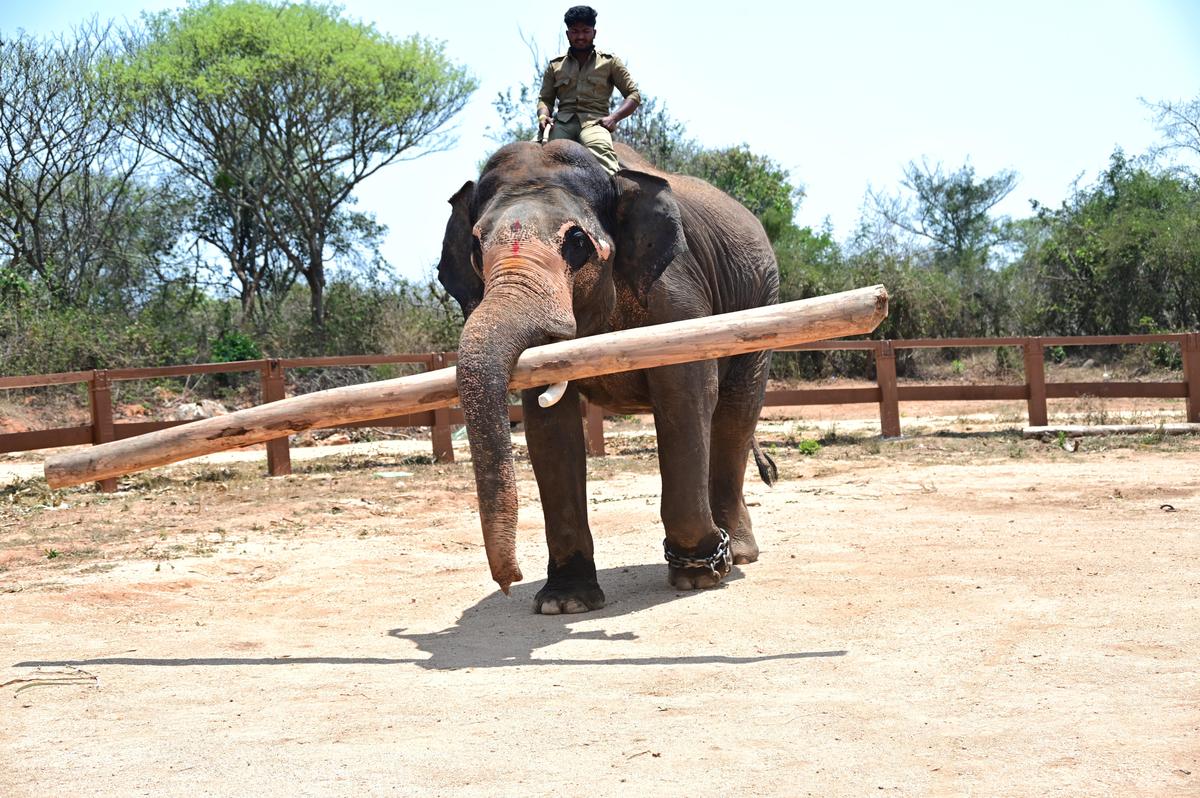
Ranjan, most agile among four Karnataka Kumkis, at routine drill in Palamaner camp.
| Photo Credit:
BY ARRANGEMENT




