


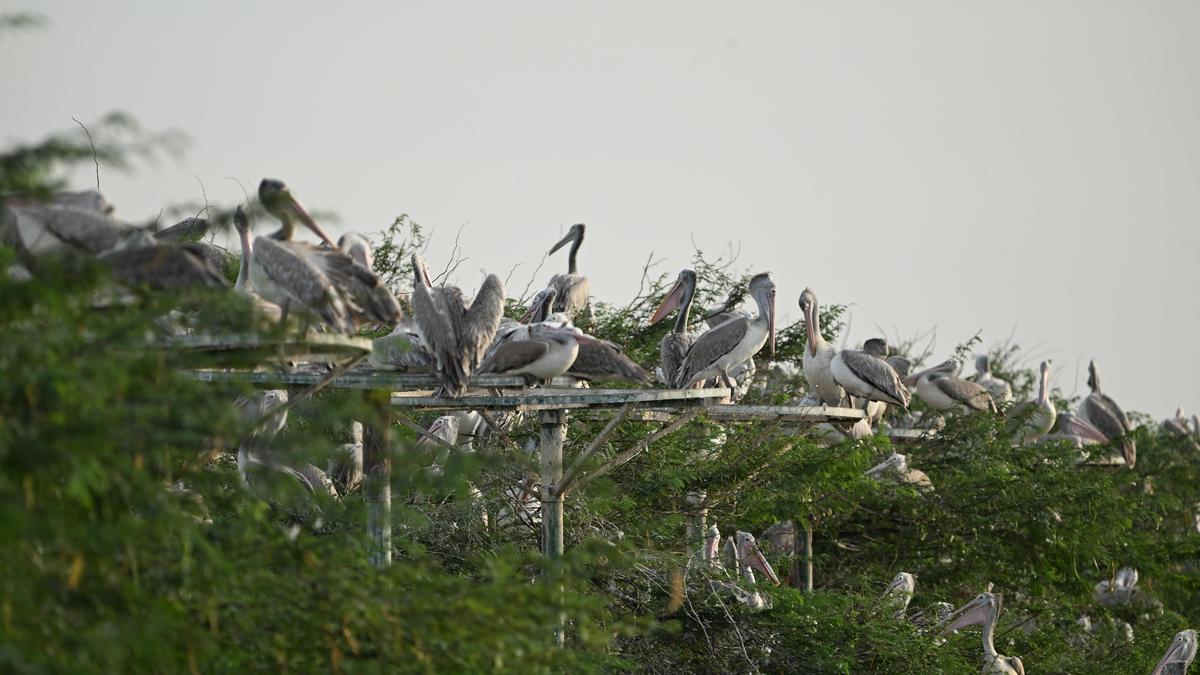
Migratory birds flock at Kolleru Wildlife Sanctuary in Eluru district.
| Photo Credit: KVS GIRI
Since the first days of January unfolded, Kolleru Wildlife Sanctuary has transformed into a living and breathing tapestry of wings, calls, and silent glides.
As the winter sun rose gently over the vast wetland, revealing a sanctuary alive with movement, the seasonal reunion of resident birds and long-distance travellers who had crossed continents to find refuge in its waters became more vivid.
As dawn broke over the lake, small flocks of Ashy Prinia (Prinia socialis) darted through reed beds, their quiet presence contrasting sharply with the overwhelming dominance of the wetlands’ signature species, the Asian Openbill (Anastomus oscitans).
With a recorded population of 1,004 birds, the openbills formed dense feeding congregations, turning mudflats into scenes of relentless activity.
Ducks dominated open water expanses. Mixed flocks of Northern Pintail (Anas acuta), Gadwall (Mareca strepera), Spot-billed Duck (Anas poecilorhyncha), and other Anatidae species collectively ran into several thousands, rising in synchronised waves whenever disturbed, a living demonstration of wetland harmony.
The wetland’s ecological depth is reflected not only in abundance but also in rarity. Just three birds of Baillon’s Crake (Zapornia pusilla) were sighted, a reminder that Kolleru also shelters species that thrive away from attention.
Nearby, Black Ibis (Pseudibis papillosa) moved deliberately through shallow waters, while elegant Glossy Ibis (Plegadis falcinellus) added iridescence to the winter palette.
Kolleru came alive with Yellow Wagtail (Motacilla flava), counted at an impressive 699, their constant motion mirroring the dynamic pulse of the sanctuary. Ground-level drama unfolded as Yellow-wattled Lapwings (Vanellus malabaricus) defended territories with sharp alarm calls.
Migratory shorebirds made their seasonal claim on the lake’s fringes. Bar-tailed Godwits (Limosa lapponica) probed the mud with tireless precision, accompanied by Wood Sandpipers (Tringa glareola) and Common Sandpipers (Actitis hypoleucos), reinforcing Kolleru’s role along the Central Asian Flyway.
Divisional Forest Officer (Territorial) B. Vijaya Suneetha told The Hindu that Kolleru Wildlife Sanctuary recorded a total of 96,195 birds belonging to 116 species during the first week of January, reaffirming its status as one of South India’s most important wintering grounds.
The migratory birds will continue to flock at the sanctuary till Maha Sivaratri festival. As the temperatures will start rising thereafter, the migratory birds would fly back to their native places, she said.
Published – January 13, 2026 11:02 pm IST



