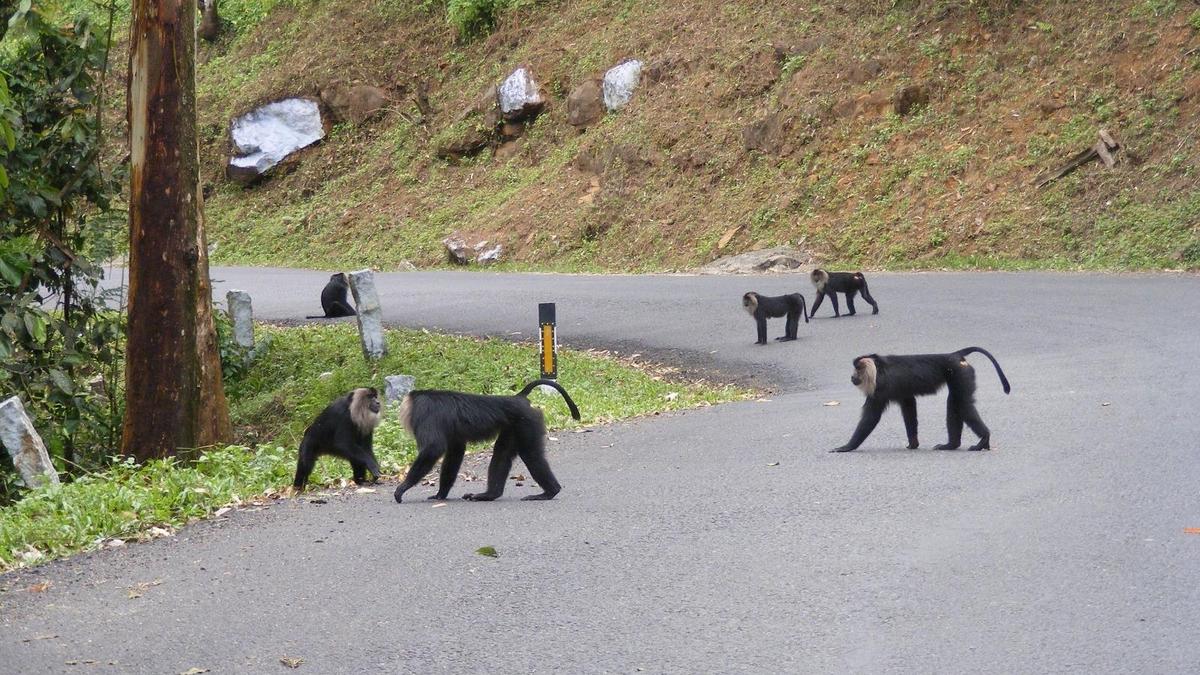
Lion-tailed macaques numbers found rising in non-protected areas due to availability of food.
| Photo Credit: SPECIAL ARRANGEMENTS
In the fragmented ancient rainforests of Anamalai Hills, an unlikely conservation paradox is unfolding. The lion-tailed macaque — one of India’s most endangered primates — appears to be thriving not in the deep, undisturbed forests, but amid bustling human activity: plantations, tourist trails, hydel projects and expanding road networks.
This growth beyond the forest’s protective boundaries might seem like a rare conservation success for a species already grappling with habitat loss. But scientists warn that rising populations in non‑protected areas could turn into a long-term threat rather than a victory.
Researchers from three institutions, including the CSIR–Centre for Cellular and Molecular Biology (CCMB), caution that the increase is driven largely by easy access to food associated with human presence. Yet this dependence, they say, also exposes the macaques to higher risks — from road accidents and electrocution to intensifying tourism and logging.
Drawing on data from a 40-year study across the fragmented forests of the Anamalai Hills in the Western Ghats, scientists found that macaque populations within protected forests remain demographically stable. Although growth is slower, these groups show healthier age–sex ratios, including a stronger presence of adult females.
The study followed 37 macaque groups from dawn to dusk across 10 rainforest fragments. Of these, 29 groups lived within protected areas, such as tiger reserves, while eight groups occupied non-protected spaces like tea, coffee, and teak plantations, human settlements, and livestock-grazing regions.
These unprotected zones offer an abundance of fruit-bearing trees and see heavy tourist and vehicular movement. Garbage piles and food waste create additional, readily accessible food sources for the macaques. While birth rates did not differ significantly between protected and non-protected regions, population stability was notably higher inside protected forests. Group sizes in these areas showed a negative correlation with canopy height — a reminder that an intact canopy remains essential for this arboreal species.
Highlighting long-term risks from growing human disturbance, road building and power infrastructure, the scientists call for urgent interventions to maintain canopy continuity. Such measures, they say, are critical to preventing accidents as monkeys travel in search of food.
Traffic regulation at vulnerable points, enforcing speed limits, installing speed breakers at wildlife crossing zones and controlling tourist inflows into sensitive habitats could greatly reduce mortality. Pilot efforts in Tamil Nadu have already shown promise and could be scaled up, Chief Scientist at CCMB’s Laboratory for Conservation of Endangered Species (LaCONES) said G. Umapathy.
Other researchers in the project — Sanatanu Mahato and H. N. Kumara of the Salim Ali Centre for Ornithology and Natural History (Coimbatore), and Mrudala Singh and Mewa Singh of the University of Mysore — stress the need for a comprehensive management plan for the lion-tailed macaque. Such a strategy could serve as a model for other parts of the Western Ghats, a global biodiversity hotspot. Their findings appear in the latest issue of the Journal for Nature Conservation.
Published – February 11, 2026 10:34 pm IST