


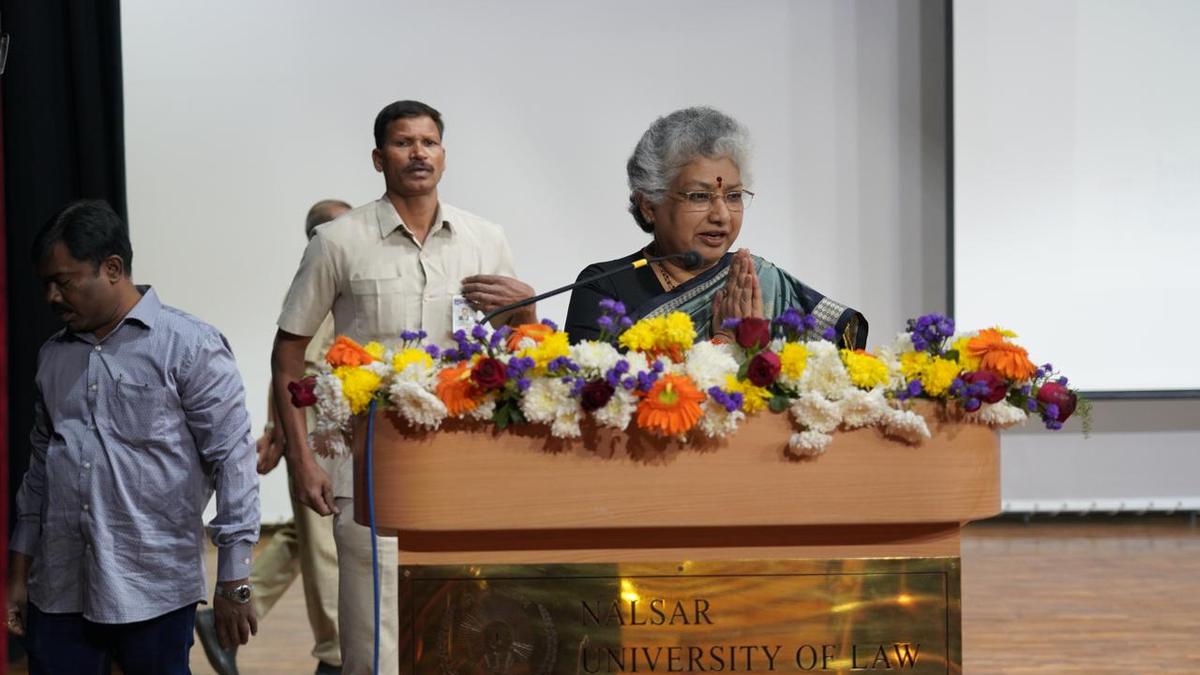
Justice B. V. Nagarathna, Judge and Chairperson of the Juvenile Justice Committee of the Supreme Court of India, speaking at the two-day National Consultation on ‘The Treatment of Children in Conflict with the Law as Adults: Rights Implications’ at NALSAR University of Law, Hyderabad.
| Photo Credit: Special Arrangement
A two-day National Consultation on ‘The Treatment of Children in Conflict with the Law as Adults: Rights Implications’ was held at NALSAR University of Law, Hyderabad concluded on Saturday, marking 10 years of the Juvenile Justice (Care and Protection of Children) Act, 2015.
The juvenile justice system reflects the reformative and rehabilitative spirit of the law at its core, Justice B. V. Nagarathna, Judge and Chairperson of the Juvenile Justice Committee of the Supreme Court of India, said in her inaugural address. She stressed that Juvenile Justice Boards must sit regularly and not merely on an occasional basis. Referring to several Supreme Court judgements, she highlighted the importance of progressive judicial interpretation. Public outrage cannot dictate judicial proceedings, which must instead be guided by discipline, humility and fidelity, she added.
Chief Justice of Telangana High Court Justice Aparesh Kumar Singh, in his address, highlighted the intricacies of the Juvenile Justice Act, including the Preliminary Assessment and Transfer System. He noted that the 2015 Act marked a significant departure from the restorative and rehabilitative philosophies of the Juvenile Justice Act, 2000.
Vice-Chancellor of NALSAR University of Law Srikrishna Deva Rao, in his address, underscored the importance of due process in the juvenile justice system. He reiterated that procedure is as vital as the principles laid down in the legislation, describing juvenile justice as “tender justice” and pointing to the moral commitment of the law towards the care and protection of children in conflict with the law.
Across multiple panels and dialogues, participants flagged serious legal, procedural, psychological and rights-based concerns arising from the practice of treating children as adults, particularly through preliminary assessments under Section 15 of the JJ Act.
Participants noted that these courts often function administratively rather than as robust reviewing authorities, with limited scrutiny of Juvenile Justice Board orders and minimal post-order monitoring of rehabilitation. It was further pointed out that children tried in Children’s Courts frequently face delays, logistical barriers, lack of access to records and inadequate legal representation, often experiencing the juvenile justice system as more onerous than the adult criminal justice system.
Published – January 25, 2026 10:07 pm IST



