


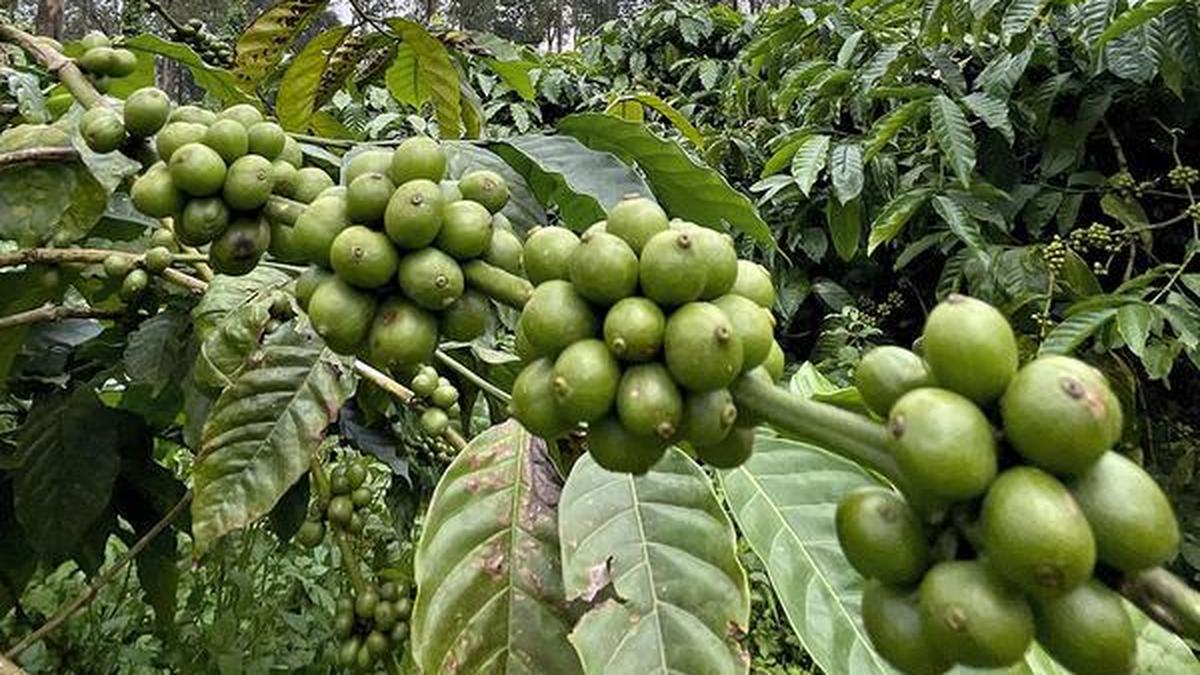
Coffee growing in India was purely dependent on weather conditions.
| Photo Credit: file photo
The absence of a weather-linked insurance policy for coffee places growers in India in an extremely vulnerable position, said Arvind Rao, president, Karnataka Planters’ Association (KPA), a body that represents coffee growers in Chikkamagaluru, Hassan, and Kodagu districts, which account for over 70% of the country’s total coffee production.
Mr. Rao said coffee growing in India was purely dependent on weather conditions. Timely blossom showers and an overall good rainfall in a year means everything for coffee cultivation. Also, global warming with unpredictable rainfall was causing extreme drought, landslides, soil erosion and degradation, affecting plans and reducing yields, he explained.
“When the vagaries of nature often play havoc, coffee crop significantly reduces and farmers incur irreparable losses. That is why climate-linked insurance is a must for coffee. It is an irony that a totally climate-sensitive crop like coffee is not covered under climate-linked insurance,’’ Mr. Rao told The Hindu.
Rainfall-based insurance
Coffee growers need a rainfall-based insurance scheme to ensure that growers who suffer crop loss owing to extreme weather conditions are compensated through subsidies from the Central and the State governments, he advocated.
The KPA has already raised this issue with the Coffee Board of India and the Department of Commerce and the Karnataka government is expected to provide rainfall data to the board to take the growers’ demand forward.
Today, most horticultural, agricultural, and commercial crops in the country are covered under weather-based crop insurance schemes that are part of the Pradhan Mantri Fasal Bima Yojana (PMFBY). “However, coffee is not on the list,” he lamented.
According to Mr. Rao, non-existence of drought resistance, pest resistant, and high yielding varieties of coffee plants is another key reason for growers being worried.
“We require drought-resistant and high-yielding coffee varieties to reverse steady crop and plant decline. The thrust has to be in R&D activities to develop drought resistant Robusta plants and shot-hole borer resistant Arabic plants,’’ Mr. Rao further said.
For instance, when India produced 800 kg of Robusta in a hectare of land, Vietnam produced 3,000 kg of Robusta from the same acreage. Similarly, when Brazil produced 1,500 kg of Arabica in a hectare, India produced only 650 kg.
Increase yield
“We have to increase our yield at least by 25%. For this, in addition to better yielding plants, we also require better water management, sustainable irrigation practices, more investments in R&D and better attention and subsidies,’’ he insisted.
Mr. Rao said there was nothing much happening in terms of mechanisation in the sector and this coupled with labour shortage was also a big challenge.
“Machines are a tough proposition for our shade-grown coffee plantations. However, the board in partnership with public and private research bodies and innovators should work on AI-driven machines (that won’t harm plants) and smart drones.’’
Mr. Rao also said India’s coffee production has been on a decline, 1.1% an average, in the last 15 years.
“The board, research outfits and industry players should work to address the problem of declining production, ‘’ he added.
Published – November 15, 2025 12:37 am IST



