


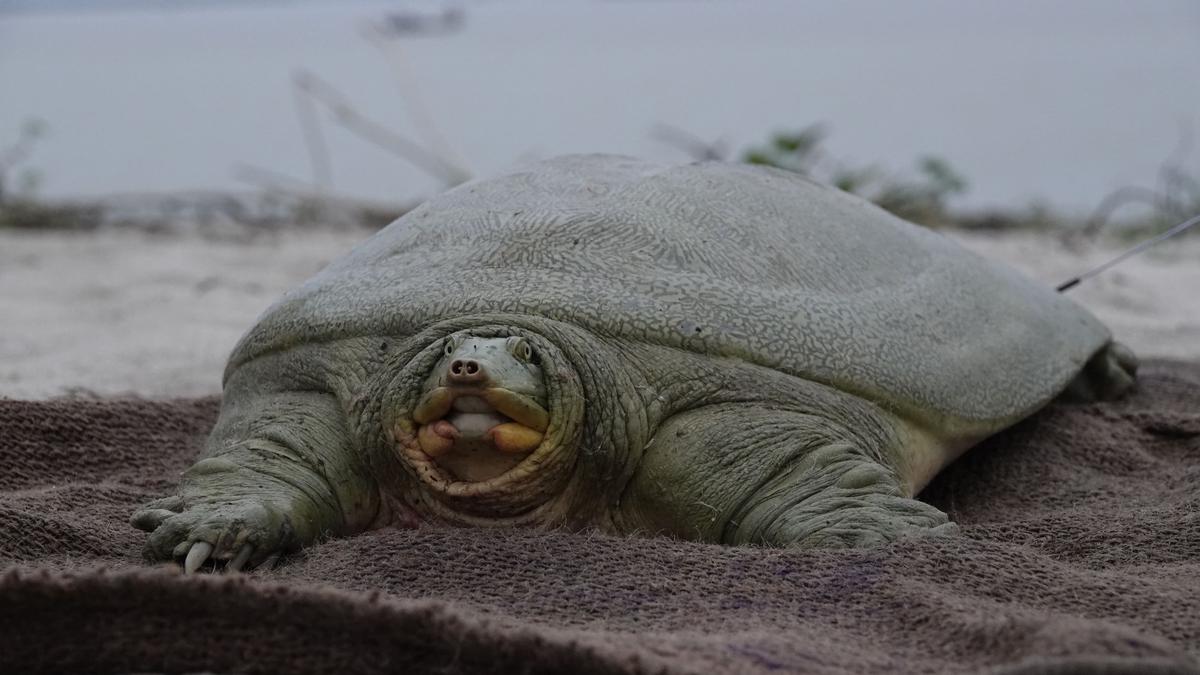
In a first in India, a satellite-tagged Ganges soft-shell turtle was released in the Kaziranga National Park and Tiger Reserve on the occasion of Endangered Species Day on Friday, May 15, 2026.
| Photo Credit: SPECIAL ARRANGEMENT
India’s first satellite-tagged Ganges soft-shell turtle, an endangered species, was released in the 1,302 sq. km Kaziranga National Park and Tiger Reserve in Assam on Friday (May 15, 2026).
The release of the freshwater reptile coincided with the observation of Endangered Species Day.
Assam Chief Minister Himanta Biswa Sarma termed the event a major step for wildlife conservation and a proud moment for the State, “as we continue to protect every species that calls our forests home”.


Assam is one of the world’s top priority areas in freshwater turtle conservation. Of the eight soft-shell turtles reported from India, five are known from the Kaziranga landscape.
The Ganges soft-shell turtle (Nilssonia gangetica), a Schedule I animal under the Wildlife Protection Act of 1972, can be differentiated from other riverine turtles by its distinct arrowhead-shaped markings on the top of the head. In India, the species inhabits large rivers, lakes, and reservoirs.
Recorded as endangered on the International Union for Conservation of Nature (IUCN) Red List, this large turtle is a major river predator and helps clean up the system by feeding on dead and decaying animal matter.
Identifying critical habits
“Understanding seasonal movement patterns, home range, and identifying critical habits like nesting and breeding will help in active management of soft-shell in the Brahmaputra river basin,” Abhijit Das, a senior scientist at the Wildlife Institute of India (WII), said.
He led a team under the Ministry of Environment, Forest and Climate Change in the satellite-tagging exercise in collaboration with the Kaziranga National Park and Tiger Reserve authorities and the Assam Forest Department. The National Geographic Society funded the project.
Forest officials said a healthy adult turtle was captured, fitted with the transmitter under veterinary supervision, and released back into its natural habitat along the northern bank of the Brahmaputra.
Published – May 15, 2026 05:48 pm IST



