


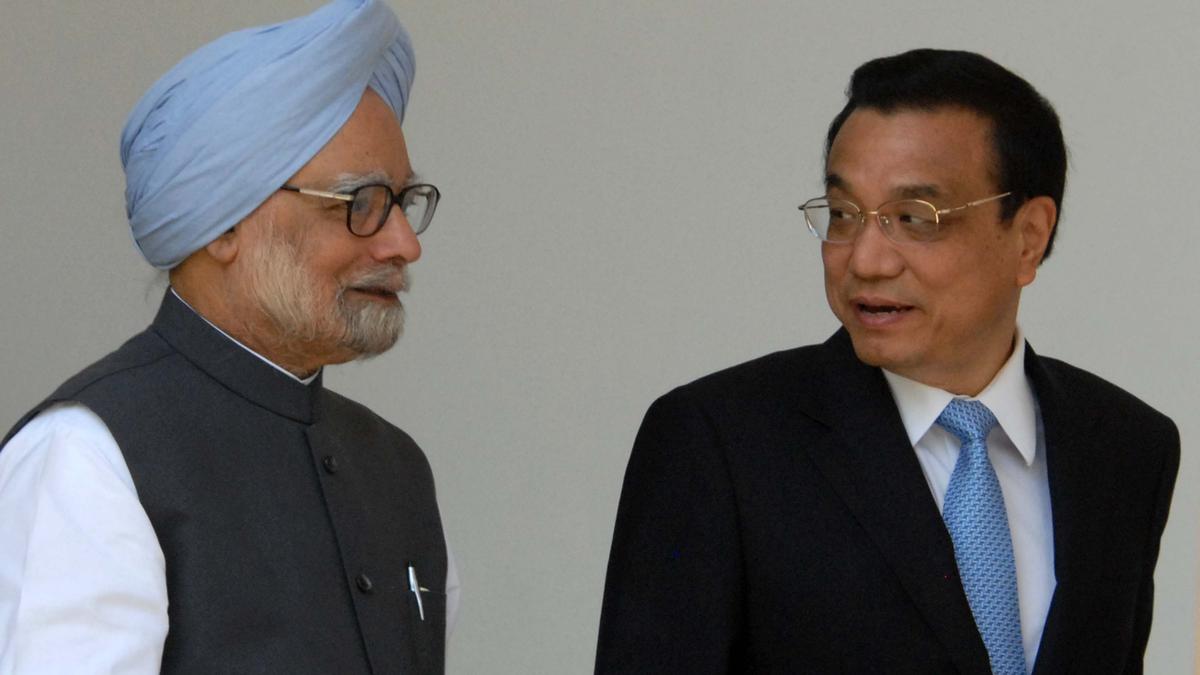
The then Prime Minister Manmohan Singh with the then Chinese Premier Li Keqiang, before a high level delegation talks in New Delhi on May 20, 2013.
| Photo Credit: The Hindu Archives
The path ahead for the India-China relationship would not be easy as China displays “arrogance of power” that is unacceptable to India, the late Prime Minister Manmohan Singh said in an essay being published posthumously, in September 2025, as part of a book. While striking a realist note on political and diplomatic issues with China, Singh urged greater economic engagement between India and its South Asian neighbours, as well as with southeast and east Asian countries, especially under the RCEP.
“China displays the arrogance of power and expects deference, which India will reject. A positive trend in India-China relations is unlikely in the foreseeable future, and our policies will need to be based on that premise,” Singh said in the essay titled ‘A Decisive Decade for India’, which is being published in India’s Tryst with the World: A Foreign Policy Manifesto edited by former External Affairs Minister Salman Khurshid and human rights campaigner Salil Shetty. The book also features articles on various aspects of Indian foreign policy by commentators and policymakers, including former Vice-President Hamid Ansari, and former National Security Advisor Shiv Shankar Menon.
During his decade-long tenure as the Indian Prime Minister, Singh met with several top Chinese leaders. His last prime ministerial visit to China was on October 22-24, 2013, at the invitation of Premier Li Keqiang, when he called on President Xi Jinping. During those meetings, Singh writes, a consensus was reached on the shape of the bilateral relationship in which China and India agreed not to view each other as a threat. “This consensus is no longer valid, and the recent and unprecedented clashes in eastern Ladakh that started in 2020 between the forces of the two countries, demonstrated this starkly,” Singh wrote, referring to the meetings.
“China is a material challenge. It has also become an ideological challenge. China is no longer insisting on its right to pursue its own model of social and economic development. Its undoubted economic success and lately, its swift control over the Covid-19 pandemic has encouraged its leadership to promote the China model of what some scholars have called ‘authoritarian state capitalism’,” Dr. Singh wrote, describing how China was denigrating liberal democracy while highlighting its development and political models. Describing the appeal for the Chinese model as “dangerous”, Singh said, “We have demonstrated in the very recent past that democracy is fully compatible with the achievement of accelerated economic growth.”
Despite the cautionary words on China, Singh also urged greater economic engagement with regional groupings, both within the South Asian Association for Regional Cooperation (SAARC) and the Regional Comprehensive Economic Partnership (RCEP). The last SAARC summit was held in 2014 in Kathmandu, but the following summit in Islamabad in 2016 was not held as India and few other member countries cancelled participation in the Islamabad SAARC summit after terror strikes in Uri. Dr. Singh described India’s relationship with Pakistan as “complex and adversarial” but argued, “The promotion of trade and economic cooperation between India and Pakistan has huge potential, as study after study has confirmed. This must remain on our agenda even if it looks unachievable at this time.”
India left the RCEP in 2019 arguing that engagement under the RCEP would not address its concerns on trade deficit with partner countries, especially China. Free trade and economic partnerships should not be viewed through the prism of exports and imports, Singh said. “By not participating in the RCEP, India may have pushed itself to the margins of most dynamic component of global economy, which is now centred in Asia,” Singh said.
Published – September 27, 2025 09:50 pm IST



