


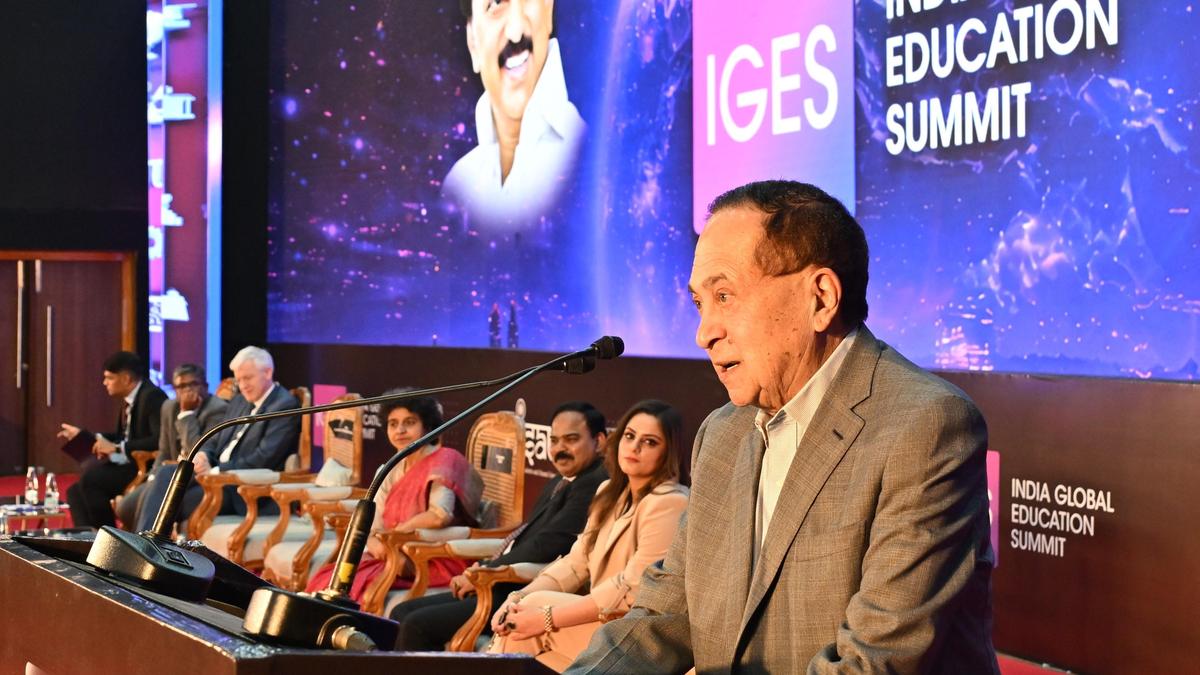
N. Ram, Director, The Hindu Group, speaking at the India Global Education Summit 2026 in Chennai on Wednesday.
| Photo Credit: M. SRINATH
The scale and funding of higher educational institutions is at the heart of challenges faced by governments and a robust commitment to state funding was an important principle to resolve this, N. Ram, Director, The Hindu Group, said here on Wednesday.
“We must learn from Europe on this,” Mr. Ram said, inaugurating the India Global Education Summit 2026, organised jointly by the Tamil Nadu Government and National Indian Students and Alumni Union, UK (NISAU).
“Can we afford to do it is the big question. I think it’s a very important factor, a robust commitment to public funding. Globally, high quality and affordable education systems in Scandinavia and parts of continental Europe have been built on sustained public investment. In India, unfortunately, investment in education continues to languish below three per cent of GDP,” he said.
Combining quality and excellence with affordability and access for the most disadvantaged sections was another persistent challenge facing higher education in India.
Substantial gap
Reservation policies have worked in the long-term, but the gap between the Scheduled Castes and Tribes and the forward communities continues to be substantial. Hidden costs and cultural barriers, especially faced by young women and those from rural background, make it difficult for them to compete with the others who come with advantages. “This is a huge issue that needs to be resolved,” he added.
“We need differential institutional missions. Not every institution needs to be research intensive, global-ranking oriented university. We have to think through this, build an ecosystem that should include teaching-based universities, community colleges, and high quality liberal arts institutions,” Mr. Ram observed.
Delivering the keynote address, Thamizhachi Thangapandian, Member of Parliament, said that in Tamil Nadu, education has always been political in the best sense of the word. “It is understood as a tool for questioning hierarchy, dismantling inherited inequality, and creating opportunity where none existed before,” she said.
Helmut Kern, Government Representative for University Rankings, Government of Austria, and Governor, University of Austria, said India, in contrast to countries with shrinking demography like China, Japan, and Korea, combined scale with sustained demographic momentum. In 2024, India accounted for 155 million people in the age-group of 18 to 23, Prof. Kern added.
P. Shankar, Higher Education Secretary, Tamil Nadu, said the highlight of the Summit would be the unveiling of Tamil Nadu Knowledge City, India’s first integrated global education and innovation institution. It represents a new model where universities do not operate in isolation but as a part of an ecosystem of industry-academia collaboration, Dr. Shankar added. Sanam Aurora, founder and chair, NISAU, set the context for the two-day deliberations while Sandhya Venugopal Sharma, chairperson, Tamil Nadu Industrial Development Corporation (TIDCO), and Sandeep Nanduri, managing director, TIDCO spoke.
Published – January 29, 2026 01:02 am IST



