


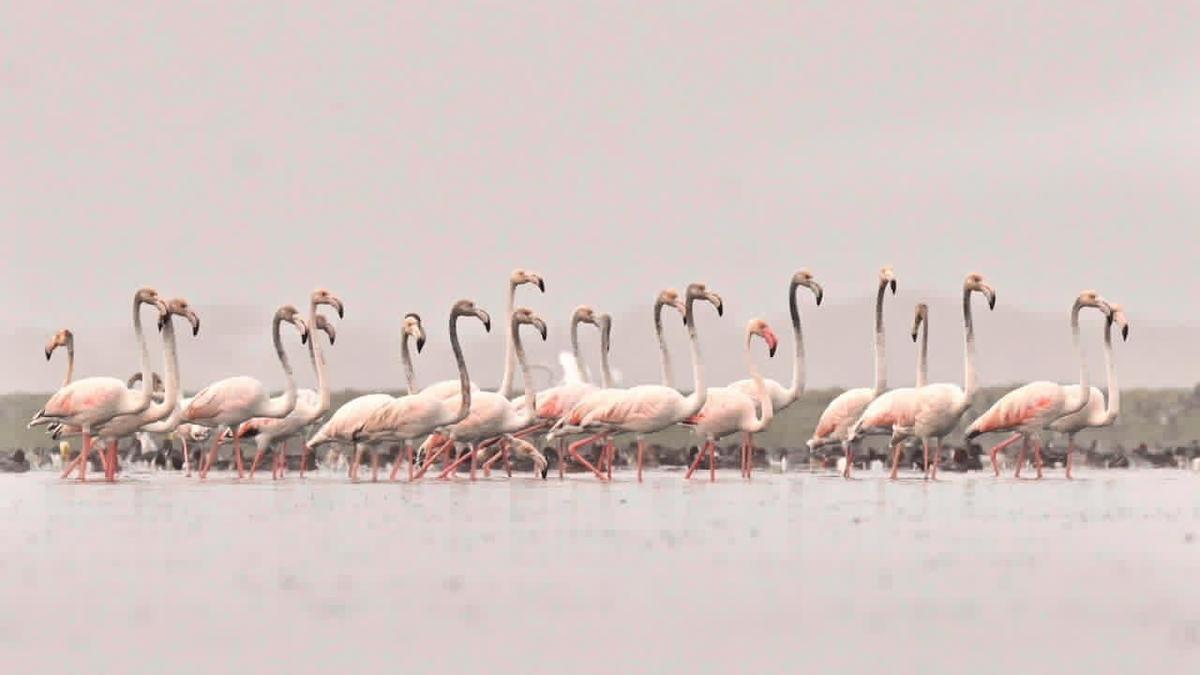
Flamingos spotted at Kolleru Lake in Andhra Pradesh.
Kolleru Lake, one of India’s largest freshwater wetlands and a globally recognised Ramsar site, is witnessing an extraordinary revival in birdlife, signalling a positive turnaround for the historically stressed ecosystem.
The senior officials of Andhra Pradesh Forest department associated with the ongoing bird census estimate that the wetland and its surrounding habitats are currently hosting “between 45 lakh and 60 lakh birds”, a figure that underscores the scale of this year’s avian influx.
Officials say that 30 to 40 key bird species, identified as important indicators of wetland health, are present across the Kolleru landscape. Many of these species have been observed in numbers higher than those documented in previous years, reflecting improved habitat conditions and availability of food and water.
Among the most striking visitors recorded during the ongoing census are flamingos, whose presence has added to the visual and ecological significance of Kolleru Lake this season. Senior officials involved in the survey said flocks of flamingos have been spotted across shallow stretches of the wetland and in adjoining water bodies, indicating favourable water depth and food availability.
Meanwhile, a senior official, on condition of anonymity, said that the removal of encroachments in Kolleru Lake has helped in the revival of rich biodiversity.
The arrival of flamingos is considered a key ecological indicator, as the species is highly sensitive to changes in water quality and habitat disturbance. Their return in noticeable numbers suggests that portions of the lake ecosystem are regaining balance after years of degradation. According to the officials, flamingos are sharing habitats with several other migratory water birds, reinforcing Kolleru’s importance as a multi-species winter refuge.
Most of the birds visiting Kolleru during this season are long-distance migrants, travelling from regions such as Siberia, Russia, and several parts of Europe to escape the harsh winters. Their return in large numbers has once again highlighted Kolleru’s critical role as a wintering and feeding ground on the international migratory route.
The ongoing census is being carried out using a scientific and systematic methodology, with teams adopting mapping techniques and grid-based surveys to ensure accuracy. Apart from the main lake area, surveyors are also covering demolished tanks, adjoining wetlands, and reclaimed water bodies that birds have gradually occupied. Officials noted that these areas, once neglected, are now emerging as important supplementary habitats.
The bird census, which began on the January 28, will continue for another week, after which the data will be compiled and verified. Officials said the exact number of birds and species-wise details would be finalised upon completion of the exercise, adding credibility to the findings.
Published – February 02, 2026 08:07 pm IST



